
On this page
Your needs, this model
Does it fit your priorities?
Does the fixed 10x50 configuration fit a 50 mm objective requirement?
Yes. The exact product page and SKU-specific sheet identify Athlon Argos G2 HD 10x50, SKU 114008.
Explore this need in the finder →Does its 17 mm published eye relief clear a 17 mm screen?
Yes at the numeric boundary, but that does not establish full-field comfort through a particular frame.
Explore this need in the finder →Is 31.5 oz within a 32 oz carry ceiling?
Yes by 0.5 oz as an instrument-weight comparison; a separately listed package weight is not binocular mass.
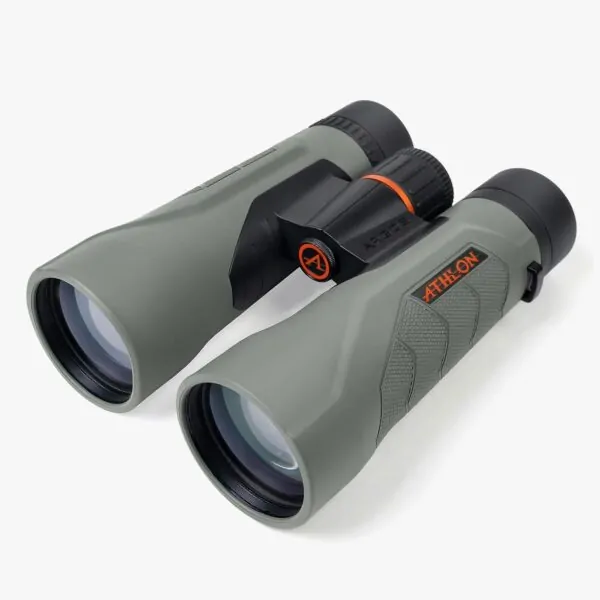
Explore this need in the finder →The Athlon Argos G2 HD 10x50 (SKU 114008) keeps 10x magnification but moves to a 50 mm objective. Its published 31.5-ounce instrument weight is six ounces above the 10x42, while its 17 mm eye relief is 0.9 mm longer. This is the carry-versus-aperture choice for someone who wants a 10x view and is willing to take a larger full-size binocular rather than a 42 mm model.
Why choose the 50 mm objective at 10x?
The 10x50 makes the most sense when the larger objective is part of the intended viewing plan: for example, longer observation sessions in a fixed spot or a preference for a larger-aperture 10x configuration. A 50 mm objective has more light-collecting area than a 42 mm objective, but that fact alone does not predict a brighter view in every condition. Optical transmission, pupil size, scene lighting and the individual viewer also matter, and no measured low-light test is available here. The benefit is not a verified brightness score.
The exact published figures make the practical cost clear. The 10x50 is 31.5 ounces, six ounces heavier than the 10x42, and its real field is 5.8 degrees (304 feet at 1,000 yards), slightly narrower than the 10x42’s 6.1 degrees and 319 feet. It does gain 0.9 mm of listed eye relief, but 17 mm still cannot promise a full view through a specific pair of eyeglasses. If the day involves a long walking route, the 10x42’s lower mass may matter more than the larger objective. If the binocular will spend most of its time on a stable rest, the extra mass may be less troublesome.
Compared with the 12x50, it favors a wider, lower-shake view
The Argos G2 HD 10x50 and 12x50 share a 50 mm objective, the same 31.5-ounce published weight and the same 6.8-by-5.6-inch manufacturer dimensions. The 10x50 is the broader-view option: 304 feet per 1,000 yards rather than 257 feet, and 17 mm eye relief rather than 16 mm. The 12x50 offers higher fixed power for distant, mostly stationary subjects but is less forgiving to frame and hold. Those are specification-based differences; they do not rank image quality.
All four Argos G2 HD configurations list a 13-foot close-focus distance, so the 10x50 is not a choice for close butterfly observation or near tabletop work. For those uses, select a binocular with a shorter verified focus limit rather than relying on its larger objective or magnification.
HD optics, coatings and weather language
Athlon’s exact product page and 10x50 sheet identify the HD line and list BaK-4 prisms, phase correction, ESP dielectric prism coating, XPL protective coating, advanced fully multi-coated lenses and a magnesium chassis. Athlon describes its HD glass as low-dispersion; the distinct Argos UHD family uses the UHD/extra-low-dispersion designation. These manufacturer terms are useful for deciding which exact variants to compare, but the checked sources contain no independent resolution, color-fringe or transmission measurements. Do not read a feature list as a head-to-head test.
The page and sheet call the binocular waterproof and argon-purged. They do not provide an IP code, immersion depth or submersion duration. That distinction matters around boats and rain: use the manufacturer’s weather-protection language but do not assume underwater operation. Care instructions say to remove grit before cleaning glass and avoid rough or dirty material that can scratch coated surfaces.
Mounting and setup help with the larger body
The 50 mm Argos HD manual documents twist-up/down eyecups, an interpupillary adjustment, central focus and a right-eye diopter. It confirms a standard 1/4-20 tripod-adapter socket. With a 10x50, a tripod or other stable support can be useful for extended stationary observation; the socket is not itself proof that a tripod adapter is bundled. Retail package contents remain unspecified in the sources reviewed, so budget for an adapter only after checking the exact item you buy.
Set the eye spacing before focusing, use the eyecups down if wearing glasses, and tune the right-eye diopter after the center wheel is set. The printed eye relief of 17 mm is a screening measure, not a fit guarantee. Athlon does not state a numerical diopter range or that this ring locks. The manual’s direct-Sun warning applies: this regular binocular is never a safe solar viewer.
Who benefits from this version?
Choose the 10x50 if you want 10x in the 50 mm class and accept a 31.5-ounce carry. Choose the 10x42 if the same magnification with six ounces less weight and a 15-foot wider listed field at 1,000 yards better fits the outing. Select the 12x50 if reach outranks field width and the higher power’s steadiness demands are acceptable. For a manufacturer-designated UHD alternative at 10x42, compare the Argos G2 UHD 10x42; its brand-level glass designation is different, but this review makes no unsupported visual-performance promise.
Manufacturer references: Argos G2 HD 10x50 product page, 10x50 specification sheet, and Argos G2 HD 50 mm manual.
Key specifications
Key details at a glance
| Magnification | 10× |
|---|---|
| Objective diameter | 50 mm |
| Real field of view | 5.8° |
| Field width at 1,000 m | 101 m |
| Eye relief | 17 mm |
| Close focus distance | 13 ft |
More specifications and setup details
| Manufacturer-published weight | 31.5 oz |
|---|---|
| Phase coatings confirmed | Yes |
| Lens and prism coatings | The exact sheet lists HD family glass, BaK-4 prisms, phase correction, ESP dielectric coating, XPL exterior coating and advanced fully multi-coated lenses. Athlon describes HD glass as low dispersion but does not identify this SKU as UHD/extra-low-dispersion; explicit ED glass status is left unknown. |
| Water and fog protection | Athlon describes the Argos G2 HD as waterproof and argon-purged/fog protective; reviewed sources publish no IP rating, immersion depth or underwater-use condition. |
| Tripod use | The shared family manual confirms a socket with standard 1/4-20 threads. A compatible tripod adapter is needed; retail box inclusion is unknown. |
| Published weight note | Instrument weight as published on the exact product-specific specification sheet; package weight is separately stated and is not the binocular mass. |
| Manufacturer-rated waterproof | Yes |
| Integrated laser rangefinder | No |
| Onboard ballistic solution display | No |
| Direct 1/4-20 tripod thread confirmed | Yes |
Use the exact model’s instructions for operating limits, supplied equipment and version differences.
Sources for this review
Sources for this assessment
- Athlon U.S. binocular family index
- Athlon Argos G2 HD U.S. category
- Athlon Argos G2 HD 10x50 exact manufacturer product page
- Athlon Argos G2 HD 10x50 product-specific specification sheet
- Athlon Argos G2 HD 50 mm binocular manual
- Athlon Argos G2 HD 10x50 manufacturer page-linked image
- CPSC recalls search (Athlon Argos G2 HD / SKUs 114010–114007)

Choose your optical trade-off first.
Choose viewing purpose first, then magnification, objective size, scene width and any fit, weather or mounting constraint. A direct-Sun requirement is separate: only exact manufacturer-confirmed solar binoculars can pass it.