
On this page
Your needs, this model
Does it fit your priorities?
Are you considering this exact earlier 8x42, or only current listings?
The exact U.S. product page identifies VPR-08-VX and labels it INACTIVE. Include it only when earlier models are allowed; it is an identification/comparison reference, not a current offer.
Explore this need in the finder →Does its listed field meet your preference for a broad real scene?
The exact page lists a 6.6° angular field and 347 ft at 1000 yd. Those are published manufacturer values, not a field test. An apparent-field figure is not listed.
Explore this need in the finder →Can its closest-focus figure meet your maximum distance?
Vortex lists 5.1 ft. A 6-ft maximum accepts that figure; a strict 5-ft maximum does not.
Explore this need in the finder →Does the stated eye relief meet your minimum?
The exact page lists 20 mm. That meets a 20-mm numeric minimum, not 20.5 mm, and does not guarantee full-field access with every eyeglass frame.
Explore this need in the finder →Can it meet a firm carry-weight ceiling?
The page lists a 23-oz instrument weight. A 23-oz cap is met by that value; a 22-oz maximum is not. Packed weight will be higher.
Explore this need in the finder →Is confirmed waterproofing essential?
The page lists an eyepiece rainguard but no housing waterproof claim. A rainguard is not proof of water resistance, so this profile cannot satisfy an essential waterproof selection.
Explore this need in the finder →Vortex’s U.S. inactive-binocular listing links the Viper 8x42 SKU VPR-08-VX. This is an earlier, conventional fixed-power binocular: useful to identify a marked pair or compare a particular used example, but not a current purchase recommendation. Keep the SKU distinct from the Viper HD VPR-4208-HD and the later Viper HD V200 8x42.
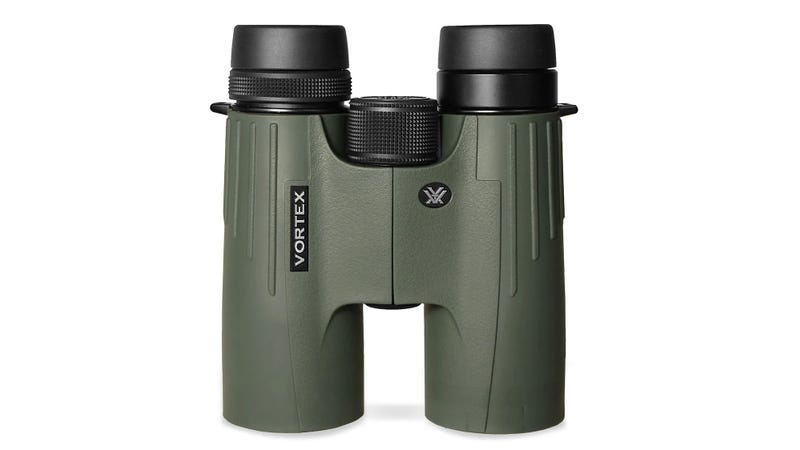
Image source and model notes
What the VPR-08-VX establishes
The exact product page identifies 8x magnification, 42 mm objectives, a 6.6-degree angular field and 347 feet at 1,000 yards. Those two field figures are mutually plausible, but they describe the maker’s published specifications rather than a field measurement. Eight-power viewing gives less enlargement than a fixed 10x pair; that can be a sensible trade when your priority is an unhurried handheld view rather than extra image scale for distant detail. The page describes fixed-power optics and no laser-ranging function; it does not establish image stabilization, so do not assume that feature.
Vortex lists a 5.25 mm exit pupil. That number is the 42 mm objective divided by 8x, so it is a geometric ratio, not a measurement of brightness or transmission. The actual view also depends on lighting, the observer’s eye position and the optical quality of the individual unit. The product page’s marketing description is not independent evidence of resolution, low-light performance or color accuracy; no hands-on test is claimed here.
Field, fit and carry
The listed 6.6 degrees and 347 feet at 1,000 yards offer a concrete field reference, while the 8x power is the more moderate of the common 8x/10x choice. Someone trying to locate moving wildlife across a broader scene may prefer to compare this field against current 8x42 listings rather than assume the Viper family name guarantees a wide view. For an example of a different, later configuration, the Viper HD V200 8x42 publishes 7.8 degrees and 409 feet at 1,000 yards; the Diamondback HD 8x42 publishes 7.5 degrees and 393 feet. These are distinct models, not updates that can be substituted in a VPR-08-VX listing.
The VPR-08-VX page lists 20 mm eye relief. That is a useful specification to compare when you wear glasses, but it cannot guarantee that every frame will let your eyes see the entire field. Try the marked unit with the glasses you actually use and check whether both barrels merge into a comfortable image. The manufacturer lists an interpupillary range of 59–75 mm; that gives a fit boundary to compare against, not a guarantee that every face can align to the view.
Vortex lists 5.1 feet as the closest focus. That is a relatively near limit for a general binocular and may matter for a close feeder or a nearby detail, but it does not turn the instrument into a macro optic. The listed body dimensions are 5.8 inches high by 5.3 inches wide, and the listed instrument weight is 23 ounces. Treat that as the binocular’s published weight, not the packed weight with strap and case. A 23-ounce ceiling is met on the page’s figure; a stricter 22-ounce maximum is not.
What is—and is not—in the package record
The exact page names a rainguard, tethered objective covers, a contoured neck strap and a padded carry case. The rainguard is an eyepiece cover, not a waterproof rating for the housing. The page does not establish waterproofing, fog protection, gas purging, immersion limits, prism construction, glass type or coating treatments. If any of those are essential, do not let a family name, sales description or neighboring Viper specification stand in for evidence on this SKU. The listed package also does not include a tripod adapter, and this page does not confirm tripod compatibility.
Likewise, the accessible product information gives the close-focus distance and basic fit dimensions but not a setup procedure, diopter range or eyecup positions. Check the actual controls before buying an older used unit, especially if multiple people will share it. Do not assume that an apparently complete case contains the original covers or that an older unit’s condition matches the page picture.
Do not merge the look-alike Vipers
VPR-08-VX is the earlier plain Viper 8x42 listed as inactive. VPR-4208-HD is a separate Viper HD SKU; it happens to publish the same 6.6-degree field, 347-foot field width and 20 mm eye relief, but that overlap does not establish identical internals, coatings, accessories or generation. The Viper HD V200 is yet another 8x42 configuration with its own specification set. Read the product code on the binocular and compare its page, not just “Viper 8x42” in a seller title. The later HD V200 and other currently listed 8x42s are better starting points if you need a present-day buying option.
Who should keep it in view?
Keep the VPR-08-VX in an earlier-model comparison if you already own one, are identifying a marked pair, or have a specific used example whose condition and included parts you can inspect. Its documented 8x42 format, 20 mm eye relief, 5.1-foot close focus and 23-ounce instrument weight are useful checkpoints. Skip it as a current recommendation if you need confirmed weather resistance, guaranteed eyewear fit, tripod support, or a current manufacturer configuration; those requirements are not established by this page. For a new purchase decision, compare current exact SKUs and their independently documented specifications instead of treating this inactive page as an offer.
Key specifications
Key details at a glance
| Magnification | 8× |
|---|---|
| Objective diameter | 42 mm |
| Real field of view | 6.6° |
| Eye relief | 20 mm |
| Exit pupil | 5.25 mm |
| Close focus distance | 5.1 ft |
More specifications and setup details
| Manufacturer-published weight | 23 oz |
|---|---|
| Water and fog protection | The page lists a rainguard for the eyepieces but makes no waterproof, fogproof, gas-purge, immersion or shock rating claim for this exact model. |
| Tripod use | No tripod adapter is named among the exact page’s included items. The page does not establish tripod compatibility or thread type. |
| Published weight note | The exact VPR-08-VX page lists 23 oz as instrument weight. It does not state packed weight with strap, covers and case. |
| Integrated laser rangefinder | No |
| Tripod adapter in package | No |
Use the exact model’s instructions for operating limits, supplied equipment and version differences.
Sources for this review
Sources for this assessment
- Official Vortex U.S. inactive binocular directory, page 3 card row 4; original archive links Viper 8x42 to its exact product page and embedded product data identifies VPR-08-VX.
- Exact Vortex U.S. product page identifies Viper 8x42 SKU VPR-08-VX and marks it INACTIVE; lists specifications, standard package and a shared-family manual link.
- Official gallery response linked from exact VPR-08-VX PDP; the archived 800 × 450 image visually shows a green binocular body on white but does not expose the SKU. Manufacturer photo/render method and reuse rights are not disclosed.
- Exact page lists the shared VTX_VPR-32-50_VPR_BIN_P_PM_WEB.pdf manual URL; previously archived response is PDF.js viewer HTML rather than readable manual pages. Reused without another request.

Choose your optical trade-off first.
Choose viewing purpose first, then magnification, objective size, scene width and any fit, weather or mounting constraint. A direct-Sun requirement is separate: only exact manufacturer-confirmed solar binoculars can pass it.