
On this page
The wider-field 26 mm Vanquish option
The Vanquish 8x26 and 10x26 have the same listed 12.7 oz instrument weight, but the 8x26 shows the wider 6.7° real field. It gives up fixed magnification and retains compact-model eye-relief limits; the objective size alone is not a low-light guarantee.
Explore the needs this model fits
Your needs, this model
Does it fit your priorities?
Do you want a fixed 8x view in a 26 mm body rather than the narrower-field 10x26?
Vortex identifies SKU VNQ-0826 as fixed 8x26. It lists a 6.7°/352 ft field; the Vanquish 10x26 lists 5.6°/294 ft. This is a published framing difference, not an independent sharpness or brightness result.
Explore this need in the finder →Will a 12.7 oz instrument limit, 15 mm eye-relief floor and 7.6 ft close-focus figure work for your outing?
The exact page and matching manual table list 12.7 oz, 15 mm eye relief and 7.6 ft close focus. Weight is instrument-only, and eye-relief is a specification rather than a guarantee of full-field comfort through particular glasses.
Explore this need in the finder →Is the 6.7° real field enough, and do you need an adapter confirmed in the box?
The maker lists a 6.7° real field, 352 ft at 1,000 yd. The package list names a case, strap, rainguard and cloth, but not a tripod adapter; if a supplied adapter is essential, this package does not meet that requirement.
Explore this need in the finder →The Vortex Vanquish 8x26 (U.S. SKU VNQ-0826) is the broader-field member of this compact, reverse-Porro pair. Vortex lists a 6.7° real field, or 352 feet at 1,000 yards, 15 mm of eye relief, 7.6-foot close focus and 12.7-ounce instrument weight. This is an assessment of manufacturer-published specifications and instructions, not a hands-on optical test.
Why pick the 8x26 rather than the 10x26?
Both Vanquish compacts use 26 mm objectives and Vortex lists both at 12.7 ounces. The choice is therefore not a published weight upgrade. It is a choice between magnification and scene width: the 8x26’s 6.7° field is wider than the 10x26’s 5.6°, with corresponding linear figures of 352 and 294 feet at 1,000 yards. That width can help scan habitat and reacquire moving birds. Eight power also tends to make hand movement less visible than a higher-power view, although the manufacturer provides no stabilization claim here.
The trade is less apparent reach. A distant animal does not appear as large as it would through the 10x version, so someone who spends more time studying a stationary subject at a distance may value the other configuration. These listed fields guide framing choices; they do not establish which pair is sharper or brighter. Objective diameter, coatings, glass, pupil size, light and the observer all matter, and the sources are not comparative test results.
Small package, with meaningful limits
Vortex lists a 4.3-inch height, 4.6-inch width and 12.7-ounce weight for the binocular itself. Its standard package lists a rainguard eyepiece cover, comfort neck strap, carry case and lens cloth. The case and accessories are additional carried mass; 12.7 ounces is not a complete loaded-pack measurement. The small format is attractive for travel and quick outings when a larger 42 mm binocular would be left at home. But 26 mm objectives are not a substitute for a larger-objective model when low-light observation is the priority. The maker’s descriptive words about bright images are not an independent measurement, and the information reviewed here cannot tell you whether this compact will satisfy your twilight use.
The page lists a 7.6-foot close-focus distance, which makes the model more plausible for a nearby subject than many long-range, high-magnification porros. Still, that figure is a closest focusing limit, not proof of macro-like detail or an optical performance score. If your routine subject is close enough that a several-foot focusing range is limiting, prioritize a model with a shorter confirmed distance instead.
Fit, focusing and the protection claim
The 15 mm eye-relief figure and 57–71 mm interpupillary-distance range are helpful screening details, but neither guarantees that your face and eyeglasses will see the full field comfortably. Frame thickness, the distance of your eye behind the lens, and how the eyecups sit matter. Vortex says the eyecups twist up or down. The family manual explains setting IPD until the two barrels form one circular image and adjusting center focus for the left eye before setting the right-side diopter. Those fit and focusing steps are practical; they do not replace trying the binocular with the glasses you actually wear.
Vortex describes the VNQ-0826 as nitrogen-purged and O-ring sealed and uses waterproof, fogproof and shockproof language, but gives no numeric immersion depth, duration or IP rating. Treat these as maker claims, not permission for underwater use. The page/manual identify a reverse-Porro prism, BaK4 prism material, fully multi-coated lenses and an SD optical system. Vortex says SD is intended to reduce chromatic aberration; this is not an independent measurement. ED glass and phase/dielectric prism coatings are not confirmed for this model.
What the box and image do not establish
The SKU-specific Vortex parts sheet identifies the Vanquish 8x26 and lists the small case, rainguard, cloth and manual. The ordinary product page also lists a comfort neck strap. Neither package list includes a tripod adapter. More importantly, the exact-page and manual evidence reviewed here does not confirm tripod compatibility, so do not assume an adapter can be attached merely because some binoculars can. If stable tripod viewing is essential, choose a model whose exact configuration documents both compatibility and the adapter arrangement.
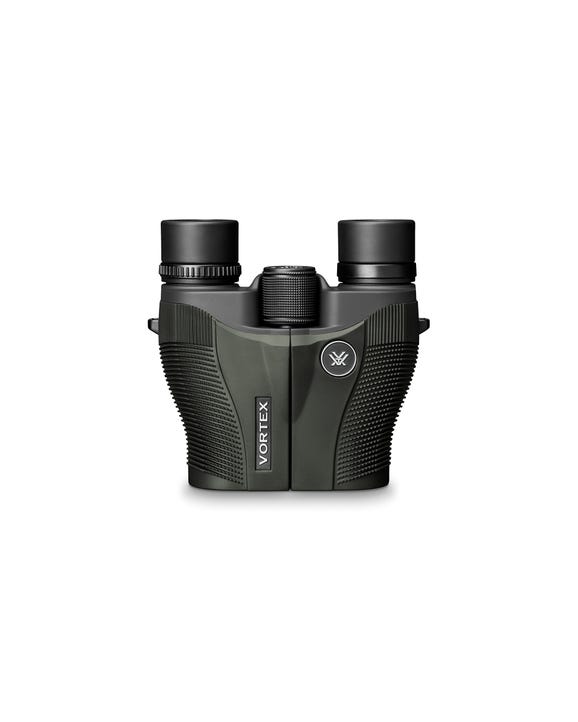
The official product image shows the compact Vanquish body, but this same page-linked 26 mm family image is used for the 8x26 and 10x26 pages. It does not visibly identify magnification; the exact SKU comes from the page, model-specific sheet and manual table. The manual itself says images are representational and a product can vary slightly. Vortex does not say whether the image is a photograph or a render, and image reuse permission has not been established.
Who should shortlist the VNQ-0826?
Shortlist it when you want a small, passive handheld binocular, prefer a wider listed scene to the 10x26’s extra reach, and can accept the 26 mm objective and 12.7-ounce instrument weight. It clears the finder’s six-degree broad-scene choice, while the 10x26 does not. If greater apparent reach is more important, compare the 10x26 and be prepared for a narrower field and more visible hand movement. If low-light performance, guaranteed glasses fit, confirmed tripod support, a numeric water-resistance rating, ED glass or phase-treated optics are essential, this source set does not establish them for VNQ-0826; select a model with exact documentation or try it in person.
The U.S. Vortex page offers a Where to Buy route, but no current retailer stock, price or exact ASIN was verified for this assessment. Search retailers by “Vortex Vanquish 8x26 binocular VNQ-0826” rather than assuming that an apparently similar compact is the same item. Ordinary binoculars must never be pointed at the Sun. The Vortex manual warns that intense light can damage eyesight; direct solar viewing requires purpose-built solar equipment.
Manufacturer sources: Vanquish 8x26 U.S. product page, VNQ-0826 parts and in-box sheet, and the linked Vanquish manual.
Key specifications
Key details at a glance
| Magnification | 8× |
|---|---|
| Objective diameter | 26 mm |
| Real field of view | 6.7° |
| Eye relief | 15 mm |
| Exit pupil | 3.25 mm |
| Close focus distance | 7.6 ft |
More specifications and setup details
| Manufacturer-published weight | 12.7 oz |
|---|---|
| Lens and prism coatings | Vortex describes fully multi-coated lenses and an SD optical system intended to reduce chromatic aberration. The sources do not identify ED glass or confirm prism phase/dielectric coatings for this exact configuration; those stay unknown. |
| Water and fog protection | Vortex describes the exact model as nitrogen-purged and O-ring sealed, waterproof, fogproof and shockproof. The inspected page/manual publish no numeric IP rating, immersion depth or duration; underwater use is not established. |
| Tripod use | No exact-page or M-00139-1 manual confirmation of tripod adaptability or a supplied adapter was found. Do not infer compatibility from the reverse-Porro design. The SKU-specific box list does not include a tripod adapter. |
| Published weight note | Manufacturer-listed instrument-only weight; case, comfort neck strap, rainguard and lens cloth increase total carry weight. No independent weighing was performed. |
| Manufacturer-rated waterproof | Yes |
| Built-in image stabilization confirmed | No |
| Integrated laser rangefinder | No |
| Onboard ballistic solution display | No |
| Tripod adapter in package | No |
Use the exact model’s instructions for operating limits, supplied equipment and version differences.
Sources for this review
Sources for this assessment
- Exact U.S. Vortex Vortex Vanquish 8x26 product page, SKU VNQ-0826
- Official U.S. Vortex binocular category page 4, observation vortex-us-category-cycle47-p4-r5
- Official exact-SKU parts sheet for VNQ-0826
- Official linked Vanquish compact binocular manual; printed identifier M-00139-1
- Exact page-linked Vanquish 26 mm family image, visually inspected; exact SKU is established by the linked page, not pixels

Choose your optical trade-off first.
Choose viewing purpose first, then magnification, objective size, scene width and any fit, weather or mounting constraint. A direct-Sun requirement is separate: only exact manufacturer-confirmed solar binoculars can pass it.
Your needs, this model
26 mm binoculars: Vortex Vanquish 8x or 10x
Choose it when: This sibling prioritizes scanning width and lists the same 12.7 oz bare-instrument weight as the 10x model.
26 mm binoculars: Vortex Vanquish 8x or 10x →