
On this page
More fixed power at the same 26 mm carry mass
The Vanquish 10x26 preserves the 8x sibling’s listed 12.7 oz mass while narrowing real field to 5.6°. It can frame smaller subjects more tightly, but hand movement may be more apparent and the 2.6 mm exit pupil is a geometric constraint, not a brightness score.
Explore the needs this model fits
Your needs, this model
Does it fit your priorities?
Do you want a fixed 10x view in a 26 mm body instead of the wider 8x26?
The exact Vortex SKU VNQ-1026 is fixed 10x26. It lists 5.6°/294 ft of real field; the same-family 8x26 is 6.7°/352 ft. The manufacturer specifications establish the framing difference, not a measured optical advantage.
Explore this need in the finder →Can you use the 12.7 oz instrument under a 16 mm eye-relief minimum and 8 ft close-focus limit?
The exact page and model table list 12.7 oz, 16 mm eye relief and 7.6 ft close focus. The weight excludes the included carry kit; try the exact binocular with your glasses because a stated relief figure does not ensure full-field fit.
Explore this need in the finder →Do you need a broad real field or an adapter supplied in the box?
This 10x26 lists a 5.6° real field, below the finder’s six-degree wide-scene choice. Its package list omits a tripod adapter; the manufacturer sources reviewed here do not confirm tripod compatibility for this exact SKU. Do not assume it from the prism design.
Explore this need in the finder →The Vortex Vanquish 10x26 (U.S. SKU VNQ-1026) pairs 10x magnification with 26 mm objectives in a compact reverse-Porro body. The manufacturer lists a 5.6° real field, or 294 feet at 1,000 yards, 16 mm eye relief, 7.6-foot close focus and 12.7-ounce instrument weight. This is a source-based buying assessment, not an independent field or laboratory test.
More apparent reach, less scene width
The family decision is unusually clean: Vortex lists the 8x26 and 10x26 at the same objective diameter, weight, close focus, dimensions and IPD range. The 10x26 gives the subject more apparent size, but its published real field is 5.6°/294 feet compared with 6.7°/352 feet on the 8x26. If you mostly watch stationary wildlife at a distance and can keep the view steady, the 10x configuration may make details easier to inspect. If you often scan from side to side or follow quick movement, its narrower field can make initial acquisition more demanding. Those are practical implications of the stated power and field, not observations from a comparative test. No stabilization system is claimed.
Ten power is not automatically “better” than eight. It magnifies both the target and small hand movements; the narrower scene can mean more repositioning when searching. A support may help, but the exact page and manual inspected here do not confirm tripod-adapter compatibility, so do not plan on a mount without a manufacturer-confirmed path. A buyer who needs quick, broad scanning can compare the Vanquish 8x26. Someone who wants a steadier platform, larger objective, confirmed tripod mount or a wider true field should expand beyond this compact rather than selecting by magnification alone.
Carry size, close focus and light limits
The official page and family table list both compact models at 4.3 by 4.6 inches and 12.7 ounces. That may suit pockets in a roomy jacket or a small daypack, though the product page provides no folded dimensions and personal comfort will vary. The listed box adds a case, neck strap, rainguard and lens cloth, which increase the weight and volume you carry. Treat 12.7 ounces as the instrument number, not a packed-system total.
Vortex lists a 7.6-foot close-focus figure, the same as the 8x26. That is a useful boundary when comparing ordinary binoculars for nearby subjects, but it does not establish close-up image quality or make this a specialized close-focus optic. A compact 26 mm objective also limits how far you can infer low-light performance from the published sheet. The product copy describes bright images and the optics use multi-coated lenses, but there is no controlled measurement or side-by-side evidence here to guarantee twilight detail. If dawn and dusk use dominate, compare larger objectives and exact measured or independently tested evidence instead of treating a marketing adjective as a promise.
Eyeglasses, coatings and weather
The listed 16 mm eye relief is a specification, not a universal glasses-fit guarantee. The adjustable eyecups twist down for eyeglass use, according to the manufacturer’s manual, but frame shape and eye position can still clip the field. Try the exact binocular with your own glasses if that matters. Its IPD range is 57–71 mm; the manual says to adjust the barrels until the eyes see a single, undistorted image. It also describes the two-step focus: set the center focus for the left eye, then adjust the right-eyepiece diopter for differences between eyes. Once set, the center wheel handles ordinary focusing.
The exact sources identify a reverse-Porro prism, BaK4 prism material, fully multi-coated lenses, and an SD optical system that Vortex says is intended to reduce chromatic aberration. These specifications do not establish a comparative sharpness or color result. The exact configuration is not documented here as ED glass, nor are phase or dielectric prism coatings confirmed. Vortex describes nitrogen purge, O-ring sealing and waterproof/fogproof/shockproof construction, but gives no numeric immersion depth, duration or ingress-protection rating. Do not turn that weather language into a claim of safe underwater use.
Accessories, image identity and buying status
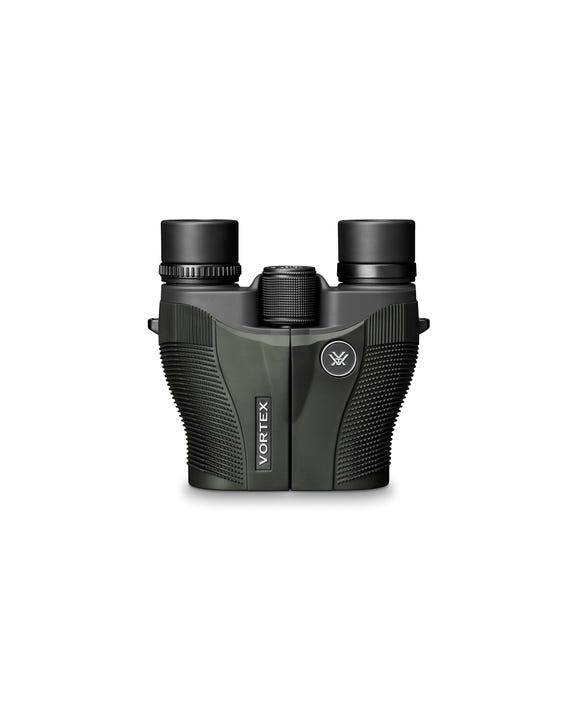
The VNQ-1026-specific parts sheet lists the owner’s manual, a rainguard, comfort neck strap, carry case and lens cloth; the page’s box list omits the manual. Neither list names a tripod adapter. The product image is officially linked from the exact 10x26 page, but the same 578 × 722 image is linked from the Vanquish 8x26 page and its pixels do not disclose power or SKU. The manual labels pictures as representative and notes the product can vary slightly. Thus, the documentation—not the product photo—establishes VNQ-1026. Vortex has not stated whether the image is a photograph or rendering, and permission to republish it has not been established.
The product is listed on Vortex’s U.S. site with a Where to Buy route. That does not prove any retailer’s current inventory or price. No exact retail ASIN was verified; search by “Vortex Vanquish 10x26 binocular VNQ-1026” and check the exact label before ordering. Do not mistake the similar 8x26 for a power variant with identical framing: the two products share weight and body dimensions, but have separate SKU sheets and different fields and eye relief.
Decision summary
Shortlist the VNQ-1026 when compact carry and more apparent reach than an 8x view are priorities, and you accept a narrower 5.6° field. Its 16 mm listed eye relief is the longer of the pair, but test actual fit. Choose the 8x26 if broad scanning, its 6.7° field and lower magnification suit your movement more. Choose a larger, better documented alternative if low-light performance, a firm tripod plan, a seven-degree field, or verified glasses comfort is non-negotiable. Both ordinary Vanquish models are passive binoculars; neither is a rangefinder or solar viewer. Follow the manual’s warning never to point them at the Sun.
Manufacturer sources: Vanquish 10x26 U.S. product page, VNQ-1026 parts and in-box sheet, and the linked Vanquish manual.
Key specifications
Key details at a glance
| Magnification | 10× |
|---|---|
| Objective diameter | 26 mm |
| Real field of view | 5.6° |
| Eye relief | 16 mm |
| Exit pupil | 2.6 mm |
| Close focus distance | 7.6 ft |
More specifications and setup details
| Manufacturer-published weight | 12.7 oz |
|---|---|
| Lens and prism coatings | Vortex describes fully multi-coated lenses and an SD optical system intended to reduce chromatic aberration. The sources do not identify ED glass or confirm prism phase/dielectric coatings for this exact configuration; those stay unknown. |
| Water and fog protection | Vortex describes the exact model as nitrogen-purged and O-ring sealed, waterproof, fogproof and shockproof. The inspected page/manual publish no numeric IP rating, immersion depth or duration; underwater use is not established. |
| Tripod use | No exact-page or M-00139-1 manual confirmation of tripod adaptability or a supplied adapter was found. Do not infer compatibility from the reverse-Porro design. The SKU-specific box list does not include a tripod adapter. |
| Published weight note | Manufacturer-listed instrument-only weight; case, comfort neck strap, rainguard and lens cloth increase total carry weight. No independent weighing was performed. |
| Manufacturer-rated waterproof | Yes |
| Built-in image stabilization confirmed | No |
| Integrated laser rangefinder | No |
| Onboard ballistic solution display | No |
| Tripod adapter in package | No |
Use the exact model’s instructions for operating limits, supplied equipment and version differences.
Sources for this review
Sources for this assessment
- Exact U.S. Vortex Vortex Vanquish 10x26 product page, SKU VNQ-1026
- Official U.S. Vortex binocular category page 4, observation vortex-us-category-cycle47-p4-r2
- Official exact-SKU parts sheet for VNQ-1026
- Official linked Vanquish compact binocular manual; printed identifier M-00139-1
- Exact page-linked Vanquish 26 mm family image, visually inspected; exact SKU is established by the linked page, not pixels

Choose your optical trade-off first.
Choose viewing purpose first, then magnification, objective size, scene width and any fit, weather or mounting constraint. A direct-Sun requirement is separate: only exact manufacturer-confirmed solar binoculars can pass it.
Your needs, this model
26 mm binoculars: Vortex Vanquish 8x or 10x
Choose it when: The 10x26 adds two powers of fixed magnification without adding listed bare-instrument mass.
26 mm binoculars: Vortex Vanquish 8x or 10x →