
On this page
Your needs, this model
Does it fit your priorities?
Is fixed 12x50 the combination you need, even though its listed real field is only 5.2 degrees?
The exact TRI-1250 page and SKU sheet show fixed 12x50, 273 feet per 1,000 yards and 5.2 degrees. It does not satisfy the finder’s six-degree broad-real-field condition.
Explore this need in the finder →Does the 26.2-ounce weight, 16 mm stated relief and 9.9-foot close focus suit your limits?
The exact product page and Triumph HD table list 26.2 ounces, 16 mm eye relief and 9.9 feet close focus. A ten-foot questionnaire maximum includes the listed 9.9 feet. The weight excludes its harness/case; personal eyeglass fit still needs a try-on.
Explore this need in the finder →Can you accept a narrower real field and a tripod adapter sold separately?
The exact page lists a 5.2-degree field and tripod adaptability, with the Sport adapter as a separate accessory rather than an in-box item. If a six-degree field or in-box adapter is essential, this is not a match.
Explore this need in the finder →The Vortex Triumph HD 12x50 (SKU TRI-1250) is the deliberate high-power, larger-objective option in the standard three-size family. Its page lists 12x magnification, 50 mm objectives, 5.2 degrees of real field, 16 mm eye relief, 9.9-foot close focus and a 26.2-ounce instrument weight. It asks the buyer to accept a tighter field and more demanding hand-holding than the 10x42, not simply to choose the largest number on the barrel.
More power, a narrower scene
At 273 feet per 1,000 yards, the 12x50's field is slightly narrower in linear terms than the compact 10x28's 279 feet and substantially narrower than the 10x42's 334 feet. The page gives 5.2 degrees for the 12x50 and 10x28, versus 6.4 degrees for the 10x42. If your use means scanning a broad woodland edge, tracking a bird in motion or locating a subject before looking at detail, the middle 10x42 is the better family fit on the published field numbers. If the subject is relatively stationary and you value a larger apparent view at higher fixed power, the 12x50 is the size to test.
Higher magnification also makes hand movement more visible, so a 12x image may be harder to hold steady than 10x for some people. Vortex marks it tripod adaptable, but the Sport Binocular Adapter is sold separately and the tripod is not included. If you mostly observe from a fixed position, include support and adapter in your practical setup; the maker's compatibility statement is not an in-box promise. If handheld comfort and quick panning are essential, compare the 10x42 rather than relying on the 12x label alone.
A 50 mm objective does not answer every light question
The 50 mm objectives sound substantially larger than 42 mm, but the listed exit-pupil geometry is about 4.17 mm (50 divided by 12), nearly the same as 4.2 mm for the 10x42. The 10x28 is 2.8 mm. This calculation can help compare pupil size; it is not a measured transmission, brightness or dusk-performance result. Eye pupil, coatings, alignment, scene and light conditions affect what a viewer sees, and no controlled comparison of these three instruments was located. Pick the 12x50 for the combination of 12x and a 50 mm entrance aperture if that is truly your use, not from the assumption that every 50 mm model will appear brighter than every smaller size.
The listed mass is 26.2 ounces for the binocular itself; the included GlassPak harness, strap and covers add to what you carry. The 10x42 is 3.3 ounces lighter before its own harness and case, while the compact 10x28 is less than half the bare-instrument mass. The 12x50's 6.9-by-5.3-inch dimensions also take more room in a bag. If you already know that the extra weight will keep the binocular at home, the 10x42 is the more practical compromise; if support makes the 12x view useful for your stationary sessions, its trade may be worthwhile.
Fit, close focus and included pieces
TRI-1250 lists 16 mm eye relief and a 56–75 mm IPD range. Those values are specifications, not assurance that your glasses or face will see the full field. Try the exact model with your own glasses and let the twist-up eyecups sit at the position that gives one complete image. The 9.9-foot close focus is shorter than the 10x42's 15.3 feet, so the larger model is not automatically a distant-only instrument. The family manual explains setting the center-focus wheel for one eye and using the right-side diopter for the other; once set, the diopter should not need to be rebalanced for every distance.
Vortex describes the roof-prism design as fully multi-coated and built around an HD Optical System with selected glass elements. The exact SKU page does not specify ED glass or phase correction, so those should remain unknown rather than inferred from the series name. It also describes nitrogen purging, O-ring sealing, waterproof, fogproof and shockproof construction. The source gives no numerical immersion rating or duration. The package includes a GlassPak binocular harness, neck strap, cloth, snap-fit objective covers and rainguard; it does not list the separately sold Sport adapter.
Who should shortlist TRI-1250?
Consider it when 12x50 is a genuine need, the 26.2-ounce instrument and narrower 5.2-degree field fit your use, and you can support it if hand movement becomes distracting. It passes a 16 mm stated-eye-relief floor, a 27-ounce ceiling and a 9.9-foot focus limit; it fails a 26.1-ounce ceiling, a 6-degree real-field requirement and an in-box adapter demand. Be strict about these boundaries: changing a weight or field requirement changes whether this exact size belongs on the shortlist.
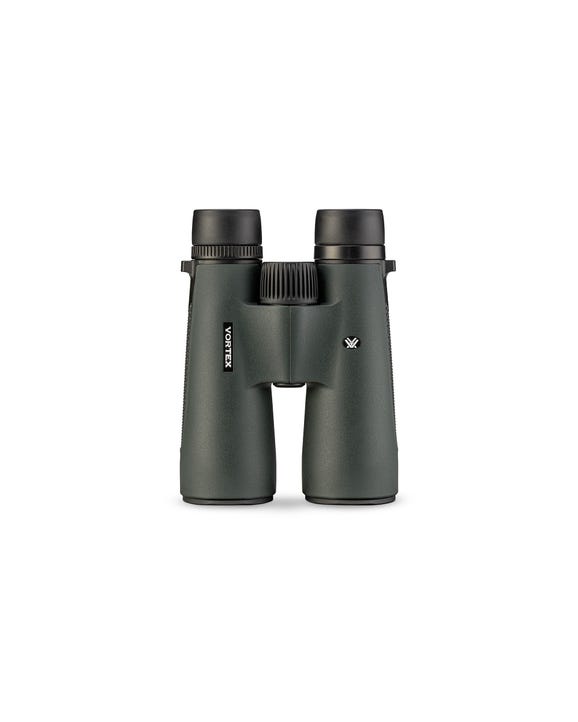
The family also includes the lighter 10x28 and broader-field 10x42. Vortex's page links this exact model to Where to Buy, which does not establish a particular shop's inventory or price. The linked product image shows the green roof-prism body but no readable 12x or SKU markings; the exact page association identifies the model, and the manufacturer does not say whether the image is a photo or rendering. The family care instructions advise clearing grit before lens cleaning and warn against viewing the Sun with ordinary binoculars.
Manufacturer sources: Vortex Triumph HD 12x50 product page and the TRI-1250 parts/specification sheet. Listed values are not independent optical measurements.
Key specifications
Key details at a glance
| Magnification | 12× |
|---|---|
| Objective diameter | 50 mm |
| Real field of view | 5.2° |
| Eye relief | 16 mm |
| Exit pupil | 4.2 mm |
| Close focus distance | 9.9 ft |
More specifications and setup details
| Manufacturer-published weight | 26.2 oz |
|---|---|
| Lens and prism coatings | The exact product page says fully multi-coated lenses and names an HD Optical System with selected glass elements. It does not identify this exact SKU as ED glass or confirm phase/dielectric prism coatings; those properties remain unknown. |
| Water and fog protection | Vortex describes this exact product as nitrogen-purged and O-ring sealed and uses waterproof, fogproof and shockproof language. No numeric ingress-protection rating, immersion depth or immersion duration is published in the inspected exact page or linked family manual; underwater use is not established. |
| Tripod use | The exact product page calls this model tripod adaptable and links a separate Vortex Sport Binocular Adapter. No adapter is listed in this exact configuration’s in-box list; adapter compatibility is supported, but the adapter is not supplied. |
| Published weight note | Manufacturer-listed instrument weight only; it is not an independent measurement and excludes the separately listed carrying case, harness, strap, covers and other carried accessories. |
| Manufacturer-rated waterproof | Yes |
| Built-in image stabilization confirmed | No |
| Integrated laser rangefinder | No |
| Onboard ballistic solution display | No |
| Tripod adapter in package | No |
Use the exact model’s instructions for operating limits, supplied equipment and version differences.
Sources for this review
Sources for this assessment
- Exact U.S. Vortex Triumph HD product page, SKU TRI-1250
- Official Vortex U.S. binocular category page 4, row 1 of 65
- Official exact-SKU XVIEW/parts sheet for TRI-1250
- Linked Triumph HD family manual response archived under M-00431; version-label bridge unresolved
- Official page-linked product image for TRI-1250

Choose your optical trade-off first.
Choose viewing purpose first, then magnification, objective size, scene width and any fit, weather or mounting constraint. A direct-Sun requirement is separate: only exact manufacturer-confirmed solar binoculars can pass it.