
On this page
Your needs, this model
Does it fit your priorities?
Are you considering this exact earlier 8x42, or only current products?
The exact U.S. page identifies Talon HD SKU TLN-4208-HD and labels it INACTIVE. Include it only when earlier models are allowed; it is a comparison/identification reference, not a current offer.
Explore this need in the finder →Does the published real field meet your broad-scene preference?
The exact page lists 8.1° and 425 feet at 1,000 yards. That clears the 6° real-field choice; no apparent-field value is listed.
Explore this need in the finder →Does the stated eye relief meet your minimum?
The manufacturer lists 18 mm. That meets a numeric minimum of 18 mm, not a minimum of 18.5 mm; full-field access still depends on the eyeglasses and fit.
Explore this need in the finder →Can the stated instrument weight meet your carry ceiling?
The exact page lists 27.4 oz for the instrument, not the packed kit. It meets a 27.4-oz ceiling; a 27-oz maximum is too strict.
Explore this need in the finder →Can its close-focus figure meet your maximum distance?
Vortex lists 6 ft. A six-foot maximum accepts the published figure; a five-foot maximum does not.
Explore this need in the finder →Is confirmed waterproofing essential?
The exact page gives no waterproof rating. An eyepiece rainguard is not evidence of housing protection, so this profile cannot satisfy an essential waterproof requirement.
Explore this need in the finder →Vortex's U.S. listing identifies Talon HD 8x42 SKU TLN-4208-HD and marks the page INACTIVE. This is a reference assessment of a standard, passive binocular: useful for confirming a marked pair or comparing an earlier unit, not a claim that it is currently for sale.
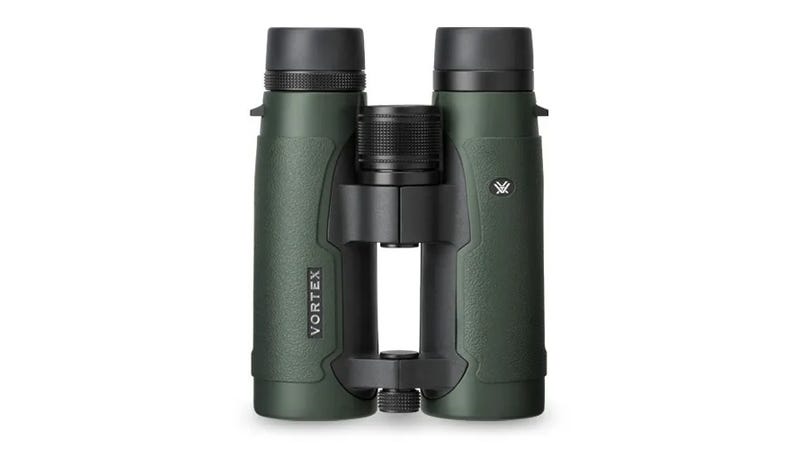
Image source and model notes
A wide listed scene at eight power
This exact SKU combines fixed 8x magnification with 42 mm objectives. Vortex lists an 8.1-degree angular field and 425 feet at 1,000 yards, the broadest scene width among the four Talon HD configurations compared here. Eight power is the lower-magnification choice against the 10x42 sibling; it keeps more of the surroundings in the listed field and gives you more time to find a moving subject while panning. That is a useful trade for general wildlife observation or scanning a landscape. It is not a guarantee that every observer will find the view steadier or brighter, and it is not based on a hands-on test. The important point is the published difference: 425 feet per 1,000 yards versus 348 feet for the 10x42.
The page lists a 5.3 mm exit pupil, the 42 mm objective divided by 8x. That geometric value is not a measured brightness or light-transmission result. A 42 mm front lens also does not tell you how a used pair was stored or whether its seals remain sound. Vortex's product description names ED glass and XR fully multi-coated lenses, but neither phrase replaces exact fit, condition, or low-light evaluation of an individual instrument.
What changes in fit and carrying
The listed weight is 27.4 ounces, with dimensions of 6.7 inches high by 5 inches wide. Its 18 mm stated eye relief is the longest of these four Talon HD variants. That figure makes it a reasonable candidate to compare if you wear glasses, but it does not promise that your particular frames will show the full field. The 10x42 sibling lists 16 mm and weighs 26.5 ounces, so it is slightly lighter but has a narrower listed view and shorter eye relief. If a strict carry limit is central, the 8x42 does not meet a 27-ounce maximum from its listed 27.4 ounces; its width-of-view advantage is not a reason to ignore that limit.
Vortex lists close focus at 6 feet and an interpupillary range of 56–73 mm. That is more suitable on paper for a nearby feeder or detail than the two 32 mm Talons, both of which focus no closer than about 8 feet. It still is a binocular for ordinary viewing rather than a close-up or macro tool. If eye alignment matters, use the actual IPD range and adjust both barrels until the two images join without shading. The shared family manual describes how to use the twist-up/down eyecups and two-step focus, with a distant object around 20 yards as a setup target.
Setup and protection
The manual's practical sequence is straightforward: set eyecups fully up when not wearing glasses and down when viewing through them; adjust interpupillary distance until one unshaded image appears; cover the left objective or close the left eye and focus the left-eye view with the center wheel; then view through the right eye and adjust the right-eyepiece diopter. Once the diopter is set, the center focus wheel handles ordinary distance changes. The instructions are especially useful when you are checking a used unit, because poor setup can be mistaken for an optical defect. The manual also labels a tripod-adapter socket. That confirms a tripod-adapter connection, but the package list does not include an adapter. It is an optional support route, not an out-of-box tripod setup.
The exact page lists HD extra-low-dispersion glass, XR fully multi-coated lenses and a magnesium open-hinge chassis. It does not state prism type, phase coating, apparent field, waterproofing, fogproofing, or a specific adapter model. The included rainguard protects the eyepieces when stored; it is not proof of a waterproof housing. The manual says to protect the lenses with the covers and use the case between sessions, and warns against pointing binoculars at the Sun or intense light. Do not select this profile to satisfy an essential weather rating, phase-coating requirement, or demand for a supplied adapter.
Questionnaire fit and alternatives
The published 8.1-degree field clears the six-degree real-field preference, but the exact page does not list an apparent-field figure. An apparent-field requirement therefore stays unconfirmed. The exact 18 mm eye relief and 27.4-ounce weight support those numeric comparisons; a minimum above 18 mm or weight ceiling below 27.4 ounces does not fit. The 6-foot close-focus limit is met at six feet or more. ED glass and tripod-adapter compatibility are confirmed; waterproofing and phase coating are not. The normal operating plan is a fixed 8x42 optical binocular, with no integrated laser rangefinder. The standard 8x42 page is distinct from the Talon HD 10K rangefinder.
Choose the 10x42 when more magnification and a slightly lower listed instrument weight are more important than the 8x42's 77-foot wider field and 2 mm longer eye relief. Choose the 8x32 if you want 8x and a broadly similar published field in a lower listed instrument weight of 19.8 ounces; it gives up 2.8 mm of stated eye relief and focuses no closer than 8.2 feet. Because this 8x42 page is inactive, keep it for identification and earlier-model comparison only, and verify the SKU and condition on any individual pair.
Identity and specifications: Vortex Talon HD 8x42 product page and the Talon HD binocular manual.
Key specifications
Key details at a glance
| Magnification | 8× |
|---|---|
| Objective diameter | 42 mm |
| Real field of view | 8.1° |
| Eye relief | 18 mm |
| Exit pupil | 5.3 mm |
| Close focus distance | 6 ft |
More specifications and setup details
| Manufacturer-published weight | 27.4 oz |
|---|---|
| ED glass confirmed for this exact model | Yes |
| Lens and prism coatings | Exact product page confirms HD extra-low-dispersion glass and XR fully multi-coated lenses; it does not establish all prism surfaces or phase/dielectric treatments. |
| Water and fog protection | The page lists a rainguard for the eyepieces but makes no waterproof, fogproof, gas-purge, immersion or shock rating claim. A rainguard is not evidence of housing protection. |
| Tripod use | The shared exact-family manual labels a tripod-adapter socket. No adapter appears in the exact PDP package list; adapter/thread model is not stated. |
| Published weight note | The exact SKU page lists 27.4 oz as instrument weight; packed weight with covers, strap and case is not stated. |
| Integrated laser rangefinder | No |
| Tripod adapter in package | No |
Use the exact model’s instructions for operating limits, supplied equipment and version differences.
Sources for this review
Sources for this assessment
- Official Vortex U.S. inactive binocular directory page 3 card row 7; original embedded product data identifies TLN-4208-HD and its exact PDP URL.
- Exact Vortex U.S. Talon HD 8x42 PDP; SKU TLN-4208-HD, marked INACTIVE; specs, page description, package and image gallery inspected.
- Initial linked manual response is retained as PDF.js viewer HTML; not treated as manual text.
- Actual five-page VTX_TLN-12-A Talon HD binocular manual exposed in the linked viewer; one archived copy reused for all four exact PDPs.
- Exact TLN-4208-HD PDP-linked front-view JPEG, archived as served and visually inspected; exact power/SKU is established by the page gallery relationship, not legible in pixels.

Choose your optical trade-off first.
Choose viewing purpose first, then magnification, objective size, scene width and any fit, weather or mounting constraint. A direct-Sun requirement is separate: only exact manufacturer-confirmed solar binoculars can pass it.