
On this page
Your needs, this model
Does it fit your priorities?
Do you need a binocular that also measures target distance?
Yes. The exact 12x50 has an integrated laser rangefinder plus on-device HCD, LOS and BAL options; a phone or Relay network is not needed for simple ranging.
Explore this need in the finder →Is the 12x50 image and larger objective worth carrying 46.8 ounces?
Vortex lists 12x50, 46.8 oz with battery and a 272 ft field per 1,000 yd. A 12x view magnifies more but narrows the real scene and is harder to keep steady.
Explore this need in the finder →Does a 25 ft closest focus meet your minimum distance?
The exact 12x50 lists 25 ft close focus. A stricter 16 ft cap excludes it and points to the 10x42 if you still require a Talon rangefinder.
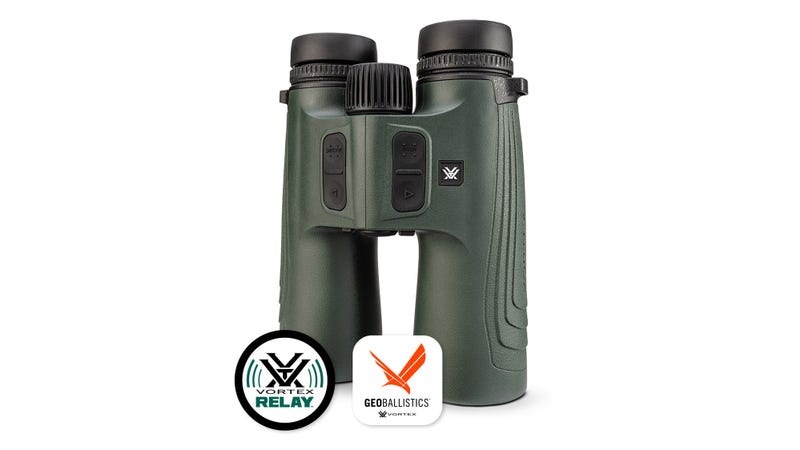
Explore this need in the finder →The Vortex Talon HD 10K 12x50 combines 12x binocular viewing with a laser rangefinder and an on-device ballistic display. At 46.8 ounces with its CR123 battery, it is a specialized instrument for someone who needs those functions and can handle a heavy, high-power view—often with a tripod nearby. It is not the best fit for casual birding, long walks or a buyer who only wants passive binocular optics.
Its advantage is reach, not a wider landscape
The exact U.S. SKU is LRF-TLN1250. Vortex lists 12x magnification, 50 mm objectives, a 5.2-degree real field (272 feet at 1,000 yards), 18.5 mm eye relief and a 25-foot close-focus distance. The 10x42 sibling is six ounces lighter, shows 321 feet at the same distance and focuses to 15 feet. The 12x50 makes distant subjects look larger, but the actual scene is narrower and the extra power makes hand movement more visible.
Both Talons have a listed exit pupil of about 4.2 mm when calculated from objective diameter divided by magnification. The 50 mm front lenses therefore do not automatically make this particular 12x50 brighter at the eye than the 10x42; the two sizes trade magnification, field and physical scale, not a guaranteed brightness step. The shared 18.5 mm eye-relief figure also means the larger objective does not solve fit for someone who needs more space behind the eyepiece.
Understand the published range limits
Vortex lists up to 10,000 yards on reflective targets, 4,200 yards on trees, 2,600 yards on deer and a ten-yard minimum. Those are manufacturer maximum specifications, not results we measured and not distances that can be assumed in every setting. The manual says color, target size, surface texture and angle matter; poor visibility in rain, fog or snow reduces maximum range. The target modes—Normal, First, Last, Extended Laser Range and Rain/Fog—help select how the instrument searches for a return. They do not remove the limits of the target or conditions. The 12x50’s listed tree/deer ceilings are only 200 and 200 yards higher than the 10x42’s, while its field narrows and weight rises.
Ballistics add data management as well as convenience
The unit can range on its own, and the manual says its connection to Vortex Relay devices is optional. You can choose line-of-sight, horizontal-component or ballistic mode. In BAL mode it can display range, inclination, wind and drop information using the selected profile; the instrument also has onboard temperature, pressure, humidity, compass and inclination sensors. The factory starting setup is HCD mode with a .308 Winchester profile, not a verified profile for every user. Vortex supplies ten common starting profiles, and the manual describes editing details on the unit or through the GeoBallistics phone app. Custom data and environmental conditions matter; the display should not be read as a universal or independently verified solution.
A CR123 battery is listed in the package. Vortex does not publish an operating-time figure on the product page, so a long trip needs a battery plan rather than an assumed runtime. The red OLED is an active display, and the rangefinding and electronic features are not passive glass. Bluetooth app pairing is available for setup and data management, but it is not required for a simple standalone range reading.
Tripod support is a practical part of the choice
At nearly three pounds, the 12x50 is a lot to hold steadily. The manual says a tripod improves the ability to range small targets at longer distances and recommends calibrating the compass with the binocular adapter installed when using a tripod. Vortex lists tripod adaptability, but the exact box contents include the sport harness, neck strap, lens covers, rainguard, cloth and CR123 battery—not the separate Pro Binocular Adapter. If your plan depends on stable mounted ranging, price and carry the proper adapter as a separate item rather than assuming it ships with the optic.
Focusing takes a little care. The center wheel adjusts both barrels, while the right-eye diopter and reticle focus are separate locking controls. Set the reticle and each eye with the manual’s procedure before use. Four-position eyecups are described for viewing with or without glasses. The manufacturer calls the body waterproof, fogproof and shockproof and says it is nitrogen purged; no exact submersion depth or IP rating is stated, so those broad terms should not be turned into an underwater promise.
When this size is the right call
Prefer the 12x50 when the larger image and the slightly higher manufacturer-listed tree/deer range are more important than the 10x42’s wider field, closer focus and six-ounce weight saving. It also shares the same 10,000-yard reflective-target maximum and the same integrated modes, display, battery type and app option as its sibling. If your top priority is one rangefinding binocular you can carry between positions, the 10x42 is the more forgiving Talon. If you do not need an active rangefinder or ballistic display, a conventional optical-only 10x42 such as Nikon PROSTAFF P7 is far lighter; a passive 12x50 may also be a better direction if you chiefly want magnification without electronic setup.
This review uses the exact Vortex U.S. SKU page, the complete two-item Talon binocular family listing, the linked product manual and exact dated CPSC name-query records. The manual warns not to look at the Sun, stare into the laser beam, activate the controls while aiming at an eye, or disassemble the unit. Follow the manufacturer’s safety directions. See the Vortex Talon HD 10K 12x50 page and the manufacturer manual for current model and package information.
Key specifications
Key details at a glance
| Magnification | 12× |
|---|---|
| Objective diameter | 50 mm |
| Real field of view | 5.2° |
| Field width at 1,000 m | 83 m |
| Eye relief | 18.5 mm |
| Exit pupil | 4.2 mm |
More specifications and setup details
| Close focus distance | 25 ft |
|---|---|
| Manufacturer-published weight | 46.8 oz |
| Locking diopter ring confirmed | Yes |
| Lens and prism coatings | Vortex describes XR Plus anti-reflective coatings on all air-to-glass surfaces. The exact page does not identify prism coatings or confirm ED glass by name; those remain unknown. |
| Water and fog protection | The exact product page and manual call the unit waterproof, fogproof and shockproof and state nitrogen purging. No immersion depth or IP rating is published; do not infer underwater suitability. |
| Tripod use | Vortex calls it tripod adaptable and says an adapter may be required. The exact package list omits the separately listed Pro Binocular Adapter; the manual says a tripod helps steady long-range small-target ranging. |
| Published weight note | Manufacturer lists weight with the included CR123 battery. No field-scale measurement is implied. |
| Manufacturer-rated waterproof | Yes |
| Power source | CR123 |
| Integrated laser rangefinder | Yes |
| Onboard ballistic solution display | Yes |
| Maximum reflective-target range (manufacturer) | 10000 yd |
| Maximum tree range (manufacturer) | 4200 yd |
| Maximum deer range (manufacturer) | 2600 yd |
| Minimum range (manufacturer) | 10 yd |
| Tripod adapter in package | No |
Use the exact model’s instructions for operating limits, supplied equipment and version differences.
Sources for this review
Sources for this assessment
- Vortex U.S. exact model page and SKU LRF-TLN1250
- Vortex U.S. Talon binocular family listing (2 of 2 products)
- Vortex Talon HD 10K product manual linked from both exact pages; 43-page English PDF
- Official Vortex exact-page-linked product image, 800 × 450 rendition
- CPSC exact manufacturer SKU name query; empty result on 2026-10-24, not a recall clearance
- CPSC exact model-name query; empty result on 2026-10-24, not a recall clearance

Choose your optical trade-off first.
Choose viewing purpose first, then magnification, objective size, scene width and any fit, weather or mounting constraint. A direct-Sun requirement is separate: only exact manufacturer-confirmed solar binoculars can pass it.