
On this page
A locking-diopter 18x56 with conflicted weight evidence
The Razor UHD 18x56 shares a 3.7° published real field with the Maven B.5 18x56 MIL and lists 18 mm eye relief plus a locking diopter. Its exact page and manual disagree on mass, so the body weight remains unresolved; its tripod adapter is also sold separately.
Explore the needs this model fits
Your needs, this model
Does it fit your priorities?
Do you prefer a wide scanning field or more magnification?
The exact 18x56 lists 194 ft at 1,000 yd and 3.7 degrees. Choosing its exact power and objective distinguishes it from other Razor UHD sizes.
Explore this need in the finder →Can the model’s closest-focus distance accommodate your nearby subjects?
Vortex lists a 10.0 ft closest focus for this exact configuration; nearer fine-detail work is not confirmed.
Explore this need in the finder →Is an explicitly named ED-glass specification essential?
Vortex names UHD/APO optical features but the exact U.S. page and linked manual do not identify an ED-glass designation for this SKU. If ED is essential, do not infer it from the broader product-family labels.
Explore this need in the finder →The Razor UHD 18x56 is the most specialized model in this family. It is for distant wildlife or other stationary viewing where high magnification is more useful than a wide scene, a light pack, or easy handheld tracking. Its 18x power, 3.7-degree field and roughly 42-ounce listed weight make it a deliberate tripod-adapted choice rather than a casual pocket binocular.
Understand the narrow, high-power view
Vortex lists a 194-foot field at 1,000 yards and a 3.7-degree angular field, the narrowest in the Razor UHD family. At a fixed position, that tighter view can help make a distant animal larger in the eyepiece, but it makes locating a moving subject more demanding. The published 18x magnification also magnifies hand movement. A support is likely to be useful for sustained viewing, and Vortex explicitly calls this configuration tripod adaptable. The exact page lists a Pro Binocular Adapter separately; the included items do not contain an adapter, so budget for a compatible one rather than treating tripod use as ready out of the box.
The large 56 mm objectives accompany the family’s highest power, but the calculated exit pupil is about 3.1 mm. This ratio is the objective diameter divided by magnification; it is not a brightness measurement. The 18x56 may suit daylight glassing across open terrain, but objective size alone does not make it the automatic low-light choice. For a wider and easier-to-hold view, the 10x50 and 12x50 cover 341 and 288 feet respectively at 1,000 yards. They give up power while showing more surrounding scene.
Check the physical fit before committing to a tripod setup
Vortex lists 41.6 ounces, 8.3 inches high, 6.1 inches wide, 18 mm eye relief, 10 feet close focus, and 56–76 mm interpupillary distance. The linked family manual’s specification table lists 42.0 ounces and 8.4 by 6.2 inches for the 56 mm model, while agreeing on 18 mm eye relief and 10 feet close focus. Keep the published weight and dimensions approximate: both current page and manual are primary sources, but the exact parts sheet does not reconcile their differences. The hard-weight finder therefore treats the exact weight as unknown for a strict maximum rather than granting the lighter page figure.
The page identifies the UHD optical system, XR Plus coatings on air-to-glass surfaces, magnesium chassis, Abbe-Koenig roof prisms, phase correction, ArmorTek protection, and argon-gas purging. It describes the unit as waterproof, fogproof and shockproof, but gives no immersion depth or independent environmental test. It does not explicitly name ED glass. If you need ED by a documented specification, or image stabilization, this model does not meet that confirmed-feature test. APO and UHD language should not be substituted for a separate ED designation.
Plan for the operating position
The exact page lists a GlassPak Pro binocular harness, comfort neck strap, rangefinder pouch, tethered objective covers, rainguard, and lens cloth. That case is not a tripod, and the Pro Binocular Adapter appears as a separate accessory rather than a box item. The long-focus design is not ideal for nearby feeder observations: the page lists 10 feet close focus, compared with 4.5 feet for the 42 mm models and 6.6 feet for the 50 mm pair. If close viewing or walking with quick target acquisition is part of the plan, a lower-power configuration is more appropriate.
The product page gives central focus, adjustable eyecups, and a locking diopter. The manual explains independent focus adjustment and recommends removing dust or grit before wiping coated glass. A solid support, a correctly matched adapter, and a clear view of the target are more useful to this 18x setup than assuming magnification alone makes a distant animal easy to observe.
Who should choose it?
Choose the 18x56 if maximum power within this family is the primary need and you are prepared for narrow-field aiming, a tripod adapter, and a heavier instrument. The 12x50 offers a more portable intermediate option; the 10x50 is easier to scan with; and the 8x42 is better suited to wide-field general observation. If a specific 42.0-ounce cutoff, an included adapter, confirmed ED glass, or a wide field is essential, this is not a confirmed match.
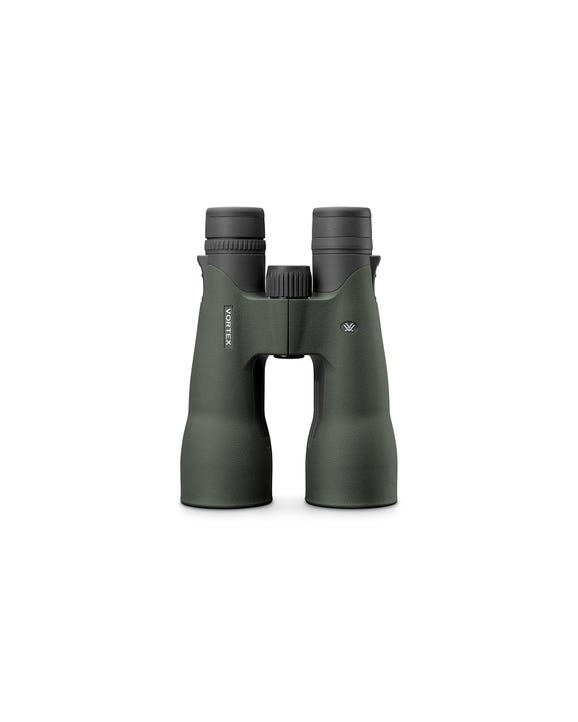
This review is grounded in Vortex’s exact RZB-1856 page, the linked Razor UHD manual, and the SKU-specific XVIEW parts/package sheet. It does not imply independent testing or personal ownership. The exact page-linked product image visibly shows a Razor UHD binocular body but does not show a readable power marking; Vortex does not disclose photograph versus rendering. See the Vortex Razor UHD 18x56 product page and the manufacturer operation manual.
Key specifications
Key details at a glance
| Magnification | 18× |
|---|---|
| Objective diameter | 56 mm |
| Real field of view | 3.7° |
| Eye relief | 18 mm |
| Close focus distance | 10 ft |
| Phase coatings confirmed | Yes |
More specifications and setup details
| Locking diopter ring confirmed | Yes |
|---|---|
| Lens and prism coatings | Vortex names XR Plus anti-reflective coatings on all air-to-glass surfaces; exact page does not confirm a named ED-glass specification or dielectric coating. |
| Water and fog protection | Exact page describes waterproof, fogproof, shockproof, argon-gas-purged construction; no immersion depth or IP rating is published. Do not infer underwater suitability. |
| Tripod use | Vortex calls the model tripod adaptable and lists the Pro Binocular Adapter separately; no adapter appears in the exact package contents. |
| Published weight note | Vortex exact page lists 41.6 oz while its linked family manual lists a different value; exact weight is unknown for hard matching. |
| Manufacturer-rated waterproof | Yes |
| Integrated laser rangefinder | No |
| Onboard ballistic solution display | No |
| Tripod adapter in package | No |
Use the exact model’s instructions for operating limits, supplied equipment and version differences.
Sources for this review
Sources for this assessment
- Vortex U.S. exact product page, Razor UHD 18x56, SKU RZB-1856
- Vortex linked Razor UHD binocular operation manual, 7-page English PDF
- Vortex SKU-specific Razor UHD 18x56 XVIEW parts and in-box accessories sheet
- Exact page-linked official Vortex product gallery image; pixels do not identify magnification
- Dated exact SKU and exact-title ProductName queries; no hit is not recall clearance
- Official Vortex U.S. binocular category row vortex-us-category-cycle47-p1-r3, inspected on page 1

Choose your optical trade-off first.
Choose viewing purpose first, then magnification, objective size, scene width and any fit, weather or mounting constraint. A direct-Sun requirement is separate: only exact manufacturer-confirmed solar binoculars can pass it.
Your needs, this model
18x binoculars: steadiness, field and reticle choice
Choose it when: The Razor UHD is the contrasting 18x56 candidate when a longer stated eye relief and confirmed tripod adaptability matter more than an MIL reticle. Vortex also lists a locking diopter for this exact configuration.
18x binoculars: steadiness, field and reticle choice →