
On this page
Your needs, this model
Does it fit your priorities?
Does 8.5x suit you better than a narrower 10x or 12x field?
The earlier 8.5x50 is an in-between power choice: its listed 358 ft per 1,000 yd is broader than the standard 10x50 and 12x50, while the 50 mm objectives and 8.5x view keep it a full-size instrument.
Explore this need in the finder →Will a 37-ounce binocular stay within your carrying limit?
At 37 oz it is much heavier than the 42 mm Razor; the listed 9.8 ft close focus is not suited to very near detail. It is inactive and distinct from the later HD/UHD series.
Explore this need in the finder →Do you require close focus nearer than 9.8 feet?
Use the exact page-listed value as a hard limit only when it is documented; a stated eye-relief or weight number does not guarantee individual comfort or handling. This model remains reference-only because its page marks it inactive.
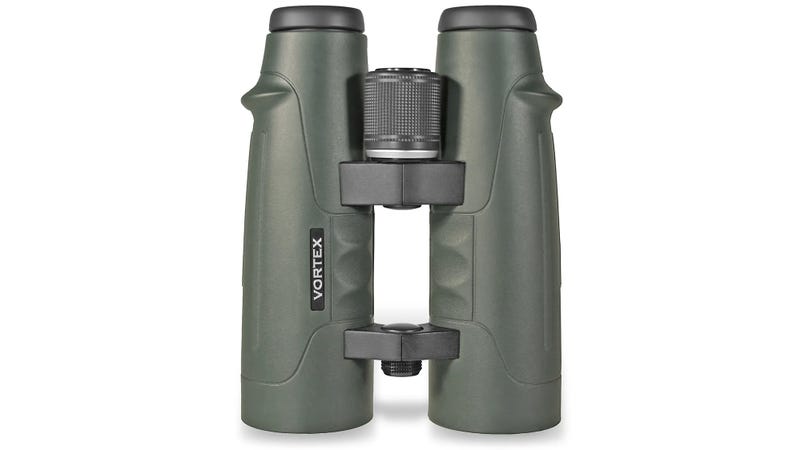
Explore this need in the finder →The Vortex Razor 8.5x50 RZR-8550EU is an unusual earlier full-size configuration: 8.5x magnification with 50 mm objectives. The manufacturer lists a 358-foot field at 1,000 yards, 18 mm eye relief and a 37-ounce weight. Vortex now labels the exact product inactive. Its lower power and broad stated field are the reason to compare it with the 10x50 and 12x50 versions, not a guarantee of superior low-light performance.
An in-between power with a broad 50 mm view
At 8.5x, this model sits between the more common 8x and 10x choices. It gives a distant feature somewhat more apparent size than 8x while keeping a broader scene than the standard Razor 10x50, which lists 329 feet at 1,000 yards. The 8.5x50 is listed at 358 feet and 6.8 degrees. That field can be useful when panning across a slope, but the instrument is still a 50 mm full-size pair, not a compact substitute for a 42 mm model.
The exact page lists a 5.88 mm exit pupil. Dividing objective diameter by magnification describes that value; it does not establish how much light reaches the eye or how bright an image will look in low light. Optical transmission, coatings, the viewer's eye and the condition of the instrument matter. The manufacturer describes this version for dawn and dusk use, but there is no independent measurement in the product record. The 9.8-foot close-focus limit also makes it a poor choice for very nearby subjects.
Long-session weight and fit
At 37 ounces, the RZR-8550EU weighs about 7.6 ounces more than the standard Razor 8x42 RZR-0842EU. A wide strap and the included padded case help with carrying and storage, but they do not erase the difference when the instrument is worn all day. Vortex lists 18 mm of eye relief and an interpupillary range of 56–76 mm. Those figures are useful filters, especially for eyeglass wearers, but actual frame clearance and face fit still need a check through the eyepieces. The listed body is 7.5 by 5.8 inches.
The shared Razor manual describes a tripod adapter socket, with the adapter sold separately. A support can help keep a 50 mm view steady while scanning from a fixed point; the binocular itself is not image stabilized. The manufacturer does not publish a field-of-view stability test.
Manual, controls and weather claims
Vortex links a five-page manual covering the 42 and 50 mm Razor configurations. It explains adjusting the barrels for one circular image, setting the eyecups, focusing the left barrel with the center wheel and correcting the right-eye diopter. It also describes fully multi-coated optics, phase-corrected silver roof prisms, internal focus, O-ring sealing and argon purging. These are manufacturer descriptions, not a controlled optical comparison. The exact page does not name ED glass for this standard RZR-8550EU, so the broad “high-definition glass technology” phrase should not be treated as that specific material claim.
The product is described as waterproof and fogproof, but the exact page and manual do not give a numeric IP, immersion depth or duration. Do not use those words as an underwater rating. The package includes interchangeable flared eyecups, rainguard, tethered objective covers, a contoured neck strap and padded case; the total carry weight is not listed.
Comparing the 8.5x50 siblings
Choose the RZR-8550EU over the standard 10x50 only if the lower power, wider listed scene and the exact earlier identity are what you need. The 10x50 raises magnification and lists 329 feet per 1,000 yards, while the 12x50 favors more apparent reach but lists only 274 feet. All are heavy enough that carry comfort matters. The later Razor HD line is another generation with different SKUs and specifications; it should be judged from its own product page, not inferred from this model.
Because the manufacturer page marks this RZR-8550EU inactive, this review is for identification and comparison. It is not a current-stock claim or a default buying recommendation. If an earlier-model option is requested, confirm the actual SKU, condition and supplied accessories before purchase; otherwise start with current 42 or 50 mm choices and their exact fit requirements.
Key specifications
Key details at a glance
| Magnification | 8.5× |
|---|---|
| Objective diameter | 50 mm |
| Real field of view | 6.8° |
| Eye relief | 18 mm |
| Exit pupil | 5.88 mm |
| Close focus distance | 9.8 ft |
More specifications and setup details
| Manufacturer-published weight | 37 oz |
|---|---|
| Phase coatings confirmed | Yes |
| Lens and prism coatings | The shared five-page Razor 42/50 mm manual identifies fully multi-coated optics and phase-corrected silver roof prisms. The exact standard RZR page uses a broad high-definition-glass description but does not name ED glass; ED remains unknown. |
| Water and fog protection | Vortex describes this model as waterproof and fogproof; the linked manual specifies O-ring sealing and argon purge. Neither source supplies a numeric IP or immersion rating. |
| Tripod use | The exact linked shared manual shows a tripod adapter socket; adapter is sold separately. No stabilization is built in. |
| Published weight note | Manufacturer-listed instrument-only weight from the exact U.S. product page; no independent specimen weighing was performed. |
| Manufacturer-rated waterproof | Yes |
| Built-in image stabilization confirmed | No |
| Integrated laser rangefinder | No |
| Onboard ballistic solution display | No |
| Tripod adapter in package | No |
Use the exact model’s instructions for operating limits, supplied equipment and version differences.
Sources for this review
Sources for this assessment
- Vortex U.S. exact Razor product page; SKU RZR-8550EU; page labels product INACTIVE; specifications and in-box list inspected.
- Vortex linked five-page Razor 42/50 mm product manual. It describes general controls, care, roof-prism/coating construction and tripod adapter socket; it is not a per-SKU independent measurement.
- Official Vortex product-gallery image linked on the exact SKU page; appearance inspected; magnification is not visually legible and photo/render method is not disclosed.

Choose your optical trade-off first.
Choose viewing purpose first, then magnification, objective size, scene width and any fit, weather or mounting constraint. A direct-Sun requirement is separate: only exact manufacturer-confirmed solar binoculars can pass it.