
On this page
Your needs, this model
Does it fit your priorities?
Do you prefer a wide, lower-power scan or more apparent reach?
The lower-power standard Razor 8x42 is the broadest-scanning member of its exact 42/50 mm series, with the manufacturer listing 410 ft per 1,000 yd. The older RZR-0842EU is a model-identification reference, not a current buy recommendation.
Explore this need in the finder →Can a full-size 29.4-ounce binocular fit your carry limit?
The full-size body weighs 29.4 oz and the page marks it inactive. It gives up apparent reach to 10x models and is distinct from the later RZB-2101 Razor HD 8x42.
Explore this need in the finder →Is at least 18 mm eye relief essential for your eyewear fit?
Use the exact page-listed value as a hard limit only when it is documented; a stated eye-relief or weight number does not guarantee individual comfort or handling. This model remains reference-only because its page marks it inactive.
Explore this need in the finder →The Vortex Razor 8x42 RZR-0842EU is an earlier, now-inactive roof-prism binocular whose strongest practical case is broad, lower-power scanning. Its U.S. product page lists a 410-foot field at 1,000 yards, 18 mm of eye relief and a 29.4-ounce instrument weight. The exact SKU matters: this is not the later Razor HD RZB-2101 8x42, despite the similar name and power.
A wide view rather than extra reach
Eight power is a useful starting point for locating birds, following a moving animal through brush or scanning a ridgeline without constantly losing the subject. Vortex lists a 7.8-degree angular field and 410 feet at 1,000 yards for this exact version. That is broader than the older Razor 10x42 RZR-1042EU, whose listed width is 325 feet, while the 10x42 makes a distant feature appear larger. The 8x42 therefore favors acquisition and a less jumpy handheld view over maximum apparent detail.
The 42 mm objectives and 8x magnification yield the page-listed 5.25 mm exit pupil. That number describes the beam geometry; it is not a measured brightness score or a promise of dawn performance. Eye placement, coatings, pupil size, weather and the condition of an individual used instrument all matter. At 8.2 feet, the listed close focus is adequate for ordinary nearby viewing, not for inspecting very close objects like a macro lens.
Carry weight, eye relief and fit
At 29.4 ounces and 6.5 by 5.5 inches, this is a full-size binocular rather than a jacket-pocket travel pair. It can be carried on a walk, but it is noticeably heavier than the later Razor HD 8x42 profile, which lists 24.2 ounces. The older model's 18 mm listed eye relief is a useful screening number for glasses, not a guarantee of full-field comfort: face shape, eyecup position and prescription frames still affect the view. The manufacturer gives a 56–76 mm interpupillary range. Anyone with unusually close-set eyes should check that the barrels can close far enough before choosing it.
For a long glassing session, the central hinge accepts a tripod adapter according to the linked manual, but the adapter is separate. A tripod can help hold a view still; it does not make this an image-stabilized instrument.
Setup and weather limits
The shared five-page Razor manual explains setting interpupillary distance to obtain one circular image, adjusting the eyecups, focusing the left barrel with the center wheel and then setting the right-eye diopter. These steps matter more than a headline specification if the image is uncomfortable or one barrel seems soft. The manual describes multi-coated optics, phase-corrected silver roof prisms, O-ring sealing and argon purging. Vortex uses waterproof and fogproof language, but the inspected page and manual do not give an IP code, immersion depth or duration. Treat it as weather-protected field equipment, not as a binocular for deliberate underwater use.
The page's box list includes interchangeable flared eyecups, a rainguard, tethered objective covers, a contoured neck strap and a padded case. Those are practical for ordinary observation; the page does not provide a weight for the full packed kit. Keep dust off the glass and use the manual's lens-cleaning guidance rather than wiping grit across the coatings.
Where it fits among the earlier Razors
This older RZR-0842EU is distinct from the later Razor HD RZB-2101 and the UHD 8x42 models. Similar magnification does not make their SKUs, optical prescriptions or published measurements interchangeable. Choose the older 8x42 as a reference if you are identifying an existing pair or comparing its broad view with a new one. For a current Vortex recommendation, the later HD 8x42 is the more direct product-page comparison; for more objective diameter, compare current 10x50 options and accept additional mass.
Vortex places this exact RZR-0842EU in its inactive listings. This review preserves the model's documented identity and tradeoffs; it does not assert retail stock or recommend it as a current purchase. In the finder, earlier models remain out of the ordinary buying shortlist unless you deliberately request earlier products. If this is the pair already in hand, the exact manual and specifications are more useful than applying claims from a newer Razor generation.
Key specifications
Key details at a glance
| Magnification | 8× |
|---|---|
| Objective diameter | 42 mm |
| Real field of view | 7.8° |
| Eye relief | 18 mm |
| Exit pupil | 5.25 mm |
| Close focus distance | 8.2 ft |
More specifications and setup details
| Manufacturer-published weight | 29.4 oz |
|---|---|
| Phase coatings confirmed | Yes |
| Lens and prism coatings | The shared five-page Razor 42/50 mm manual identifies fully multi-coated optics and phase-corrected silver roof prisms. The exact standard RZR page uses a broad high-definition-glass description but does not name ED glass; ED remains unknown. |
| Water and fog protection | Vortex describes this model as waterproof and fogproof; the linked manual specifies O-ring sealing and argon purge. Neither source supplies a numeric IP or immersion rating. |
| Tripod use | The exact linked shared manual shows a tripod adapter socket; adapter is sold separately. No stabilization is built in. |
| Published weight note | Manufacturer-listed instrument-only weight from the exact U.S. product page; no independent specimen weighing was performed. |
| Manufacturer-rated waterproof | Yes |
| Built-in image stabilization confirmed | No |
| Integrated laser rangefinder | No |
| Onboard ballistic solution display | No |
| Tripod adapter in package | No |
Use the exact model’s instructions for operating limits, supplied equipment and version differences.
Sources for this review
Sources for this assessment
- Vortex U.S. exact Razor product page; SKU RZR-0842EU; page labels product INACTIVE; specifications and in-box list inspected.
- Vortex linked five-page Razor 42/50 mm product manual. It describes general controls, care, roof-prism/coating construction and tripod adapter socket; it is not a per-SKU independent measurement.
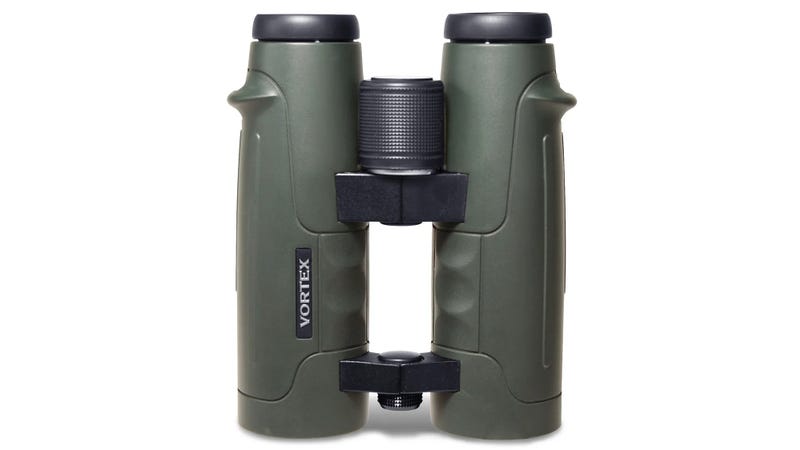
- Official Vortex product-gallery image linked on the exact SKU page; appearance inspected; magnification is not visually legible and photo/render method is not disclosed.

Choose your optical trade-off first.
Choose viewing purpose first, then magnification, objective size, scene width and any fit, weather or mounting constraint. A direct-Sun requirement is separate: only exact manufacturer-confirmed solar binoculars can pass it.