
On this page
Your needs, this model
Does it fit your priorities?
Do you prefer 10x magnification with a 50 mm objective, or a different power/field balance?
The exact inactive SKU RZR-5010-HD is 10x50; its listed real field is 330.8 feet at 1,000 yards. A current-scope request should use a different exact SKU.
Explore this need in the finder →Will the manufacturer's listed 38.5 oz instrument weight fit your carry limit?
The exact page lists 38.5 ounces; the body is a substantial full-size binocular, and any lower hard limit should reject it rather than rounding.
Explore this need in the finder →Is confirmed tripod-adapter compatibility essential, even when the adapter is an additional accessory?
The linked manual shows a tripod-adapter socket, but the exact box list has no adapter. Optional supported mounting requires the compatible adapter as an extra; the inactive reference remains excluded from buying matches.
Explore this need in the finder →The older Vortex Razor HD 10x50 (RZR-5010-HD) combines ten-power magnification with 50 mm objectives. Its U.S. product page lists 330.8 feet of field at 1,000 yards, a 38.5-ounce instrument weight and 19 mm eye relief. It is the middle-power 50 mm choice in this inactive Razor HD set: more reach than the 8.5x50, but a wider stated scene and slightly less weight than the 12x50. The exact product is marked inactive by Vortex, so this is a reference for identification and comparison rather than a buying recommendation.
What ten power and 50 mm mean in use
The 10x setting can help make a distant bird or animal look larger than it does through an 8.5x binocular, while the published 6.3-degree field is broader than the 12x50’s 5.3 degrees. The listed width—330.8 feet at 1,000 yards—still falls short of the 8.5x50’s 362.3 feet. If your usual observation involves locating a moving subject quickly or sweeping a broad landscape, that difference is more relevant than the “50 mm” label alone. If fine distant detail is the priority and the subject is relatively still, the higher power may be useful, but hand motion will also appear more obvious than at 8.5x.
The 50 mm objective with 10x magnification yields a calculated 5 mm exit pupil. This ratio is a geometry calculation, not an optical transmission or low-light test. A larger objective can be useful when the viewing situation and your eye benefit from the available light, but coatings, contrast, eye position and conditions influence the view. The exact product page provides no measured transmission value. Avoid treating either the objective diameter or the product’s HD name as a promise of dusk performance or as confirmation of ED glass; the latter is not named in the page reviewed.
A big optic to carry
The listed 38.5 ounces and 7.4-by-5.6-inch body make the RZR-5010-HD a heavy full-size binocular. Harness carry may distribute the load better than a neck strap on a long walk, but it cannot turn this into a lightweight setup. A strict 30-ounce maximum rules it out; the older 10x42 weighs 29.5 ounces, and the current Razor HD 10x42 is a separate, lighter model with its own specifications. The 10x42 gives up objective diameter, not the nominal magnification. Anyone choosing between these sizes should decide whether the larger front lenses justify roughly nine extra ounces before considering any subjective brightness claim.
The product page lists 19 mm eye relief and a 54–75 mm interpupillary range. Those figures are helpful screening information for glasses and face fit, but they do not predict individual comfort. The listed closest focus is 14 feet, so this is not the most suitable option for frequent close observation of nearby butterflies or plants; the 42 mm pair lists 8 feet. The page does not publish a waterproof depth or duration, an IP rating, or optical transmission measurement. Treat those as unknown rather than inventing a numeric threshold.
Focus, support and care
The exact page links a five-page Razor HD manual. It explains how to set interpupillary distance, adjust the twist-up eyecups, focus the left eye with the center wheel, and use the right-eye diopter ring before locking it. This is not a substitute for trying the binocular with your own glasses; it is a way to get a properly adjusted image before deciding whether the eye relief works for you. The same manual describes the tripod-adapter socket. A stationary, tripod-supported observation plan can be built with a compatible adapter, but the “Included in the Box” list does not include one. The listed accessories are a rainguard, tethered objective covers, comfort neck strap and deluxe padded carry case.
Care guidance is unusually practical for a long-lived reference: remove dust or grit before wiping a lens, then use a suitable optical brush, cloth or paper rather than a shirt sleeve. The manual cautions against viewing the Sun or another intense light source through ordinary binoculars. This model has no sourced built-in stabilization, laser ranging or electronic feature; it should be understood as a passive optical instrument.
Where it fits in the older Razor HD family
Compare the RZR-5010-HD with the 8.5x50 when a broader field and longer listed eye relief matter more than a little extra magnification. Choose the 12x50 only when its extra apparent reach is worth a narrower scene and more weight. The 10x42 is the more portable same-power reference, while an 8x42 is the easier-moving-subject option. Current RZB-series Razor HD models share familiar names but are separate generations and SKUs; use their exact product pages rather than transferring this older model’s numbers. The RZR-5010-HD is most useful when checking a used binocular’s label or reading an older specification sheet, not when shopping for a currently supported profile.
This review uses the exact Vortex U.S. page and the linked general operating manual. It does not report a hands-on test, stock status or measured performance. For comparison with the later generation, see the current Razor HD model review. See the Razor HD 10x50 page and Razor HD operation manual.
Key specifications
Key details at a glance
| Magnification | 10× |
|---|---|
| Objective diameter | 50 mm |
| Real field of view | 6.3° |
| Eye relief | 19 mm |
| Exit pupil | 5 mm |
| Close focus distance | 14 ft |
More specifications and setup details
| Manufacturer-published weight | 38.5 oz |
|---|---|
| Locking diopter ring confirmed | Yes |
| Tripod use | The linked manual diagram identifies a tripod-adapter socket. The exact page box list does not include an adapter; the compatible adapter model is not established in the reviewed sources. |
| Published weight note | Manufacturer-published instrument weight on the exact archived U.S. product page; no independent specimen weighing was performed. |
| Tripod adapter in package | No |
Use the exact model’s instructions for operating limits, supplied equipment and version differences.
Sources for this review
Sources for this assessment
- Vortex exact U.S. Razor HD 10x50 product page identifying SKU RZR-5010-HD; specifications and box contents inspected.
- Vortex linked five-page Razor HD operating manual; it documents fit, focusing, lens protection and a tripod-adapter socket, but no per-SKU numerical specifications.
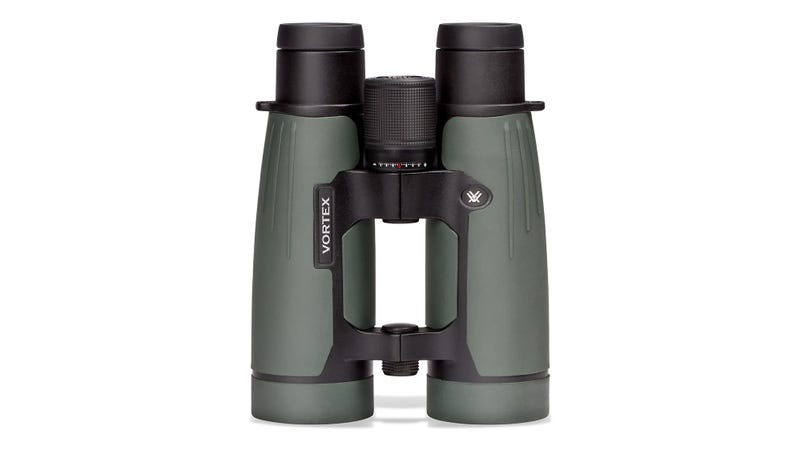
- Official image file linked by this exact manufacturer product page; local original is archived and personally inspected. The power marking is not legible in the shared front view.
- Vortex U.S. inactive Razor-family snapshot; individually resolved exact SKU card and page link.
- Vortex U.S. exact product page, Razor HD 10x50, SKU RZB-2103

Choose your optical trade-off first.
Choose viewing purpose first, then magnification, objective size, scene width and any fit, weather or mounting constraint. A direct-Sun requirement is separate: only exact manufacturer-confirmed solar binoculars can pass it.