
On this page
The exact 8.5x Raptor's field and support limits
The Raptor 8.5x32 is the only exact 8.5x result and pairs a 7.4° listed real field with 18.7 oz body weight. Its 15 ft closest focus and unconfirmed tripod compatibility are important limits; Vortex's waterproof/fogproof claim has no numeric immersion condition in the reviewed record.
Explore the needs this model fits
Your needs, this model
Does it fit your priorities?
Do you need the R385’s exact 8.5x32 configuration and wider published field?
Vortex identifies SKU R385 as 8.5x32, with 390 ft at 1,000 yd (7.4°); the 10x32 sibling has a tighter 339 ft (6.3°) scene.
Explore this need in the finder →Does the R385’s 14 mm eye-relief figure and 18.7 oz instrument limit meet your needs?
Vortex lists 14 mm eye relief and 18.7 oz for R385. These are screening figures, not a glasses-fit or packed-weight guarantee.
Explore this need in the finder →Must the binocular’s published minimum IPD setting reach 50 mm?
The exact Raptor table lists a 50–70 mm IPD adjustment range. Fit remains personal, but the manufacturer’s lowest setting is confirmed at 50 mm.
Explore this need in the finder →The Vortex Raptor 8.5x32, SKU R385, is the wider-field of the two current Raptor 32 mm configurations examined here. Vortex lists a 7.4° real field, 14 mm eye relief, 15-foot close focus and 18.7-ounce instrument weight; its shared Raptor manual confirms the 8.5x32 row and a 50–70 mm interpupillary range. This is a source-based assessment, not a hands-on test.
What 8.5x changes in a 32 mm Raptor
The adjacent Raptor 10x32 uses the same 32 mm objectives and the same 50–70 mm interpupillary adjustment range. The practical difference is not a vague promise that one is universally brighter or sharper: it is the published framing and fit numbers. R385 is listed at 390 feet per 1,000 yards (7.4°) and 14 mm eye relief; R310 is listed at 339 feet (6.3°) and 13 mm. The lower-power version therefore keeps a wider real scene and a little more stated eye relief, while the 10x model gives a larger view of the same distant subject. The 8.5x pair is only 0.3 ounce lighter on the published instrument-only figures, so carry weight is not a meaningful reason to pick it over its sibling.
For a person watching moving wildlife, following birds through branches or scanning a broad area, more scene width can make it easier to locate and keep a subject in view. If the subject is distant and you prefer greater apparent reach, compare the 10x32. That higher power also narrows the listed field and makes small hand movements more noticeable. Neither product page reports a controlled optical comparison, so these are format trade-offs, not measured claims about resolution, brightness or stabilization. Both have a 15-foot close-focus limit; neither is the choice for people whose main task is viewing details very near the front of a hide or feeder.
Fit across a household
Vortex specifically presents Raptor as a mid-size Porro-prism binocular designed to accommodate a wide range of interpupillary distances. The manual gives the exact R385 adjustment range as 50–70 mm and describes rotating the barrels until the viewer sees one undistorted image. That range can matter when one pair is shared by people whose eyes sit at different distances apart. It is a specification rather than a guarantee that every family member will align comfortably; check the actual viewer with the eyecups and their normal glasses.
The manual says the eyecups twist up and down. It recommends fully extended eyecups without glasses and lowering them for use through glasses, but the listed 14 mm relief is not a promise of full-field access for every frame. The setup procedure also separates the two focusing adjustments: focus the left barrel with the center wheel, then use the right-side diopter for the other eye. Once set, use the center control for ordinary distance changes. The manufacturer gives a ±4 diopter range for this family. This can help a mixed group share an instrument, but it cannot replace individual vision correction or a trial fit.
Construction and limits of the claims
The shared manual identifies Porro prisms made from BaK4 glass. The exact page describes an SD optical system and fully multi-coated lenses; these are manufacturer feature statements, not independent measurements of color fringing or transmission. The page also says the binocular is nitrogen-purged, O-ring sealed, waterproof, fogproof and shockproof. No IP code, immersion depth or time limit is stated in the reviewed materials. Treat those as weather-resistance claims, not a license to submerge the optic or expose it to water beyond its instructions.
At 18.7 ounces, R385 is a mid-size binocular rather than a pocket pair. Vortex lists a five-inch height and 6.2-inch width. Those figures describe the binocular, not a packed system. No integrated rangefinder, electronic display or image stabilization is listed, and the model uses no battery. Tripod compatibility is not established by the exact page or family manual, so do not select it for an essential mounted-viewing requirement on the evidence here.
Package, setup and care
The manufacturer lists a rainguard eyepiece cover, tethered objective covers, comfort neck strap, carry case and lens cloth in the box. That is a useful starter set for carrying and basic lens protection; the 18.7-ounce specification does not include those pieces. The manual explains how to adjust spacing and focus, attach the strap, protect lenses and clean coated optics. Blow dust or grit away before wiping, and use products intended for coated lenses. The manual cautions against disassembly and against applying extra lubricant.
One safety limit should override every casual-use assumption: ordinary Raptor binoculars are not intended for looking at the Sun or another intense light source. Do not use them to observe a solar eclipse. Direct solar viewing requires dedicated equipment designed for that purpose and used exactly as instructed.
Who should shortlist the R385?
Shortlist this exact 8.5x32 if you want a manageable mid-size pair, a wider published scene than the 10x Raptor, the shared family’s 50–70 mm adjustment range, or 14 mm rather than 13 mm stated eye relief. Choose the R310 instead if the extra magnification is more important than those two differences. If waterproofing is essential, the maker uses that word for both; if a numeric immersion rating, tripod support, built-in stabilization or a guaranteed eyeglass fit is essential, these reviewed sources do not establish it. A 42 mm pair such as a reviewed Vortex Crossfire HD configuration is a different size class, not an automatic upgrade: compare its actual weight and field against your outing rather than assuming the larger objective settles the decision.
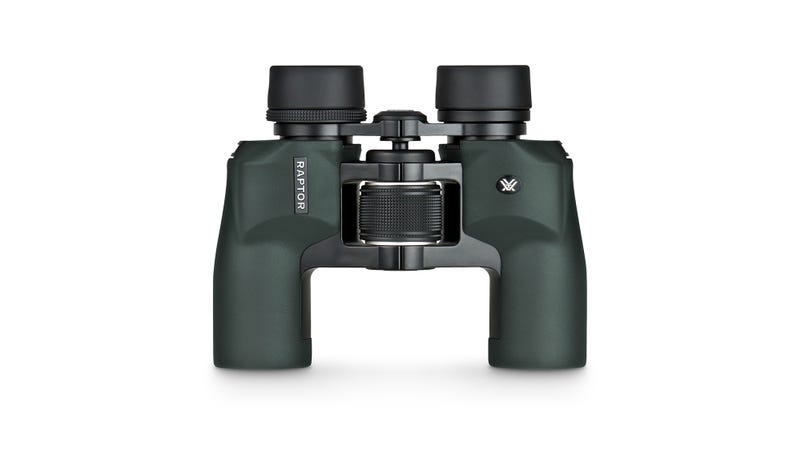
The exact manufacturer page associates this model with a front-view Raptor image. Vortex uses byte-identical 800 × 450 image files on the 8.5x32 and 10x32 pages; the picture shows the Raptor body but does not identify power. Its manual also says illustrations are representative and that the product may vary slightly. The image is therefore not used as proof of magnification, and the maker does not disclose whether its file is a photograph or render. Vortex currently routes the exact page to Where to Buy; that does not verify a retailer’s stock or price.
Manufacturer sources: Raptor 8.5x32 product page, the official Raptor product manual (specifications on p. 2; setup, care and safety on pp. 3–7, with manual identifier M-00104-1 on p. 12), and the Vortex binoculars category page 4 that lists the model.
Key specifications
Key details at a glance
| Magnification | 8.5× |
|---|---|
| Objective diameter | 32 mm |
| Real field of view | 7.4° |
| Field width at 1,000 m | 130 m |
| Eye relief | 14 mm |
| Close focus distance | 15 ft |
More specifications and setup details
| Manufacturer-published weight | 18.7 oz |
|---|---|
| Lens and prism coatings | Vortex describes fully multi-coated lenses; no exact-source claim of ED glass or phase/dielectric prism coating was found. |
| Water and fog protection | Vortex says the binocular is nitrogen-purged and O-ring sealed and uses waterproof/fogproof/shockproof language. The reviewed exact page/manual do not give a numeric ingress code or immersion depth/duration. |
| Tripod use | The exact page and Raptor manual do not state tripod compatibility. A tripod adapter is not listed in the package; compatibility remains unknown rather than presumed. |
| Published weight note | Vortex-listed instrument-only weight; carry case, strap, covers and lens cloth add to the packed system. No independent weighing was done. |
| Manufacturer-rated waterproof | Yes |
| Built-in image stabilization confirmed | No |
| Integrated laser rangefinder | No |
| Onboard ballistic solution display | No |
| Tripod adapter in package | No |
Use the exact model’s instructions for operating limits, supplied equipment and version differences.
Sources for this review
Sources for this assessment
- Exact Vortex U.S. Raptor 8.5x32 product page, SKU R385
- Official Vortex U.S. binocular category page 4 observation, row for Raptor 8.5x32
- Official shared 12-page Raptor Product Manual, model table contains SKU R385; printed footer M-00104-1
- Official 800 x 450 image URL linked from exact R385 product gallery

Choose your optical trade-off first.
Choose viewing purpose first, then magnification, objective size, scene width and any fit, weather or mounting constraint. A direct-Sun requirement is separate: only exact manufacturer-confirmed solar binoculars can pass it.
Your needs, this model
A fixed 8.5x binocular: the Vortex Raptor
Choose it when: The Raptor is the only exact 8.5x match, and its 7.4° field and sub-20-ounce listed mass make the configuration easy to compare with ordinary 8x and 10x choices without pretending they are the same power.
A fixed 8.5x binocular: the Vortex Raptor →