
On this page
A 10x50 with Vortex's R/T mrad ranging aid
The Ranger HD R/T 10x50 combines a manual mrad scale with four silhouette aids that rely on assumed target dimensions, not laser returns. It is a distinct layout from Bushnell's SHOT-CALL MRAD, with a separately focused reticle and an adapter required for tripod mounting.
Explore the needs this model fits
Your needs, this model
Does it fit your priorities?
Do you want the Ranger HD R/T 10x50 configuration rather than another size?
This exact model is fixed at 10x with 50 mm objectives. It cannot become 12x or a 42 mm pair.
Explore this need in the finder →Do you want a manual optical ranging reticle that relies on known target dimensions rather than a laser distance readout?
The RGR-303 has an mrad R/T reticle and silhouette aid; it has no integrated laser and does not display a measured range.
Explore this need in the finder →Will its listed 20 mm eye relief and approximately 27.2-ounce instrument figure fit your own use?
The page lists 20 mm eye relief and 27.2 oz, but its weight cell repeats “5.2 inches” before the ounce value. Eye relief is not a glasses-fit guarantee; test the frame and do not count case/strap weight as part of the instrument figure.
Explore this need in the finder →The Vortex Ranger HD R/T 10x50 is an optical binocular with a ranging reticle, not an electronic rangefinder. The reticle can help estimate distance when you know the dimensions of the object you are looking at and can hold the binocular steady. Choose it for that hands-on method and its fixed 10x50 view; choose a laser model if you want the device to return a distance number.
The R/T reticle changes what “ranging” means
The model page identifies the exact U.S. SKU as RGR-303 and describes a four-silhouette R/T reticle as a secondary ranging aid. The linked manual explains that its crosshair scale is based on milliradians (mrad). The user compares a known-size target against the scale, reads the angular span, then uses the target size and measured mrads to calculate range. Its example uses a six-foot person, treated as two yards, spanning four mrads to estimate 500 yards. It is an example, not a guarantee.
The manual also shows silhouette shapes for quick estimates, based on assumed dimensions such as a 20-inch shoulder width, 11-inch head width and 17-inch back-to-brisket height. They help only when a real target is close to those assumptions; a different animal, posture, angle or unknown size can mislead. The instrument does not measure distance by itself or display a result. If electronic readings are essential, compare the Ranger HD 3000 or another integrated laser model.
A fixed 10x50 view for detail, with a narrower scene
Vortex lists 10x magnification, 50 mm objectives, a 5.3-degree real field (278 feet at 1,000 yards), 20 mm eye relief and an 8.2-foot close-focus distance. Ten power can make distant detail easier to inspect than a lower-power view, but it also magnifies hand movement and makes fast panning less forgiving. The 5.3-degree field is narrower than the 6.6-degree figure listed for the Viper HD 10x50; if you spend more time scanning broad terrain than using the reticle, the Viper’s wider published field is a useful distinction.
A 5 mm exit pupil describes view geometry, not guaranteed brightness; light, eye placement and the observer all matter. The 20 mm eye-relief figure is potentially useful for glasses wearers, but it cannot guarantee that your frames will show the entire field comfortably. The manual says to fold the winged eyecups down for eyeglass viewing; try the exact binocular with your normal glasses if that fit is essential.
Optical construction and handling
The product page calls this a roof-prism binocular and describes HD (high-density, extra-low-dispersion) objective glass, XR Plus anti-reflective coatings, phase correction, ArmorTek exterior lens protection and rubber armor. Vortex describes the instrument as waterproof, fogproof and shockproof, but the reviewed page does not give an IP code or a water-immersion depth. Those terms should not be stretched into an underwater-use rating, and they are manufacturer claims rather than independent durability tests.
Vortex lists the instrument at 27.2 ounces and 6.7 by 5.2 inches. The weight row on the page repeats “5.2 inches” from the width line before “27.2 oz”; the ounce value is identifiable, but the formatting defect is worth preserving rather than quietly correcting. It is not a measured sample weight or a total carry-system weight. The package list names a soft waterproof eyepiece cover, tethered objective covers, a contoured neck strap and a padded carry case. The manual diagram shows a tripod-adapter socket and says a steady brace or tripod can improve reticle readings; the adapter and tripod are not listed among the included items.
Setup takes more than turning one focus wheel
The manual separates normal image focus, right-eye diopter adjustment and reticle focus. First set interpupillary distance until you see one unshaded image. Focus the left eye with the center wheel, set the right-eye diopter, and then focus the reticle itself with the control at the left ocular. Vortex lists an interpupillary range of 59–75 mm on the product page; the linked nine-page manual explains how to align the barrels but does not supply a separate numeric range in its extracted specification text. Do not confuse the reticle-focus ring with the image-focus controls.
Practice the mrad scale on a safe, known-size object before relying on it in the field. A stable hold is part of the method: the manual recommends bracing the arms or using a tripod mount for better ranging accuracy. This is a passive optical instrument, so there is no display, battery, phone connection or electronic measurement to set up. Its simplicity also means that it cannot replace a laser when target dimensions are unknown, indistinct or difficult to hold on.
Who should choose it—and who should look elsewhere?
Keep the Ranger HD R/T 10x50 in consideration if you specifically want a manual reticle for estimating range from known dimensions, want a 10x50 binocular, and accept the narrower field and the need for a steady hold. It also makes sense for someone who prefers a passive device with no battery to manage. If you want a fast range readout, the Ranger HD 3000 10x42 is a different model with a built-in laser; if you want a wider 10x50 scene without the R/T reticle, compare the Viper HD 10x50. These are functional alternatives, not claims that one is optically superior.
The manufacturer classifies RGR-303 as Limited Distribution and provides a Where to Buy route; that is not proof of current stock. No independent test, current street price or verified retail ASIN is asserted here. For a retailer search, use the exact model name and RGR-303 so it is not confused with the electronic Ranger HD 3000 or a Vortex rangefinder.
Product identity, specifications, features and box contents come from the Vortex Ranger HD R/T 10x50 page. Setup, reticle interpretation, formulas, silhouette assumptions, tripod socket, care and the direct-Sun warning come from its linked Ranger HD R/T manual. Never use binoculars to view the Sun.
Key specifications
Key details at a glance
| Magnification | 10× |
|---|---|
| Objective diameter | 50 mm |
| Real field of view | 5.3° |
| Eye relief | 20 mm |
| Exit pupil | 5 mm |
| Close focus distance | 8.2 ft |
More specifications and setup details
| Manufacturer-published weight | 27.2 oz |
|---|---|
| ED glass confirmed for this exact model | Yes |
| Phase coatings confirmed | Yes |
| Lens and prism coatings | Manufacturer describes HD as high-density extra-low-dispersion objective glass, XR Plus anti-reflective coatings on air-to-glass surfaces and Phase Correction for roof prisms. No independent optical tests are claimed. |
| Water and fog protection | Vortex calls the model waterproof, fogproof and shockproof. The exact page does not specify an IP code or an immersion depth/duration. These are manufacturer claims, not independent testing. |
| Tripod use | The exact manual identifies a tripod-adapter socket and recommends a brace/tripod for steadier reticle readings. The product-page package list does not include an adapter or tripod; no adapter model is established. |
| Published weight note | The exact product page weight cell repeats the prior width text and renders “5.2 inches27.2 oz”; the ounce-labeled 27.2 oz is retained as the manufacturer page-listed instrument weight, with this formatting defect disclosed. No independent weighing or full carry-kit weight is claimed. |
| Manufacturer-rated waterproof | Yes |
| Integrated laser rangefinder | No |
| Onboard ballistic solution display | No |
| Tripod adapter in package | No |
| Optical ranging-reticle format | Vortex R/T mrad reticle with four silhouette-ranging shapes |
Use the exact model’s instructions for operating limits, supplied equipment and version differences.
Sources for this review
Sources for this assessment
- Exact U.S. Ranger HD R/T 10x50 SKU RGR-303 product page; magnification, objectives, optical specifications, feature claims, package contents and Limited Distribution status
- Official U.S. Limited Distribution page 3; positions 25–36 of 131 with Ranger HD R/T 10x50 at position 6
- Exact page-linked Ranger HD R/T 10x50 product manual, delivered as VTX_M-00177-0_RGR_HD-RT_BIN_P_PM_WEB.pdf; 9-page PDF
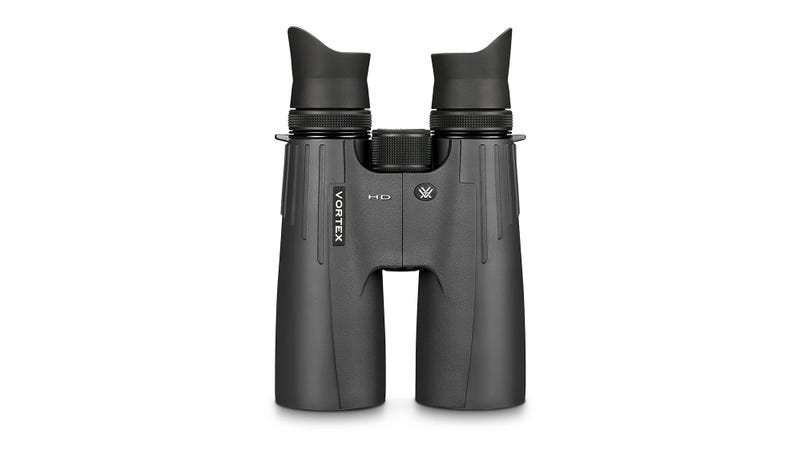
- Exact product-page gallery front view; official 800x450 JPEG retrieved and visually inspected

Choose your optical trade-off first.
Choose viewing purpose first, then magnification, objective size, scene width and any fit, weather or mounting constraint. A direct-Sun requirement is separate: only exact manufacturer-confirmed solar binoculars can pass it.
Your needs, this model
Binoculars with manual known-size ranging reticles
Choose it when: Consider this exact RGR-303 if you want a 10x view with a manually read mrad scale and four secondary silhouette aids. The manual says to compare the scale with an object of known dimensions; the silhouettes rely on assumed common dimensions rather than a laser return.
Binoculars with manual known-size ranging reticles →