
On this page
Your needs, this model
Does it fit your priorities?
Are you deliberately choosing 18x power with a narrow 194-foot field for distant, mostly stationary targets?
KAI-5618 is fixed 18x56 and lists 194 feet at 1,000 yards (3.7°); it is not the wide-scanning choice for fast-moving nearby subjects.
Explore this need in the finder →Must the manufacturer confirm at least 17 mm of eye relief for your glasses?
The exact page and manual list 16.4 mm. Try the model with your own eyewear; it cannot meet a strict 17 mm published-spec threshold.
Explore this need in the finder →Does the package need to include binocular tripod-adapter equipment?
The page lists a Sport Binocular Adapter and the KAI-5618 sheet lists a UNI-DAP Uni-Daptor tripod adapter. A tripod is not listed as included.
Explore this need in the finder →The Vortex Kaibab HD 18x56 (KAI-5618) is a high-power binocular for steady views of distant terrain or wildlife. Its narrow field, 43.5-ounce body and 19.8-foot close focus make it a poor substitute for a light walking or quick-scanning pair.
Reach comes at the cost of a narrow window
Vortex lists a 3.7-degree field, or 194 feet at 1,000 yards. That is a small slice of a landscape: finding and following a moving subject takes more deliberate panning than with a wider 8x or 10x pair. Eighteen-power magnifies hand movement, and Vortex recommends tripod use. This is for stationary glassing, not casual walking observation.
The 56 mm objectives do not guarantee a bright view. Dividing 56 mm by 18x gives a geometric exit pupil of about 3.1 mm, not a brightness measurement. This may suit daylight glassing over open terrain, but objective diameter alone does not make it an automatic low-light choice.
Support is recommended, and one useful part is included
At 43.5 ounces—about 2.7 pounds before the case, strap and support—this is a substantial binocular. The product page recommends a tripod and lists a “Sport Binocular Adapter” in the box; the SKU sheet lists an in-box “UNI-DAP Uni-Daptor Tripod Adaptor.” A tripod itself is not included. Check your support's compatibility rather than assuming an adapter is the same as stabilization.
Vortex’s Razor UHD 18x56 lists the same 194-foot field but a 10-foot close focus, compared with 19.8 feet here. Its package does not list a tripod adapter; Kaibab package documentation does. The choice is between documented close-focus and included-adapter differences, not an independent performance test.
Check dimensions and eye fit before a long session
The listed dimensions are 7.7 by 5.7 inches, eye relief is 16.4 mm and interpupillary distance spans 60–76 mm. Its eye relief is shorter than the Razor UHD 18x56's listed 18 mm. Glasses wearers should test their own frames; a published figure cannot guarantee a full-field view. Check the 60 mm minimum interpupillary distance if the binocular will be shared.
The 19.8-foot closest-focus figure rules out nearby feeder viewing. The narrow field and high power also make small, fast-moving birds harder to find than with a lower-power pair.
Set it up and care for it as the manual describes
The linked manual explains IPD adjustment, twist-up/down eyecups, center focus and the separate right-eye diopter. It recommends focusing on a target about 20 yards away, covering one objective at a time; the listed diopter range is ±3. Set the diopter once before relying on the center wheel for ordinary refocusing.
The page lists HD optics, XR Plus coatings, APO technology, ArmorTek protection and argon purging, plus waterproof, fogproof and shockproof claims. It gives no IP code or immersion depth. ED glass is not named for this SKU, so “HD” and “APO” do not confirm an ED requirement. The manual warns against looking at the Sun; this is not solar-filtered.
Who should choose the KAI-5618?
Choose the Kaibab HD 18x56 if high magnification for a distant, mostly stationary view is the central requirement, you are comfortable with a narrow field, and you intend to use a tripod or another compatible support. Its specified adapter inclusion is useful for that plan. Pick a lower-power binocular for broad landscape scanning, frequent hand-held use, travel, close subjects or fast birds; pick a different documented model if a wide field, at least 17 mm eye relief or named ED glass is essential.
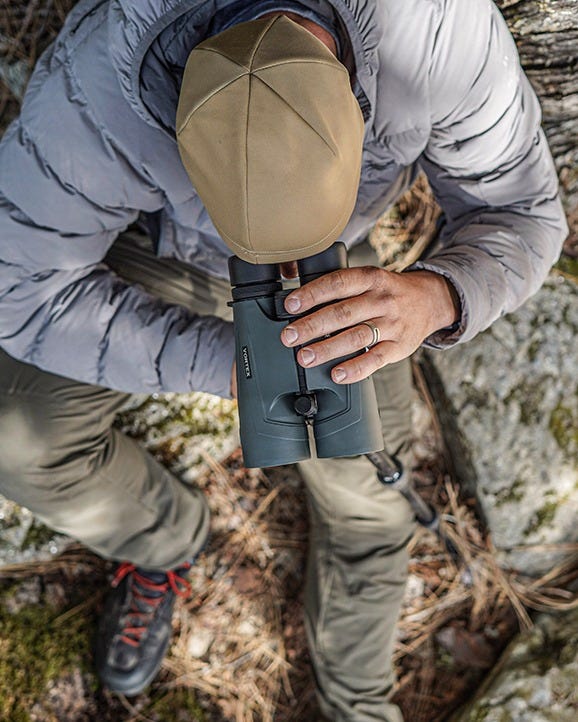
This assessment uses Vortex’s exact KAI-5618 U.S. product page, its linked Kaibab HD manual and the KAI-5618 XVIEW parts sheet. The page calls the supplied adapter “Sport,” while the sheet calls it “UNI-DAP”; both identify tripod-adapter equipment in the package, and the different names are retained rather than silently normalized. The manual link filename says M-00093-0, although the PDF footer and XVIEW in-box listing identify M-00093-1; the linked PDF itself contains the 18x56 specifications used here. The page-linked photograph shows a person using a Vortex binocular, but no readable power marking; Vortex does not state whether the image is a photograph or rendering. This is a source-based assessment, not an ownership or field-test report. See the Kaibab HD 18x56 product page, linked manual, and KAI-5618 parts and package sheet.
Key specifications
Key details at a glance
| Magnification | 18× |
|---|---|
| Objective diameter | 56 mm |
| Real field of view | 3.7° |
| Eye relief | 16.4 mm |
| Exit pupil | 3.1 mm |
| Close focus distance | 19.8 ft |
More specifications and setup details
| Manufacturer-published weight | 43.5 oz |
|---|---|
| Phase coatings confirmed | Yes |
| Locking diopter ring confirmed | Yes |
| Lens and prism coatings | The exact product page lists the HD optical system, XR Plus anti-reflective coatings on all air-to-glass surfaces, APO technology, phase correction, and ArmorTek exterior protection. It does not explicitly identify ED glass or prism type for this exact SKU. |
| Water and fog protection | The page names waterproof, fogproof and shockproof protection and argon-gas purging; no IP rating or immersion depth is specified, so underwater use is not confirmed. |
| Tripod use | Vortex recommends tripod use. The exact product page lists a Sport Binocular Adapter in the box; the SKU sheet lists a UNI-DAP Uni-Daptor tripod adapter. The tripod itself is not listed as included. Keep the manufacturer's two adapter names visible rather than asserting an unverified equivalence. |
| Published weight note | Exact page and linked manual both list 43.5 oz; this is the manufacturer-published instrument value, not a weighed specimen or packed system weight. |
| Manufacturer-rated waterproof | Yes |
| Tripod adapter in package | Yes |
Use the exact model’s instructions for operating limits, supplied equipment and version differences.
Sources for this review
Sources for this assessment
- Vortex U.S. exact product page, Kaibab HD 18x56, SKU KAI-5618
- Seven-page Kaibab HD operation manual linked by the exact product page; page 2 contains the 18x56 specification table and pages 3–4 give user setup and cleaning instructions.
- KAI-5618 XVIEW parts and in-box accessories sheet; identifies the exact 18x56 SKU and UNI-DAP Uni-Daptor tripod adapter in the package.
- SKU-named official image linked from the exact KAI-5618 U.S. product-page gallery; model marking is not legible in the pictured use scene.
- Dated SaferProducts.gov ProductName queries for exact SKU and exact model title; empty responses are retrieval results, not recall clearance.
- Official Vortex U.S. binocular category page 1, observed row p1-r10; reconciled to exact Kaibab HD 18x56 page and SKU KAI-5618.

Choose your optical trade-off first.
Choose viewing purpose first, then magnification, objective size, scene width and any fit, weather or mounting constraint. A direct-Sun requirement is separate: only exact manufacturer-confirmed solar binoculars can pass it.