
On this page
Your needs, this model
Does it fit your priorities?
Are you choosing the 15x56 Kaibab for the broader scene compared with the 20x56 sibling?
The exact KAI-5602 page lists 215 ft at 1,000 yd (4.1°). The KAI-5603 20x56 page lists 168 ft (3.2°); both are narrow, high-power views rather than wide scanning binoculars.
Explore this need in the finder →Will the listed 15 mm eye relief meet your minimum, especially with glasses?
The exact product page says 15 mm. It meets a 15 mm numeric minimum but not 15.5 mm; trying the eye position with your own glasses is still necessary.
Explore this need in the finder →Is the included tripod adapter sufficient, or must a direct standard 1/4-20 port be confirmed?
The exact KAI-5602 box list includes the Uni-Daptor Quick-Release Tripod Adapter and the manual confirms tripod-adapter compatibility. A tripod is not listed, and a direct 1/4-20 binocular port is not established; a strict direct-port requirement does not pass.
Explore this need in the finder →Vortex Kaibab HD 15x56 (KAI-5602) review
The Kaibab HD 15x56 is a long-range tool, not a general-purpose pair for every outing. The exact U.S. Vortex page identifies SKU KAI-5602 and lists fixed 15x magnification, 56 mm objectives, a 4.1-degree real field (215 feet at 1,000 yards), 15 mm eye relief, 23-foot close focus and 43.5-ounce instrument weight. It also lists a Uni-Daptor quick-release tripod adapter in the box. Vortex places this model in its inactive binocular directory, so this is an opt-in reference assessment rather than a current purchase recommendation.
Why choose 15x in a 56 mm body?
Fifteen-power brings distant detail closer than the familiar 8x or 10x field-binocular class, but the trade is visible in ordinary handling: small hand movements are magnified along with the subject. A high-power view is most useful when you can settle into one position, scan slowly and support the barrels. Vortex's Kaibab manual describes the family as a high-magnification instrument to pair with a tripod. That is practical guidance, not a claim that this review measured steadiness or resolution.
The 15x56 sits between two useful reference points. Against the Kaibab HD 20x56, it gives a wider real scene: 215 feet per 1,000 yards instead of 168, and a listed 3.7 mm exit pupil rather than 2.8 mm. Both have the same published 43.5-ounce weight, 15 mm eye relief and 23-foot close focus. Against Vortex's Kaibab HD 18x56, this 15x model also has the wider listed field, 4.1 degrees versus 3.7 degrees. The lower power does not turn either binocular into a fast, wide-angle walking optic; it simply eases the reach-versus-field compromise within this high-power group.
Support and setup matter
KAI-5602's exact box list names the Uni-Daptor quick-release tripod adapter, plus a rainguard, tethered objective covers, comfort neck strap and padded carry case. The tripod itself is not in that list. If you already own a tripod, the supplied adapter addresses an important part of mounting a 15x instrument; if you want a compact handheld binocular, the adapter does not solve the mass or magnification trade-offs.
The shared Kaibab HD manual is useful for fitting and focusing rather than for this model's numeric specifications. Its specification table covers the 18x56, so the 15x56 numbers above come from the exact KAI-5602 page, not from a sibling row. The manual explains how to set interpupillary distance for one undistorted circle, use the twist-up/down eyecups, and separate the right-eye diopter adjustment from center-wheel focusing. It suggests selecting a target around 20 yards away during initial adjustment. Follow the exact two-step sequence instead of using the center wheel to compensate for a mismatched diopter.
Limits worth checking before you look for one
At 43.5 ounces before the case, strap or support gear, this is not a light day-hike choice. Its 7.7-inch height and 5.7-inch width are substantial dimensions, and the 23-foot near-focus limit makes nearby insects, feeders or close woodland subjects poor matches. The 4.1-degree field is still much narrower than a broad-scene threshold of six degrees. For locating moving birds or tracking action, the magnification can make acquisition harder even though it can help inspect a distant, settled subject.
Eye relief is listed at 15 mm. That is a number to compare, not a promise that every glasses wearer will see the full field; eye socket depth, eyecup position and frame shape matter. The exact specification table does not establish an immersion rating or a waterproof depth, so do not treat its unknown weather status as proof of waterproofing. Nor should the 56 mm objective alone be read as a low-light-performance measurement. This assessment makes no independent optical test, specimen weighing or image-quality claim.
Image and exact-model note
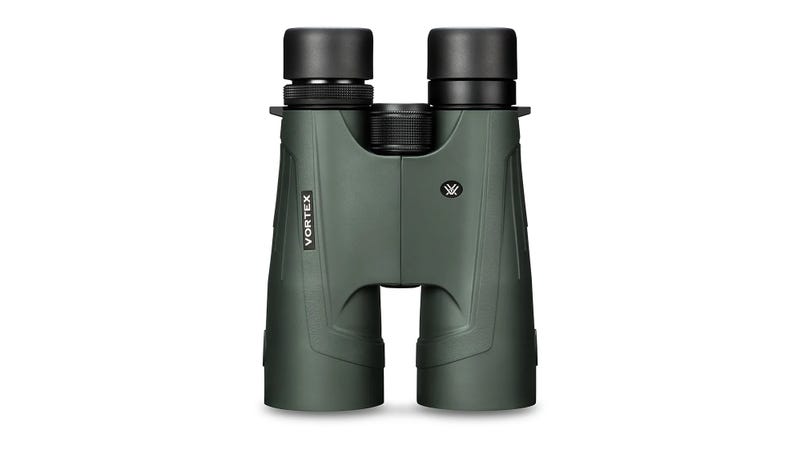
The displayed Vortex image is a shared Kaibab HD 56 mm family view used on the exact 15x56 and 20x56 product pages. It shows the binocular body but no readable power marking; use the model specifications and SKU, not the picture, to distinguish the two powers. Vortex does not disclose whether the gallery image is a photograph or a rendering.
Alternatives and verdict
Choose the Kaibab HD 20x56 only if you accept its tighter 168-foot scene for more fixed magnification. The Kaibab HD 18x56 is another high-power comparison, while an 8x42 or 10x42 pair is a more sensible starting point for walking, quick scanning or a lighter carry. Compare exact fields, eye relief, weight and support needs rather than assuming that equal 56 mm objectives make these configurations interchangeable.
The KAI-5602 is most defensible for a stationary observer who specifically wants 15x reach, can tolerate the substantial weight and will use the supplied adapter with a separate tripod. It is a poor match when wide field, close focus, confirmed waterproofing, a light pack or a one-hand handheld view is essential. Because Vortex marks this exact listing inactive, check the present availability and condition of any older example independently; this review does not imply that a new unit is on sale.
Key specifications
Key details at a glance
| Magnification | 15× |
|---|---|
| Objective diameter | 56 mm |
| Real field of view | 4.1° |
| Eye relief | 15 mm |
| Exit pupil | 3.7 mm |
| Close focus distance | 23 ft |
More specifications and setup details
| Manufacturer-published weight | 43.5 oz |
|---|---|
| Locking diopter ring confirmed | Yes |
| Lens and prism coatings | The exact 15x56 page identifies this as a Kaibab HD model but does not give a 15x-specific coating or glass-composition table. No performance test or coating inheritance from another power is asserted. |
| Tripod use | The exact KAI-5602 product page lists a Uni-Daptor Quick-Release Tripod Adapter in the box; the Kaibab HD manual describes a tripod-adapter socket and recommends pairing the high-power binocular with a tripod. A tripod is not in the listed box contents; a direct 1/4-20 port on the binocular is not established. |
| Published weight note | Vortex lists 43.5 oz for the binocular instrument. This is a published specification, not an independent weighing or packed-system weight. |
| Tripod adapter in package | Yes |
Use the exact model’s instructions for operating limits, supplied equipment and version differences.
Sources for this review
Sources for this assessment
- Official Vortex inactive binocular directory page 1, row 5; the card links to the exact Kaibab HD 15x56 U.S. page.
- Exact U.S. Vortex page: Kaibab HD 15x56, SKU KAI-5602; exact power-specific table and standard box list inspected.
- Seven-page Kaibab HD operation manual linked from the exact page. Pages 3-4 describe shared body setup, eyecup/IPD adjustment, focus and care; page 2's numerical table is only for 18x56 and was not used as 15x data.
- Official exact-page gallery image, archived once because the 15x56 and 20x56 pages return identical bytes; it is used as a 56 mm family view, not as a visible 15x marking.

Choose your optical trade-off first.
Choose viewing purpose first, then magnification, objective size, scene width and any fit, weather or mounting constraint. A direct-Sun requirement is separate: only exact manufacturer-confirmed solar binoculars can pass it.