
On this page
Keep the earlier LRF302 mode distinct from LRF301
The Fury HD 5000 AB LRF302 is an inactive earlier profile whose manual documents HCD/BAL modes. That named BAL configuration is not interchangeable with the current-reference LRF301’s HCD/LOS-only manual; verify the exact suffix and availability.
Explore the needs this model fits
Your needs, this model
Does it fit your priorities?
Would you retain an earlier model when integrated ballistic display is essential?
LRF302 is an earlier/inactive 10x42 profile with HCD/BAL, sensors and wind-bearing capture. It is for comparison, not current buying.
Explore this need in the finder →Does this 10x42 size match your observation needs?
The exact LRF302 page lists 10x42, 6.1 degrees and 321 ft per 1,000 yards; ballistic features do not change its fixed optical power.
Explore this need in the finder →Will a 32.5-ounce instrument ceiling fit without counting harness and other kit?
The exact page lists 32.4 oz for the instrument; a 32.3-ounce maximum is more restrictive than the published value.
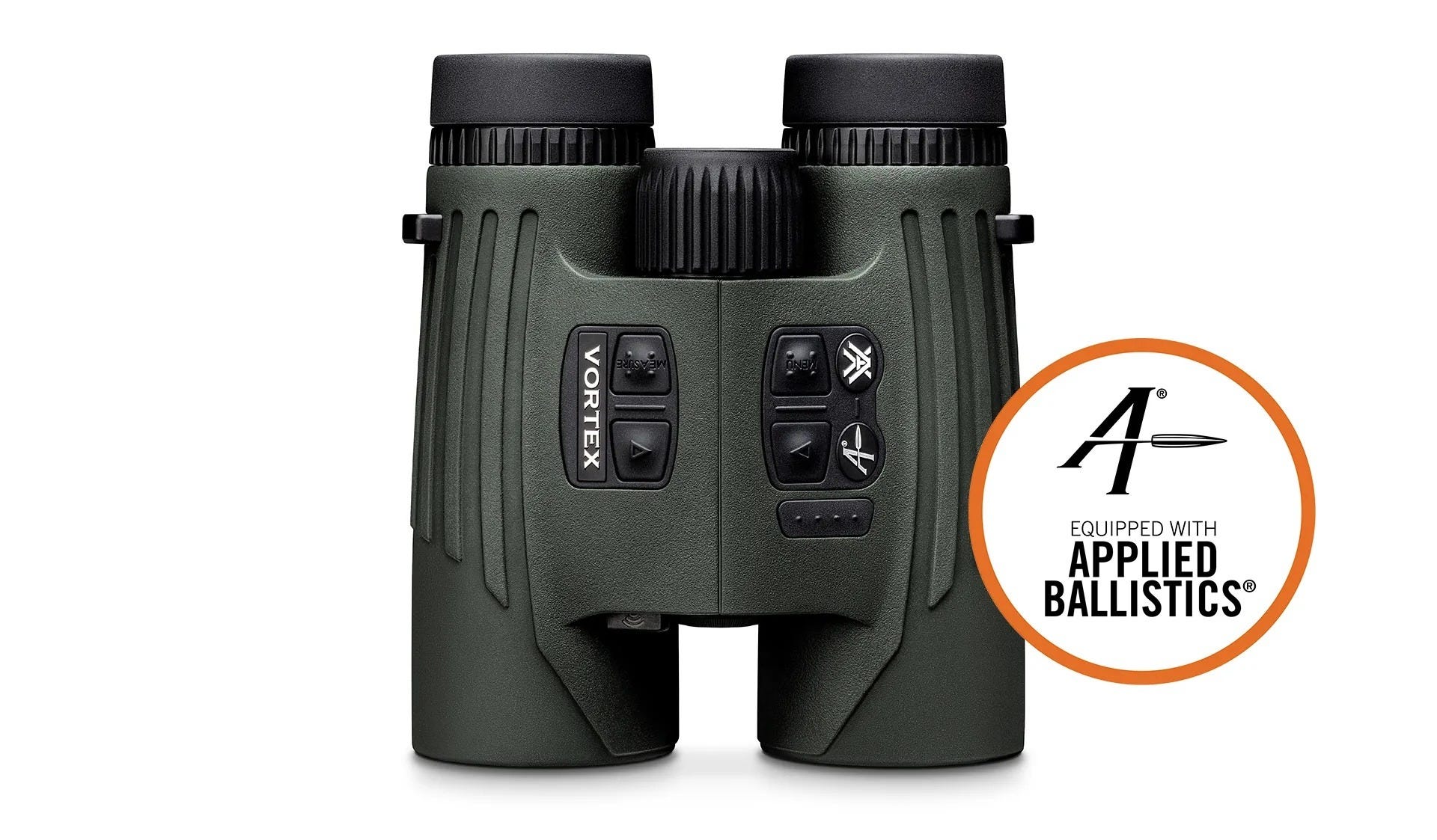
Explore this need in the finder →The Vortex Fury HD 5000 AB 10x42 is a rangefinding binocular with a profile-based ballistic display, environmental sensors and wind-bearing capture. It shares the standard Fury’s 10x42 view and published range ceilings, but the AB changes the operating task: useful output depends on setting up and maintaining a profile and understanding the readings. Vortex’s U.S. page identifies SKU LRF302 as Inactive, so this is an earlier-model reference, not a current purchase recommendation.
The important difference is the display workflow
Both Fury 10x42 versions put optical viewing and laser ranging in one body. The AB page lists a 6.1-degree angular field, 321 feet at 1,000 yards, 16 mm eye relief, 18.5-foot closest focus, 58–72 mm interpupillary adjustment and a 32.4-ounce instrument weight. The standard LRF301 lists the same key optical geometry and 32.3 ounces. A tenth of an ounce should not decide between them; the meaningful difference is the extra data system, controls and setup on the AB.
The AB product manual documents HCD slope-compensated range and BAL ballistic display modes, as well as scan, built-in environmental sensors and a wind-bearing capture function. It also describes Bluetooth pairing with compatible Kestrel and Garmin devices. These features make the AB more specialized, not automatically more accurate or simpler. The ballistic manual asks the operator to configure firearm and ammunition information and shows how to create or edit profiles. A displayed solution is only as dependable as the inputs and conditions represented in that profile. Start by matching a known configuration, check the relevant settings and independently validate information before relying on it. A range readout alone is not a ballistic solution, and the standard LRF301 does not become an AB because both products are called Fury HD 5000.
Range limits are target-specific
Vortex lists up to 5,000 yards on reflective targets, 2,400 yards on trees and 1,600 yards on deer, with the page giving a five-yard minimum. These maximums describe different targets and cannot be treated as a single guaranteed reach. A reflective plate and a dark, angled or small animal do not return the same amount of laser energy. Size, surface, angle, visibility, precipitation and how steadily the user holds the sight picture all affect a reading. The figures are manufacturer claims, not independent range tests.
The 10x42 body has a 321-foot field at 1,000 yards and is a reasonable format for scanning and observing while ranging. Its 32.4-ounce listed instrument weight remains much more than a passive 10x42, and the AB’s additional buttons and sensor functions add tasks even though the base optical measurements resemble the LRF301. If your use stops at distance measurement, the standard Fury has HCD and LOS choices without the AB’s documented BAL workflow. If a lighter all-around rangefinder is more important, the Ranger HD 3000 weighs 32.4 ounces and focuses closer, but its maximum range claims are lower and its manual does not document onboard BAL. If you do not need a laser at all, compare passive 10x42 designs before accepting electronic weight and battery dependence.
Setup is part of ownership
The product manual separates the optical view from the electronic reticle: adjust the right-eye diopter and central focus for the scene, then focus the display reticle. It describes HCD and BAL selection, display brightness, scan operation and battery setup. The separate ballistics manual covers profile selection and editing, the app connection, measured environmental inputs, wind capture and optional pairing with supported external devices. The app is an aid to profile management, not proof that a profile is correct. The manuals list default example profiles such as .308 Winchester, 6.5 Creedmoor and 5.56; those examples are not substitutes for your actual firearm, load or verified data.
The Fury AB uses a CR2 battery, and the listed package includes one. The manufacturer does not publish a runtime here. The AB is tripod adaptable, but a tripod adapter is not listed in the core package; plan for the separate accessory if your use depends on a stable mounted position. Its 16 mm stated eye relief may be relevant to glasses, but a number does not guarantee a comfortable full-field view. Try it in your actual viewing position if fit is essential.
What its protection claims do not tell you
The exact page and manual describe the AB as waterproof, fogproof and shockproof and say the housing is nitrogen purged. They do not give an immersion depth or IP rating, so treat those words as weather-protection claims, not permission to submerge it. The manual also warns against looking at the Sun, pointing the laser at a person’s eyes, staring into the beam or disassembling the unit. Its active display and rangefinder require battery power; the passive optics and powered functions should not be confused when planning a trip.
Who should consider this earlier model?
The AB makes sense as a reference when you specifically want one instrument to combine 10x binocular observation, laser ranging, ballistic output and environmental inputs, and you are willing to configure and check the system. It is not the right answer to a simple “longest advertised range” question: its 5,000-yard reflective ceiling is conditional, and other current systems may offer different range modes or ergonomics. It is also a poor fit if you need an active current-production recommendation or do not want to manage profile data.
Vortex’s U.S. exact page marks LRF302 Inactive. The matching toggle for earlier models can preserve it for comparison, but that status should not be mistaken for current stock, warranty terms or a verified retail listing. The manufacturer links product and ballistics manuals whose filenames use M-00275-0 and M-00276-0; the supplied PDF footers read M-00275-1 and M-00276-1 respectively. Follow the newest instructions Vortex provides for the actual unit. See the Vortex Fury HD 5000 AB 10x42 page, its product manual and ballistics manual. No independent optical, laser-range or ballistic testing is claimed.
Key specifications
Key details at a glance
| Magnification | 10× |
|---|---|
| Objective diameter | 42 mm |
| Real field of view | 6.1° |
| Eye relief | 16 mm |
| Exit pupil | 4.2 mm |
| Close focus distance | 18.5 ft |
More specifications and setup details
| Manufacturer-published weight | 32.4 oz |
|---|---|
| Lens and prism coatings | Exact page describes HD optical system and coatings; specific ED-glass and prism-coating fields remain unknown. |
| Water and fog protection | Manufacturer describes waterproof, fogproof and shockproof performance; no IP code or immersion depth is given. |
| Tripod use | Manufacturer calls it tripod adaptable; adapter is not listed in the package. The AB manual says a binocular tripod adapter is needed for mounting. |
| Published weight note | Manufacturer lists 32.4 oz instrument weight; do not treat it as full carry-system weight or an independent measurement. |
| Manufacturer-rated waterproof | Yes |
| Power source | CR2 |
| Integrated laser rangefinder | Yes |
| Onboard ballistic solution display | Yes |
| Maximum reflective-target range (manufacturer) | 5000 yd |
| Maximum tree range (manufacturer) | 2400 yd |
| Maximum deer range (manufacturer) | 1600 yd |
| Minimum range (manufacturer) | 5 yd |
| Tripod adapter in package | No |
Use the exact model’s instructions for operating limits, supplied equipment and version differences.
Sources for this review
Sources for this assessment
- Official Vortex U.S. exact product page, SKU LRF302; category Inactive and availability false in captured page state.
- Official linked 13-page AB manual; filename M-00275-0, delivered PDF footer M-00275-1.
- Official linked 29-page ballistics manual; filename M-00276-0, delivered PDF footer M-00276-1.
- Exact-page-linked original manufacturer image, 1920 by 1123, viewed locally; production method not stated.

Choose your optical trade-off first.
Choose viewing purpose first, then magnification, objective size, scene width and any fit, weather or mounting constraint. A direct-Sun requirement is separate: only exact manufacturer-confirmed solar binoculars can pass it.
Your needs, this model
Include earlier integrated laser-rangefinding binoculars
Choose it when: The exact LRF302 manual documents an HCD/BAL configuration, a distinct earlier output path for users identifying that specific item.
Include earlier integrated laser-rangefinding binoculars →