
On this page
Your needs, this model
Does it fit your priorities?
Do you want 15x magnification with 56 mm objectives?
The exact DB-218 page and SKU sheet identify a fixed 15x56 binocular; the target is not another high-power configuration.
Explore this need in the finder →Is a 35-ounce instrument ceiling acceptable?
Vortex publishes 34.8 oz for DB-218. It fits a 35-ounce instrument cap; that figure is not the full carried kit.
Explore this need in the finder →Do you need at least 15.5 mm listed eye relief?
The exact page lists 15.6 mm eye relief: it meets 15.5 and not 16 mm. This is not a guarantee of glasses fit.
Explore this need in the finder →Vortex Diamondback HD 15x56 binoculars (U.S. SKU DB-218) are a specialized high-power pair for distant, relatively stationary subjects. Their 15x magnification, 56 mm objectives and 230-foot field at 1,000 yards put more reach ahead of broad scanning or easy one-handed carrying. Vortex lists a tripod adapter in the box; a tripod itself is separate.
Fifteen power is the decision, not the 56 mm number
The most important choice is whether 15x is useful for the way you watch. It can make distant ridgelines, wildlife across an open basin or celestial objects appear larger than a 10x or 12x binocular. That enlargement also magnifies hand movement. Even if you can hold the instrument for a quick look, maintaining a relaxed, stable view for a long observation is a different task. For prolonged use, the included adapter makes a firm support part of the practical plan rather than an optional accessory to discover later.
The listed real field is 4.4 degrees, or 230 feet at 1,000 yards. That is narrow beside the 12x50 Diamondback HD's 5.2 degrees and a much wider view than many small high-power instruments? No: it remains a compact window compared with 8x models such as the 8x42, which lists 7.5 degrees. A moving bird can leave a narrow field quickly, and reacquiring it takes practice. If your outing is mostly following birds through branches, scanning shorelines or watching children play, lower power and more field are usually the more forgiving choice.
Large objectives and real carry costs
At 34.8 ounces and roughly 7.1 by 5.8 inches, this is substantially larger than a 42 mm Diamondback HD. The 56 mm front lenses may be attractive for dusk or sky viewing, but objective diameter alone does not prove brighter-looking images. The exit pupil is about 3.7 mm by calculation (56 divided by 15), a geometric figure rather than a measured light-transmission result. Compare the actual viewing environment, steadiness and weight you will carry; do not treat a larger number as a guarantee of useful detail in every condition.
Eye relief is listed as 15.6 mm. That is not a universal glasses-comfort guarantee. If you wear glasses, use the adjustable eyecups as the manual directs and check whether you can see the full field without pressing into the lenses. The interpupillary adjustment spans 59–76 mm, so users outside that range should test a different model. Close focus is 14 feet, making this much less suitable for butterflies, flowers or nearby exhibit details than the 5- or 6-foot close-focus models in the family.
Mounting, weather and setup
The exact page describes the binocular as tripod adaptable and lists a Sport Tripod Adapter in the package. The SKU-specific parts sheet calls its included piece a UNI-DAP Uni-Daptor tripod adaptor. Those names are both preserved here because the manufacturer materials do not establish that they are interchangeable descriptions of one exact part. A tripod is not in the box, and a vehicle-window mount would be another support rather than a substitute adapter. Confirm the exact supplied adapter and mount fit before relying on a particular rig.
Vortex lists a center focus, adjustable eyecups, fully multi-coated lenses, dielectric prism coatings, phase correction and ArmorTek exterior-lens protection. It calls the body waterproof, fogproof and shockproof, argon-purged and O-ring sealed, but publishes no IP code, immersion depth or duration. This is an outdoor binocular, not a documented underwater instrument. No exact-page ED glass claim is established, so a strict ED requirement should not be treated as met. The optics are passive; there is no integrated rangefinder, battery or stabilization system in the verified configuration.
Who should shortlist it
Choose the DB-218 when you expect to observe at long range, can carry a large instrument and will use support for careful viewing. It may be a sensible fit for a fixed lookout, open country or supported astronomy where the narrow field is less troublesome. The 12x50 DB-217 is lighter at 28.9 ounces and shows a wider 5.2-degree field, while the 10x50 DB-216 weighs 30 ounces and lists six degrees. Either gives up some enlargement but may be easier to find and hold on a subject. For handheld general nature use, compare the 8x42 and 10x42 instead: their wider fields, lower weights and shorter close-focus distances suit a different job.
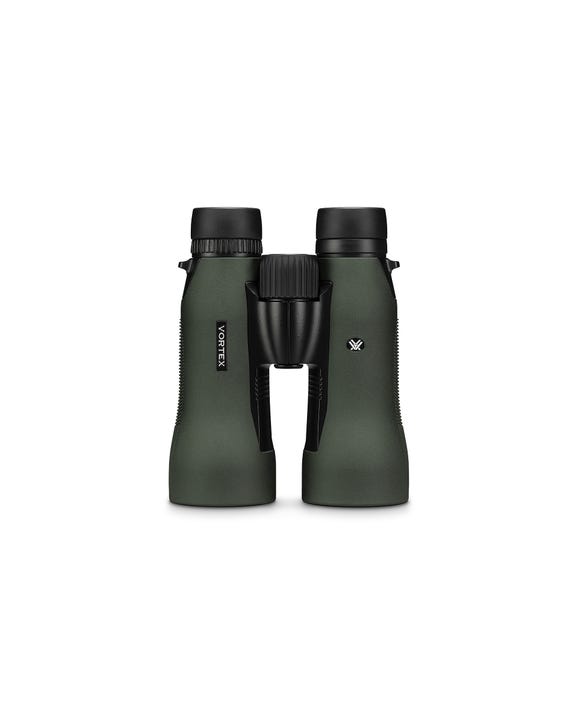
Before buying, check the 34.8-ounce ceiling against your full day’s kit, try the 15.6 mm eye relief, and decide where the adapter and support will travel. The exact manufacturer page routes to “Where to Buy”; that does not establish current store inventory or a particular retail package. The page-linked image has no readable power marking, and Vortex does not disclose whether it is a photograph or rendering. Product identity comes from the exact DB-218 page and its SKU sheet, not image pixels. The manual warns against viewing the Sun; ordinary binoculars must never be pointed at it.
Key specifications
Key details at a glance
| Magnification | 15× |
|---|---|
| Objective diameter | 56 mm |
| Real field of view | 4.4° |
| Eye relief | 15.6 mm |
| Exit pupil | 3.73 mm |
| Close focus distance | 14 ft |
More specifications and setup details
| Manufacturer-published weight | 34.8 oz |
|---|---|
| Phase coatings confirmed | Yes |
| Lens and prism coatings | Vortex lists fully multi-coated lenses, dielectric prism coatings, phase correction, ArmorTek exterior-lens protection and its HD Optical System. The exact page does not explicitly identify ED glass. |
| Water and fog protection | Vortex describes the exact HD model as waterproof, fogproof and shockproof, argon-purged and O-ring sealed. The page supplies no IP code, immersion depth or duration; underwater use is not established. |
| Tripod use | A tripod is not listed as included. Adapter availability is SKU-specific; exact DB-218 page/XVIEW list an adapter, other exact HD SKU box lists do not. |
| Published weight note | Manufacturer-listed instrument weight only; not independently measured and excludes carrying kit. |
| Manufacturer-rated waterproof | Yes |
| Built-in image stabilization confirmed | No |
| Integrated laser rangefinder | No |
| Onboard ballistic solution display | No |
| Tripod adapter in package | Yes |
Use the exact model’s instructions for operating limits, supplied equipment and version differences.
Sources for this review
Sources for this assessment
- Official Vortex U.S. exact product page, Vortex Diamondback HD 15x56, SKU DB-218
- Official Vortex SKU-specific DB-218 parts and in-box XVIEW sheet
- Official Vortex-linked Diamondback HD owner manual, page/in-box label M-00253-0; PDF footer M-00253-1
- Official Vortex gallery image linked from the exact DB-218 page; archived native product-image asset
- Official Vortex U.S. binocular category page 2, item 9; item manually matched to exact product page

Choose your optical trade-off first.
Choose viewing purpose first, then magnification, objective size, scene width and any fit, weather or mounting constraint. A direct-Sun requirement is separate: only exact manufacturer-confirmed solar binoculars can pass it.