
On this page
Your needs, this model
Does it fit your priorities?
Do you specifically want the earlier Classic 12x50 D5012 configuration?
The exact U.S. page and inactive-directory record identify D5012. Opt into earlier models and choose 12x with 50 mm objectives; this is not the similarly named DB-207 or HD DB-217.
Explore this need in the finder →Is the listed 18 mm eye relief enough for your specification?
The exact D5012 page lists 18 mm. A minimum of 18 mm passes that numeric screen; 18.5 mm does not. Neither figure guarantees full-field viewing through your own glasses.
Explore this need in the finder →Is optional tripod adaptation acceptable, or must its adapter be in the box?
The linked manual shows an adapter socket but the exact-page box list does not include an adapter. It passes a tripod-compatibility requirement if separate support is acceptable; it fails a requirement that the adapter be supplied.
Explore this need in the finder →Vortex Diamondback Classic 12x50 review
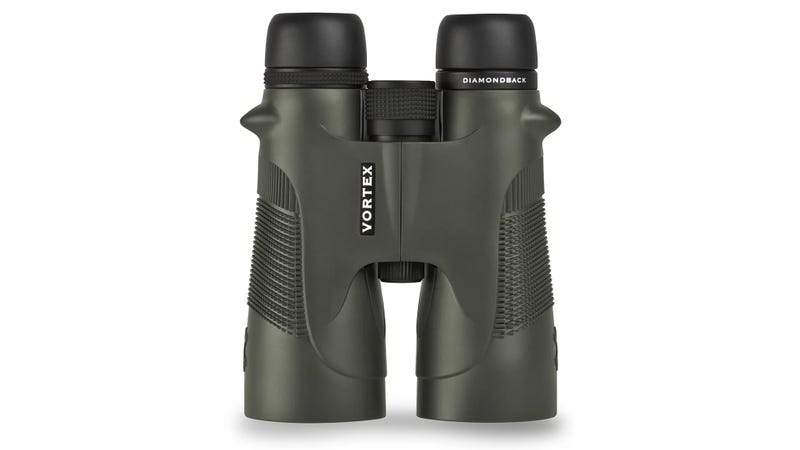
The exact U.S. Vortex listing identifies the Diamondback Classic 12x50 as item D5012 and marks it INACTIVE. Keep this assessment for identifying an existing pair or comparing a particular earlier example; it is not a current buying recommendation. D5012 is not the standard Diamondback 12x50 SKU DB-207 and is not the current Diamondback HD 12x50 DB-217. Similar names and the same 12x50 format do not make their specifications interchangeable.
What the 12x50 format gives you
Vortex lists fixed 12x magnification and 50 mm objectives. That combination makes distant subjects look larger than they do through a 10x instrument, which can help when you are watching a stationary animal across an open area or checking details from a settled observation point. It does not add optical resolution by itself, and extra magnification makes hand movement more noticeable. The 50 mm objective also gives a substantial front end; this is not a compact walk-around binocular.
The published exit pupil is 4.2 mm. It is a geometric ratio, not a measured brightness score or a guarantee of a bright twilight image. Vortex lists a real field of 4.6 degrees, or 241 feet at 1,000 yards. That is a relatively narrow scene for scanning. The earlier standard Diamondback 12x50 DB-207 lists a wider 5.2 degrees and 271 feet at 1,000 yards; the Classic 10x50 D5010 lists 5.4 degrees and 283 feet. The current-reference HD DB-217 also lists 5.2 degrees and 271 feet. These are useful differences when choosing between cards, not laboratory measurements of which view looks better. For following quick birds or searching a crowded canopy, a lower-power, wider-field model is usually the easier direction to compare.
Fit, close focus and carry
D5012's page lists 18 mm of eye relief and an interpupillary adjustment range of 61–74 mm. The first number is relatively generous on paper, but it cannot promise that your glasses will let you see the whole field; frame shape, eye position and eyecup setting matter. Try the exact instrument with your own glasses if edge-to-edge view is important. The minimum IPD is worth checking for a shared pair or a viewer whose eyes need a narrow setting: a requirement below 61 mm is not supported by the published range.
The stated close-focus distance is 9 feet. That can cover many ordinary garden or trail observations, but it is not a close-focus specialist for nearby insects or details at arm's length. Instrument weight is listed as 31 ounces, before case, strap or other carried accessories. A long hike, repeated neck carry or a light travel kit may favor a smaller 8x or 10x model. The build figures here are manufacturer specifications, not independent measurements.
Optics and weather language
Vortex describes fully multi-coated optics, phase-corrected prisms, waterproof and fogproof construction, and rubber armor. Those claims make the Classic more plausible for ordinary outdoor use than an unprotected indoor optic, but the exact page does not publish an IP code or a depth-and-duration immersion rating. Do not translate general waterproof wording into permission to submerge it or rinse it under pressure. The same page does not identify ED glass, prism glass, dielectric coating or a gas-purge type, so those features should remain unknown rather than be borrowed from a similarly named HD model.
Phase correction and full multi-coating are specific design claims, not a promise of measured resolution, edge sharpness or low-light performance. The 12x power, 4.2 mm exit pupil, field width and your ability to hold the binocular steady all affect what is practical. If confirmed ED glass, built-in stabilization or a quantified water rating is essential, this page does not establish that need for D5012.
Handheld use and a tripod plan
This is a passive fixed-power binocular: the exact listing does not describe a laser rangefinder, variable zoom or image stabilization. At 12x, a small shake can move the subject noticeably; the 31-ounce body is a real tradeoff rather than a stabilizer. The linked Diamondback manual shows an adapter socket, so tripod adaptation is supported, but the adapter is not in the listed D5012 package. A tripod plan therefore also needs a compatible separately acquired adapter. If the adapter must arrive in the box, this configuration does not meet that requirement.
The product page names a rainguard, tethered objective covers, comfort neck strap and deluxe padded case. The linked manual describes setting the eyecups and interpupillary distance, focusing with the center wheel and right-eye diopter, and caring for the lenses. Those instructions help with ordinary setup; the manual's shared family scope is not a replacement for the exact page's D5012 numerical specifications.
How to use the questionnaire result
With earlier models left off, D5012 should stay out of the comparison even when 12x and 50 mm look like a match. Opt in to earlier models, then choose 12x and 50 mm to see it beside the distinct DB-207 and DB-217 profiles. A 10x preference removes D5012. If the 18 mm published eye-relief figure is your minimum, it passes that numerical screen; a higher minimum does not. A 31-ounce ceiling accepts the listed bare instrument, while a lighter limit rejects it. Confirmed waterproof construction, phase correction and tripod compatibility are documented, but requiring ED glass or image stabilization cannot be satisfied by an unknown claim or absent feature. Requiring the tripod adapter in the box also rejects it.
The INACTIVE label is the decisive purchase caveat. No current stock, condition, included accessories on a used example, or service outcome for a particular pair is established here. If you already own one, the page and manual help identify its configuration. If you are evaluating an older listing, verify that the item is D5012 rather than DB-207 or DB-217 and inspect the actual unit and package; use a current model for a present-day shortlist.
Key specifications
Key details at a glance
| Magnification | 12× |
|---|---|
| Objective diameter | 50 mm |
| Real field of view | 4.6° |
| Eye relief | 18 mm |
| Exit pupil | 4.2 mm |
| Close focus distance | 9 ft |
More specifications and setup details
| Manufacturer-published weight | 31 oz |
|---|---|
| Phase coatings confirmed | Yes |
| Lens and prism coatings | The exact Classic D5012 page lists fully multi-coated optics and phase-corrected prisms. It does not identify ED glass, dielectric coatings, prism glass or a gas-purge type; Diamondback HD claims are not transferred. |
| Water and fog protection | The exact page describes waterproof and fogproof construction and rubber armor, but gives no IP code or immersion depth/duration. Nitrogen/argon purge and shock resistance are not claimed here. |
| Tripod use | The identical #BIN-DBK-12A manual linked from D5012 shows a tripod-adapter socket. The exact D5012 box list does not include an adapter; the compatible adapter model is not specified in this record. |
| Published weight note | The exact D5012 page lists 31 oz for the instrument. Case, strap and other carried items are not included in that listed figure; it is not independently measured. |
| Manufacturer-rated waterproof | Yes |
| Built-in image stabilization confirmed | No |
| Integrated laser rangefinder | No |
| Onboard ballistic solution display | No |
| Tripod adapter in package | No |
Use the exact model’s instructions for operating limits, supplied equipment and version differences.
Sources for this review
Sources for this assessment
- Official Vortex inactive-binocular directory, page 4 card 1, observed Diamondback Classic 12x50 with item ID D5012
- Official Vortex U.S. Diamondback Classic 12x50 product page, SKU D5012, INACTIVE
- Official Vortex-linked Diamondback binocular owner manual, code #BIN-DBK-12A; identical linked URL reused from the prior DB-207 archival review
- Vortex image linked from the exact D5012 U.S. product page

Choose your optical trade-off first.
Choose viewing purpose first, then magnification, objective size, scene width and any fit, weather or mounting constraint. A direct-Sun requirement is separate: only exact manufacturer-confirmed solar binoculars can pass it.