
On this page
Your needs, this model
Does it fit your priorities?
Do you specifically want the earlier Diamondback 10x50 DB-206 configuration?
Opt into earlier models and choose ordinary viewing, fixed 10x and 50 mm objectives. The exact U.S. page identifies SKU DB-206 and labels it INACTIVE.
Explore this need in the finder →Is at least 17 mm of listed eye relief enough for your specification?
The exact page lists 17 mm; that meets a 17 mm threshold but does not guarantee full-field eyeglass fit.
Explore this need in the finder →Do you need to keep the bare instrument at or below 30 ounces?
Vortex lists the DB-206 at 29.6 oz before case, strap and other carry items; the value is manufacturer-published, not independently weighed.
Explore this need in the finder →Must the minimum close-focus distance be seven feet or less?
The exact DB-206 page lists seven feet; a six-foot limit is tighter than the published figure.
Explore this need in the finder →Is tripod adaptability enough, or must the adapter be supplied?
The exact-page-linked manual shows an adapter socket, while the exact package list names no adapter. A separate adapter is required.
Explore this need in the finder →Vortex Diamondback 10x50 review
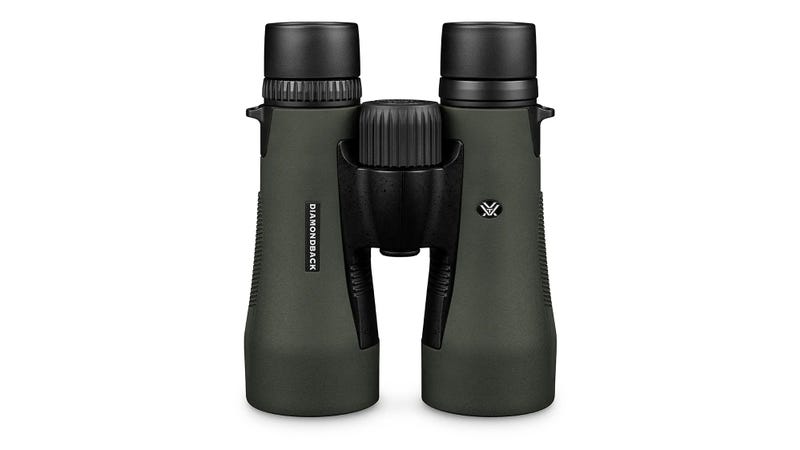
The exact U.S. Vortex page identifies this binocular as Diamondback 10x50, SKU DB-206, and marks it INACTIVE. Keep this review for identifying an existing example or comparing older configurations, not as a current buying recommendation. It is not the Diamondback Classic D5010 or the Diamondback HD DB-216: their names, product identifiers, and some published specifications differ.
What the 10x50 format is for
DB-206 combines fixed 10-power magnification with 50 mm objectives. Ten power gives more apparent reach than an 8x binocular, while the 50 mm front lenses collect a larger geometric entrance pupil than a 42 mm model at the same power. Vortex lists a 5 mm exit pupil. That is a ratio of objective diameter to magnification, not a measured transmission score or promise that the view will look brighter in every condition. More glass also means a larger instrument to carry.
The official table gives a 6-degree real field, or 315 feet at 1,000 yards. That is useful when sweeping a broad hillside or locating wildlife across open ground, though it does not make a 10x view as forgiving to aim as lower power. The published close focus is 7 feet, so the format can handle some nearby garden subjects but is not a substitute for a close-focus specialist. Vortex lists 29.6 ounces for the instrument and 6.7 by 5.5 inches for its height and width. Those dimensions and weight put this firmly in a full-size kit; budget additional space and carrying load for the case and strap.
Separate it from the similarly named 10x50s
The standard Diamondback DB-206 and Diamondback HD DB-216 share a 315-foot field, 17 mm stated eye relief, 60–75 mm interpupillary range, and 7-foot close focus on their respective U.S. pages. Their listed instrument weights and bodies are close, not identical: DB-206 is listed at 29.6 ounces and 6.7 by 5.5 inches; the HD page lists 30 ounces and 6.6 by 5.3 inches. Those small numerical differences will not settle an optical comparison. The pages use different model names and SKUs, and DB-206 is the one clearly marked inactive here.
Do not confuse this profile with Diamondback Classic D5010. The Classic page lists a narrower 283-foot field, 19 mm eye relief, nine-foot close focus, and 31-ounce instrument weight. If eye relief or close focus is a deciding number, compare the exact label on the binocular and use the matching specifications rather than shopping by the shared “Diamondback 10x50” phrase. These are manufacturer figures, not independent measurements or a claim that one unit will look better through your eyes.
Eye placement, focus and weather limits
Vortex lists 17 mm of eye relief and an interpupillary range of 60–75 mm. A 17 mm minimum can pass a numerical questionnaire threshold of 17 mm, but it cannot guarantee that every glasses wearer will see the full field; eyeglass shape, eye position and eyecup setting matter. Try the exact binocular with your own frames if that fit is essential. The linked Diamondback manual explains setting the eyecups and interpupillary distance, then setting one-eye diopter focus and using the center wheel to refocus for distance.
The product page describes a fully multi-coated, dielectric optical system and lists nitrogen gas purging and rubber armor. It does not identify the prism type, prism glass, ED glass or phase-correction coating. Nor does this page give a waterproof claim or quantified immersion rating. Nitrogen purging is a real listed feature, but it should not be turned into an unlisted waterproof rating. If ED glass, confirmed phase correction, or waterproof construction is essential, leave this model out unless separate evidence for the exact DB-206 establishes that need.
Tripod use and the included kit
The exact box list includes an eyepiece rainguard, tethered objective covers, a comfort neck strap and deluxe padded carry case. The manual linked from this page is the same already archived five-page Diamondback manual, code #BIN-DBK-12A; it shows the tripod-adapter socket and covers ordinary care, but is not a numerical specification table for DB-206. A tripod can steady 10x viewing from a settled position, yet the adapter is not in the product page’s included-items list. If your plan requires tripod support, allow for a separately compatible adapter; if the adapter must be supplied in the box, this configuration does not meet that requirement.
How questionnaire choices change the match
Leave “earlier or discontinued models” off and DB-206 should not appear among ordinary recommendations, even if 10x and 50 mm fit your preferred format. Opt in to earlier models, then the exact DB-206 identity can be compared. A 17 mm minimum eye-relief request and a 30-ounce ceiling fit its published figures; a 17.5 mm floor or a 29-ounce ceiling do not. A maximum close-focus distance of 7 feet is met by the listed number, while 6 feet is not. Essential ED-glass, phase-correction or waterproof requests cannot be satisfied by features the exact page leaves unspecified.
For a present-day shortlist, compare current 10x42 and 10x50 options instead of treating the inactive SKU as available. If inspecting a used pair, check the engraving and included accessories on the physical unit: this review does not establish current stock, the condition or completeness of a particular used example, recall clearance, warranty transfer, or service outcome.
Key specifications
Key details at a glance
| Magnification | 10× |
|---|---|
| Objective diameter | 50 mm |
| Real field of view | 6° |
| Eye relief | 17 mm |
| Exit pupil | 5 mm |
| Close focus distance | 7 ft |
More specifications and setup details
| Manufacturer-published weight | 29.6 oz |
|---|---|
| Lens and prism coatings | The exact DB-206 page calls its optical system enhanced, dielectric and fully multi-coated. It does not identify prism type, ED glass or phase-correcting coating, and its wording does not assign the dielectric claim to a specific element. |
| Water and fog protection | The exact page lists nitrogen gas purging and rubber armor but makes no waterproof/fogproof claim and gives no IP code or immersion depth/duration. Nitrogen purge does not establish a quantified water rating. |
| Tripod use | The exact-page-linked #BIN-DBK-12A manual shows a tripod-adapter socket. The exact DB-206 in-box list does not include an adapter; its model number is not established here. |
| Published weight note | Vortex lists 29.6 oz for the DB-206 instrument. This is the manufacturer-published figure, not an independent measurement; the case and carry items are not instrument weight. |
| Built-in image stabilization confirmed | No |
| Integrated laser rangefinder | No |
| Onboard ballistic solution display | No |
| Tripod adapter in package | No |
Use the exact model’s instructions for operating limits, supplied equipment and version differences.
Sources for this review
Sources for this assessment
- Official Vortex U.S. inactive-binocular directory, page 4 card 2; exact embedded item ID DB-206 links to Diamondback 10x50
- Official Vortex U.S. Diamondback 10x50 exact product page, SKU DB-206, marked INACTIVE
- Official Vortex exact-page-linked Diamondback binocular owner manual, code #BIN-DBK-12A; reuses identical already archived bytes
- Official Vortex 800x450 image linked from exact DB-206 U.S. product page

Choose your optical trade-off first.
Choose viewing purpose first, then magnification, objective size, scene width and any fit, weather or mounting constraint. A direct-Sun requirement is separate: only exact manufacturer-confirmed solar binoculars can pass it.