
On this page
Your needs, this model
Does it fit your priorities?
Should this earlier DB-205 be considered alongside current models?
Only if you opt into earlier products: the exact U.S. page identifies SKU DB-205 and marks it INACTIVE.
Explore this need in the finder →Does the stated 15 mm eye-relief figure meet your minimum?
It meets a 15 mm numeric floor, not 15.5 mm; neither number proves full-field fit with your glasses.
Explore this need in the finder →Must the bare instrument stay at or below 22 ounces?
The manufacturer lists 21.4 oz for the binocular itself, before its carry kit. It meets 22 oz but not a 21 oz ceiling.
Explore this need in the finder →Is a seven-foot close-focus limit sufficient?
Vortex lists 6.7 ft; that meets a 7 ft ceiling but not 6.5 ft.
Explore this need in the finder →Do you require a confirmed waterproof construction claim?
The exact page lists nitrogen purging but no water rating. If waterproofing is essential, this unknown does not qualify.
Explore this need in the finder →Is confirmed ED glass essential?
The exact page does not identify ED glass; do not infer it from “enhanced” or “dielectric.”
Explore this need in the finder →Is roof-prism phase correction essential?
The exact page does not state prism type or phase correction; its dielectric wording does not answer this need.
Explore this need in the finder →Must tripod adaptation be confirmed for this exact model?
The page-linked manual diagram is representative and the product page makes no model-specific tripod claim; essential tripod support remains unconfirmed.
Explore this need in the finder →Vortex Diamondback 10x42 review: earlier SKU DB-205
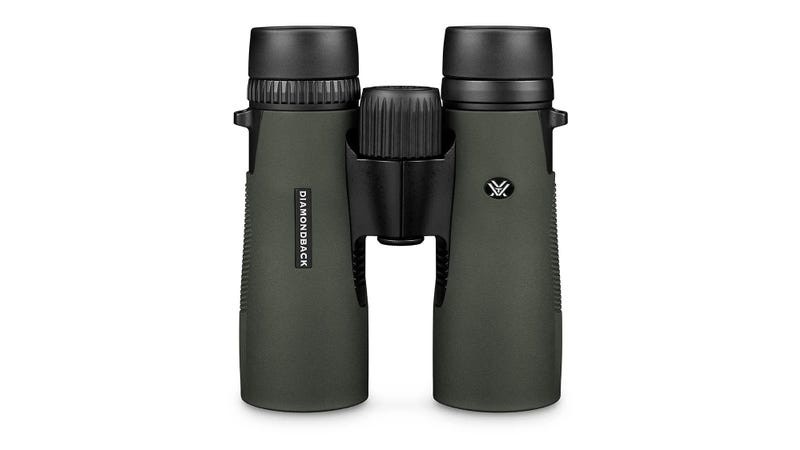
This is the standard Vortex Diamondback 10x42 binocular identified on Vortex’s U.S. product page as SKU DB-205. The manufacturer marks that exact page INACTIVE, so this review is for identifying an existing pair or comparing an older configuration—not a current purchase recommendation. It is not the Diamondback Classic D241 or the later Diamondback HD DB-215; similar names do not make their features interchangeable.
What the 10x42 format asks you to trade
DB-205 combines fixed 10-power magnification with 42 mm objectives. Vortex lists a 6.3-degree angular field and 330 feet at 1,000 yards. That is a useful amount of reach for distant wildlife or a field across a sports ground, while the published field is more generous than the 315-foot figure on the earlier 10x50 DB-206. Ten power also makes hand movement more visible than it would be at lower magnification; there is no image-stabilization system here. A steady stance matters, and this is not the model to choose if a broad, easy-to-scan view is your first priority.
The listed 4.2 mm exit pupil follows the 42 mm objective divided by 10x magnification. It describes geometry, not a brightness test. Compared with the 10x50 DB-206’s listed 5 mm exit pupil, this 10x42 is the smaller, lighter option on paper, but its smaller aperture gives less geometric margin in dim viewing. The exact page does not provide transmission measurements, so the manufacturer’s low-light language should not be read as a lab result or a guarantee at dusk.
Eye placement, close focus and carry weight
Vortex lists 15 mm eye relief, an interpupillary range of 55–75 mm, a 6.7-foot close-focus distance, and a 21.4-ounce instrument weight. The weight is the maker’s published instrument figure, not an independent weighing of a sample; it does not include the padded case, strap or loose accessories. The body is listed at 5.8 inches high by 5.1 inches wide. It is a conventional full-size 42 mm binocular, not a pocket compact.
Fifteen millimeters of stated eye relief may be workable for some eyeglass wearers but is not a promise of full-field viewing with every frame. The page does not state a usable-eye-relief test, and the linked general Vortex binocular manual says eyecup arrangements vary by model. Try the actual pair with your glasses if that fit is essential. A 6.7-foot minimum focus is adequate for many farther subjects, but it will not focus as close as binoculars whose published minimum is five feet; butterflies, nearby feeders and other close subjects may be a poor match.
Coatings and weather limits: keep the claims separate
The exact DB-205 page describes an enhanced optical system with dielectric and fully multi-coated lenses, and lists nitrogen gas purging and rubber armor. Those are the manufacturer’s listed features, not measurements from our own optical or impact testing. The page does not identify the prism type, ED glass, phase correction, or an immersion or waterproof rating. It also does not explicitly establish fogproof or shockproof performance. Nitrogen purging by itself is not a water-resistance specification, so do not use the word “weatherproof” as a substitute for evidence.
Vortex’s page-linked five-page binocular manual is useful for general care and adjustment: its diagrams and text discuss eyecups, focus, diopter adjustment and lens cleaning. However, it labels the illustrations as representative and warns that product appearance varies. One generic diagram labels a tripod-adapter socket; that does not establish that DB-205 itself has a socket or identify a compatible adapter. The exact product-page box list names a rainguard, tethered objective covers, comfort neck strap and deluxe padded carry case, but no adapter. If a confirmed tripod mount is essential, this profile cannot answer that requirement from the available model-specific evidence.
How to use the comparison
Choose an earlier-model comparison only if you deliberately want to consider inactive configurations. With that choice and a 10x42 preference, DB-205 is a plausible reference match. Its listed 15 mm eye relief meets a 15 mm numeric floor, but not a 15.1 mm floor; neither threshold proves eyeglass fit. A 22-ounce limit includes its listed instrument weight, while a 21-ounce limit does not. A seven-foot close-focus ceiling accepts the 6.7-foot figure; a stricter 6-foot ceiling rejects it. If you need established waterproofing, confirmed ED glass, roof-prism phase correction, or model-confirmed tripod support as an essential condition, leave DB-205 out rather than turning a missing specification into a pass.
For a current Vortex 10x42 to investigate, compare the distinct Diamondback HD DB-215 page: it lists a five-foot close focus and explicitly describes waterproof/fogproof construction and tripod adaptability. Those claims belong to DB-215, not to this inactive DB-205. The earlier Diamondback Classic D241 is another separate 10x42 SKU with its own specification sheet. For a 10x50 comparison, DB-206 has a larger objective, different field and greater listed instrument weight. Verify each exact model number and page rather than selecting by the Diamondback name alone.
Bottom line
DB-205’s 10x42 format, 330-foot listed field and sub-22-ounce published instrument weight explain why an existing pair may still suit someone who values reach without the mass of a 10x50. Its inactive status, 15 mm stated eye relief, 6.7-foot close focus and important unreported weather/prism details are equally material. Use the review to identify the older SKU and make a needs-aware comparison; it says nothing about current stock, the condition or completeness of a used example, warranty transfer, or service outcome.
Key specifications
Key details at a glance
| Magnification | 10× |
|---|---|
| Objective diameter | 42 mm |
| Real field of view | 6.3° |
| Eye relief | 15 mm |
| Exit pupil | 4.2 mm |
| Close focus distance | 6.7 ft |
More specifications and setup details
| Manufacturer-published weight | 21.4 oz |
|---|---|
| Lens and prism coatings | The exact DB-205 page describes an enhanced optical system with dielectric and fully multi-coated lenses. It does not identify prism type, ED glass or phase correction, or specify which optical surfaces carry the dielectric treatment. |
| Water and fog protection | The exact DB-205 page lists nitrogen gas purging and rubber armor but gives no waterproof/fogproof claim, environmental rating or immersion depth/duration. Nitrogen purge alone does not establish a water rating. |
| Tripod use | The exact DB-205 product page does not list tripod compatibility. Its linked general Vortex manual contains a representative diagram labelled with a tripod-adapter socket and says product appearance varies; this does not establish DB-205-specific socket compatibility. No adapter appears in the exact page’s box list. |
| Published weight note | Vortex lists 21.4 oz for the DB-205 instrument. This is a manufacturer-published figure, not an independent measurement; the carry kit is not instrument weight. |
| Built-in image stabilization confirmed | No |
| Integrated laser rangefinder | No |
| Onboard ballistic solution display | No |
| Tripod adapter in package | No |
Use the exact model’s instructions for operating limits, supplied equipment and version differences.
Sources for this review
Sources for this assessment
- Official Vortex U.S. inactive-binocular directory, page 4 card row 4; exact link to DB-205 product page
- Official Vortex U.S. Diamondback 10x42 exact product page, SKU DB-205, marked INACTIVE
- Vortex binocular product manual linked from exact DB-205 page; code VTX_M-00024-2_WEB.pdf; identical previously archived file reused
- Manufacturer image opened from the exact DB-205 U.S. PDP gallery

Choose your optical trade-off first.
Choose viewing purpose first, then magnification, objective size, scene width and any fit, weather or mounting constraint. A direct-Sun requirement is separate: only exact manufacturer-confirmed solar binoculars can pass it.