
On this page
Your needs, this model
Does it fit your priorities?
Do you specifically want the fixed 12x50 configuration?
The exact U.S. page and SKU sheet identify Vortex Crossfire HD 12x50 (CF-4314) as a fixed 12x50 configuration.
Explore this need in the finder →Are the 15 mm stated eye relief and 29.5-ounce instrument weight within your limits?
Vortex lists 15.0 mm eye relief and 29.5 oz instrument weight; the case and harness add to the carry system, and the number does not guarantee your personal glasses fit.
Explore this need in the finder →Must tripod-adapter compatibility be confirmed, or must the adapter actually be included?
The exact page confirms tripod adaptability, but the listed package does not include an adapter. It meets a confirmed-support need only when a separate adapter is acceptable; it does not meet an adapter-in-the-box requirement.
Explore this need in the finder →The Vortex Crossfire HD 12x50, U.S. SKU CF-4314, is the highest fixed power in this family. Its exact page and shared manual list a 5.2-degree real field (273 feet at 1,000 yards), 15 mm eye relief, six-foot close focus, 60–76 mm interpupillary range and 29.5-ounce instrument weight. The 12x reach is a deliberate trade: the scene is narrower and hand movement is more visible than with the 8x42 or 10x models.
Reach versus scene width
Twelve power is useful when an observer values a larger-looking subject and has time to settle on it. It is less forgiving when locating a small moving bird or sweeping a broad landscape: the published real field is 273 feet at 1,000 yards, only 5.2 degrees. That falls below the finder’s six-degree wide-real-field threshold. A 10x50 Crossfire HD gives a wider listed 6.1-degree field (320 feet at 1,000 yards), while the 8x42 opens to 7.5 degrees and 393 feet. These published figures do not describe every aspect of image quality, but they make the framing trade-off plain.
Higher magnification magnifies apparent motion along with the subject. Some users can comfortably hold 12x; others prefer support, especially for longer looks. There is no built-in stabilization listed. The product page does say tripod adaptable, and the manual diagram identifies a tripod-adapter socket, but the adapter is not in the listed package. If a stable long observation is essential, plan for a compatible separate adapter and mount rather than assuming the included case or harness is a support system.
Fitting the eyepieces and working distance
The page lists 15 mm eye relief, the shortest among these four configurations. This can matter if glasses are important, but the number alone is not a guarantee: eye placement, facial structure and frame depth affect whether the full view is visible. The shared manual describes twist-up eyecups and the barrel hinge adjustment. Set the interpupillary distance until the view forms a single round image, then use the eyecup position that suits your eyewear. Try the exact pair with your regular glasses before deciding that 15 mm is enough.
CF-4314 shares the family’s six-foot minimum focus. That figure supports ordinary observation at modest distances but not a requirement for a documented five-foot focus. The manual’s focus procedure is to close or cover the right side and set the center wheel using the left barrel, then close the left side and adjust the right-eye diopter. It lists a ±3 diopter range. After that initial setup, the center wheel is the regular focus control.
What a 50 mm objective does and does not tell you
The 50 mm front lens is larger than the 42 mm objectives in CF-4311 and CF-4312. That size is one reason a buyer might compare the 50 mm pair for observations where the larger format is welcome. It does not establish how bright or clear the view will be in a real scene; coatings, optical design, pupil size, eye adaptation and conditions all matter, and no comparative test is supplied here. The 12x50 is listed at 29.5 ounces, slightly lighter than the 10x50’s 30.4 ounces. That manufacturer-listed instrument mass does not include the case or accessories.
Other specifications reinforce that CF-4314 is not interchangeable with the 10x50. It is listed at 5.2 degrees/273 feet rather than 6.1 degrees/320 feet and 15 mm rather than 17 mm eye relief. Both are 50 mm, waterproof/fogproof/shockproof-labeled, tripod-adaptable Crossfire HD models with the same six-foot close focus, but the additional magnification changes the viewing experience and support question.
Protection, kit and unknowns
Vortex describes an HD optical system, fully multi-coated lenses, a true open hinge, adjustable eyecups, rubber armor, nitrogen purging and O-ring sealing. It labels CF-4314 waterproof, fogproof and shockproof, without an IP code or a numerical immersion depth and duration in the source material reviewed. These are manufacturer statements, not an independent endurance or water test. The page does not confirm ED glass or phase-correction coatings; do not infer either from the words “HD” or “fully multi-coated.”
The listed package includes a GlassPak case and harness, comfort neck strap, tethered objective covers, rainguard and lens cloth. There is no adapter in that list. The manual covers the focus, diopter, eye spacing, harness and tether assembly, lens maintenance, storage and direct-Sun warning. Its stated procedure is to blow dust and grit off before cleaning and use supplies made for coated optical lenses. These binoculars are not for looking at the Sun; choose a dedicated solar instrument if that is the use.
Who should shortlist the 12x50?
CF-4314 makes sense for someone who has already chosen fixed 12x and wants the full-size 50 mm format, accepts a 29.5-ounce instrument, and can live with its 5.2-degree field and 15 mm relief. It clears a 29.5-ounce maximum and a 30-ounce ceiling, but fails a 17 mm relief requirement, a six-degree field requirement and an adapter-in-box demand. If the same 50 mm objective with wider framing is more useful, the 10x50 has 17 mm eye relief and a broader 6.1-degree field but is 0.9 ounce heavier. For handheld scanning, the 8x42 is the broad-field option.
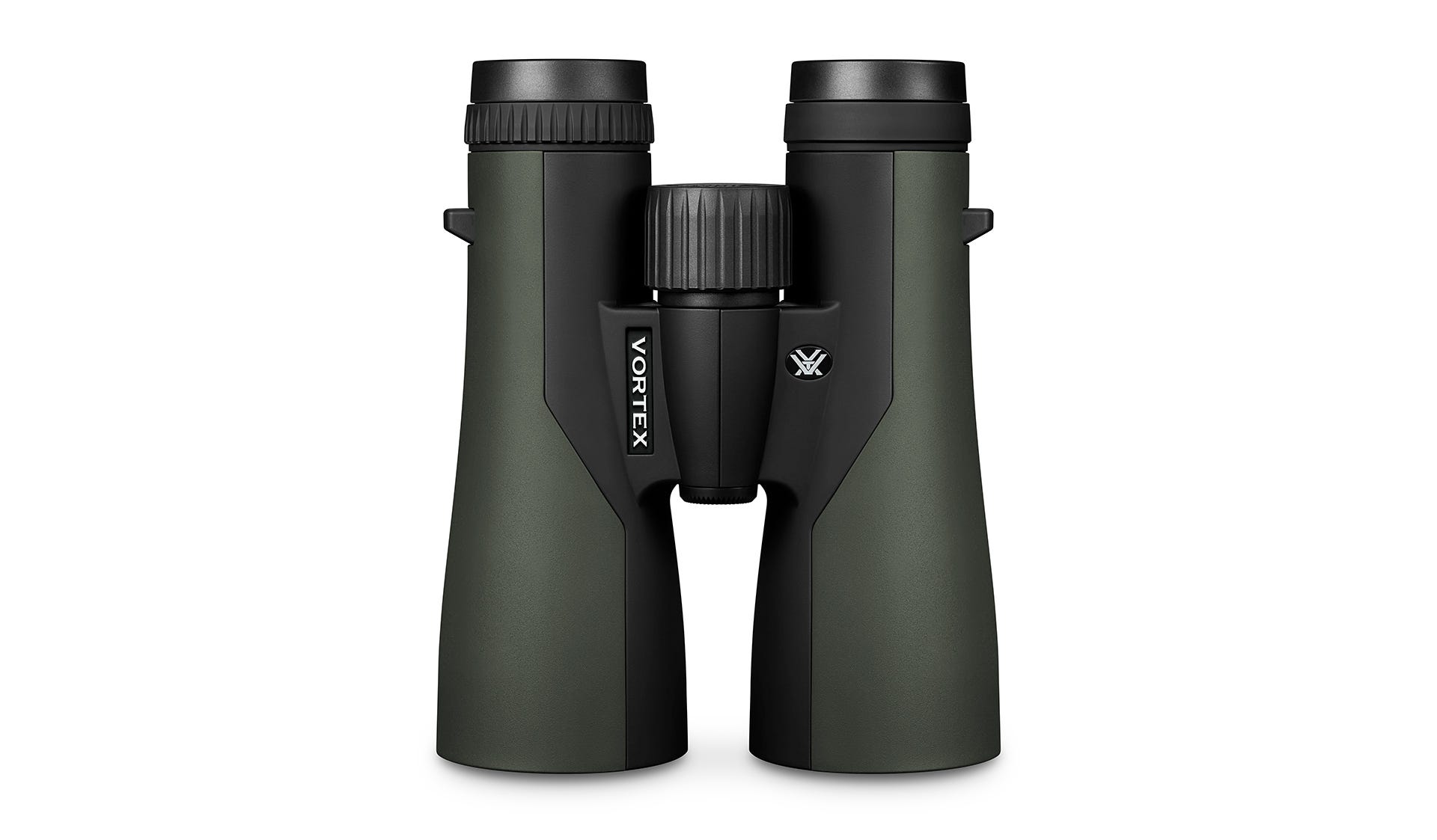
The product image is linked from Vortex’s exact CF-4314 page, but shares its pixels with the 10x50 page and does not prove the power. The exact model and specification sheet do that work; photography-versus-rendering status remains undisclosed. Listing the binocular within the current U.S. family is not a promise that a retailer has stock or a specific offer. This assessment is based on manufacturer-published information, not an ownership report, lab test or personal image-quality rating.
Manufacturer sources: Crossfire HD 12x50 product page, its CF-4314 specification sheet and the linked Crossfire HD manual.
Key specifications
Key details at a glance
| Magnification | 12× |
|---|---|
| Objective diameter | 50 mm |
| Real field of view | 5.2° |
| Field width at 1,000 m | 83.2 m |
| Eye relief | 15 mm |
| Close focus distance | 6 ft |
More specifications and setup details
| Manufacturer-published weight | 29.5 oz |
|---|---|
| Lens and prism coatings | Exact Vortex page identifies fully multi-coated lenses. It does not confirm ED glass or phase treatment for this SKU. |
| Water and fog protection | Manufacturer page says nitrogen-purged and O-ring sealed and uses waterproof/fogproof/shockproof language. No numeric IP/depth/duration is provided; do not infer submersion limits. |
| Tripod use | Exact product page says tripod adaptable; a tripod adapter is not listed in the included package. Confirm the separate compatible adapter if support is essential. |
| Published weight note | Vortex-listed instrument-only ounces; case, harness and included accessories add carry weight. No independent weighing was performed. |
| Manufacturer-rated waterproof | Yes |
| Built-in image stabilization confirmed | No |
| Integrated laser rangefinder | No |
| Onboard ballistic solution display | No |
| Tripod adapter in package | No |
Use the exact model’s instructions for operating limits, supplied equipment and version differences.
Sources for this review
Sources for this assessment
Choose your optical trade-off first.
Choose viewing purpose first, then magnification, objective size, scene width and any fit, weather or mounting constraint. A direct-Sun requirement is separate: only exact manufacturer-confirmed solar binoculars can pass it.