
On this page
Your needs, this model
Does it fit your priorities?
Does 12x50 provide the most reach in this exact family?
SI-SPH1250 is the highest fixed magnification here; the 50 mm objectives and narrowest family field fit open, distant viewing better than quick scanning.
Explore this need in the finder →Can its 20 mm stated relief meet a 20 mm screening floor?
Page and manual both list 20 mm; this satisfies a numeric screen only and does not guarantee the full field through your frames.
Explore this need in the finder →Can a separate adapter and support complete your high-power plan?
The manual confirms a socket and compatible separately acquired 90-degree adapter; it does not list the adapter in the package.
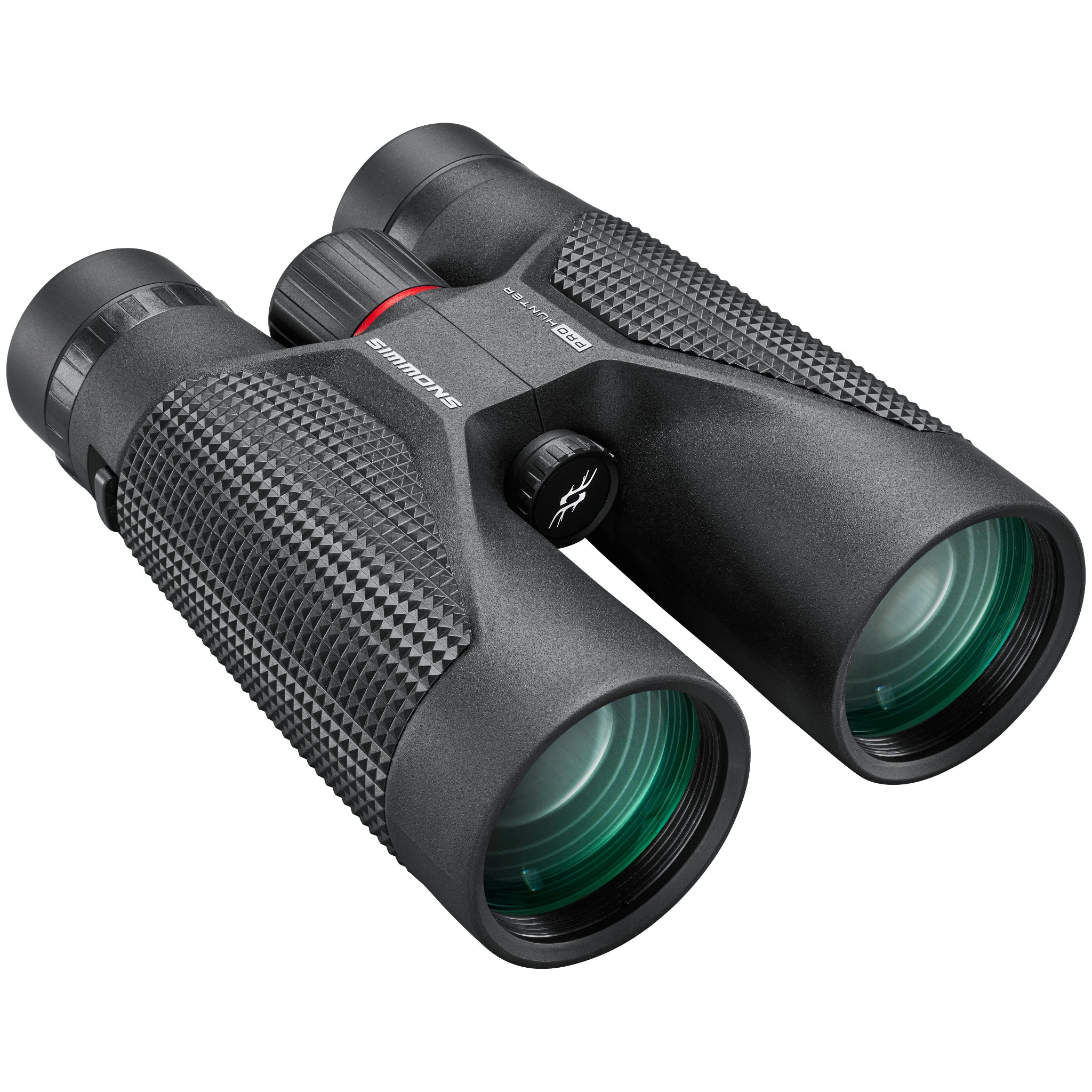
Explore this need in the finder →The Simmons Pro Hunter 12x50 is the highest-power member of this four-configuration family. Its fixed 12x image makes distant detail larger than the 8x42, 10x42 and 10x50, while the 50 mm objectives keep the body at the family's heavier end. Bushnell identifies the U.S. product as SI-SPH1250; the guide lists a 270-foot field at 1,000 yards, 20 mm eye relief and 29.9 ounces. This assessment is grounded in the exact product page and owner guide rather than a personal field test.
Favor reach when the subject is distant and relatively still
At 12x, this pair can make a far ridge, stationary animal or other distant feature appear larger than the siblings' 8x or 10x views. That is a meaningful choice when you have time to settle your hands and are observing across open country. It is less convenient for quick scanning: the field width is the narrowest in the line, at 270 feet per 1,000 yards, and small hand movement appears more strongly at higher power. If your usual view involves tracking birds in brush, moving wildlife or repeated quick glances, the broad-field 8x42 or the less demanding 10x42 is likely easier to use handheld. More magnification does not cancel atmospheric haze or create detail that the scene does not contain.
The two 50 mm models have the same stated body length, 6.8 inches, and are close in listed weight. The 12x50 is 29.9 ounces (849 g) in both the official page and manual, so it is a heavier full-size optic, not an all-day pocket carry choice. The 4.2 mm exit pupil is close to what the nominal 50/12 geometry suggests. That number alone should not be turned into a brightness ranking; transmission and conditions matter. The 10x50 is the same objective size with lower power, wider field, and 23 mm stated eye relief instead of 20 mm, making it the more relaxed family option for many handheld and eyeglass users.
Decide how you will stabilize it
The hinge socket allows tripod or monopod use with a compatible 90-degree binocular adapter. Bushnell's guide names its #161002CM as one example, and it says that adapter is an additional accessory rather than a supplied part. The package list is case, neck strap, lens covers and cleaning cloth. If you plan long stationary observation, include a separate adapter and a stable support in the field plan; do not assume the box contains mounting hardware. The manual describes a covered threaded socket but does not specify a direct 1/4-20 port, so I would not use this model to satisfy that exact mounting requirement without a confirmation from Bushnell.
Handheld use remains possible, but the larger image can be more sensitive to movement. A brace against a tree, a seated position or optional support may improve the practical view; this is a use consideration, not a manufacturer promise of stabilization. The binocular has no image-stabilization mechanism or integrated rangefinder. If you need a measured distance as well as an optical view, a rangefinding binocular is a separate operating choice.
Fit, protection and optics claims
Published eye relief is 20 mm. Roll the twist-up eyecups down for glasses, set the hinge so you see one full image, then complete the center-focus and right-diopter steps in the guide. As always, try with your frames: a nominal eye-relief figure cannot predict the position of every lens, frame shape or eye. The manual lists an 18-foot close-focus distance, which is not suited to very near nature study.
The exact page describes IPX7 waterproof and fogproof construction, an all-glass system, fully coated lenses, roof prisms and BK-7 glass. It does not confirm ED glass, phase correction, dielectric coatings, or the gas used inside. Those features remain unknown rather than implied by a roof-prism body. Waterproof rating is for protection, not underwater viewing. Use the supplied covers and soft cleaning cloth; remove grit first to avoid grinding it against the lens coatings.
Pick it for a specific reason
Choose the SI-SPH1250 when higher fixed power is more valuable than a wide field and you accept the weight, narrower scene and benefit of support for steadier prolonged viewing. Choose the 10x50 if the 50 mm objective interests you but you want less hand shake and longer published eye relief. Choose either 42 mm model to reduce bulk, with the 8x42 providing a broader 340-foot field and the 10x42 a bit more reach in a similarly sized package. The family's listed materials and accessories are broadly shared; magnification and field width are the meaningful differences here.
Bushnell's exact U.S. listing showed Add to Bag at the time it was checked. That is only a snapshot, not a guarantee of continuing stock, so search the exact SKU SI-SPH1250 and verify the selected 12x50 variant before buying. The 12x50 is not an ordinary solar viewer; never point it toward the Sun. A dedicated solar model is required for direct solar observation.
Key specifications
Key details at a glance
| Magnification | 12× |
|---|---|
| Objective diameter | 50 mm |
| Eye relief | 20 mm |
| Exit pupil | 4.2 mm |
| Close focus distance | 18 ft |
| Manufacturer-published weight | 29.9 oz |
More specifications and setup details
| Water and fog protection | Manufacturer describes IPX7 waterproof and fogproof construction; no underwater use should be inferred. Exact instructions do not state immersion depth or duration. |
|---|---|
| Tripod use | Manual confirms a covered threaded socket at the center hinge and a compatible separate 90-degree binocular adapter for a standard tripod or monopod. It does not state a direct 1/4-20 thread size; no adapter or tripod is listed in the package. |
| Published weight note | Exact page and official guide list 29.9 oz / 849 g; this is a manufacturer-listed instrument weight, not a packed carry weight. |
| Manufacturer-rated waterproof | Yes |
| Built-in image stabilization confirmed | No |
| Integrated laser rangefinder | No |
| Onboard ballistic solution display | No |
| Tripod adapter in package | No |
Use the exact model’s instructions for operating limits, supplied equipment and version differences.
Sources for this review
Sources for this assessment
- Simmons Pro Hunter Binoculars | 12x50mm | Bushnell; SKU SI-SPH1250
- Simmons Pro Hunter Binocular Owner Guide revision 04-24; exact model table includes four SKUs
- Official Shopify product JSON for four Simmons Pro Hunter variant IDs, SKUs, GTINs, availability and featured-image URLs
- Bushnell/Simmons official image URL linked to SI-SPH1250 selected product variant
- Bushnell U.S. Hunt binoculars collection row; Simmons Pro Hunter family

Choose your optical trade-off first.
Choose viewing purpose first, then magnification, objective size, scene width and any fit, weather or mounting constraint. A direct-Sun requirement is separate: only exact manufacturer-confirmed solar binoculars can pass it.