
On this page
Your needs, this model
Does it fit your priorities?
Which Travelite VI size has the most fixed magnification?
The 12x25. It lists a 4.2° real field and 220 ft at 1,000 yards, narrower than the 10x25 and 8x25, so the extra subject scale comes with a more restricted scene.
Explore this need in the finder →Can the Travelite 12x25 meet a 14 ft maximum closest-focus requirement?
Yes. Nikon lists 13.1 ft. That is the farthest minimum-focus distance among the three Travelite VI sizes.
Explore this need in the finder →Does the Travelite 12x25 have a published waterproof rating?
Nikon's cited exact product and family specifications do not publish one. If a water-sealing rating is essential, choose a different exact model with an explicit rating.
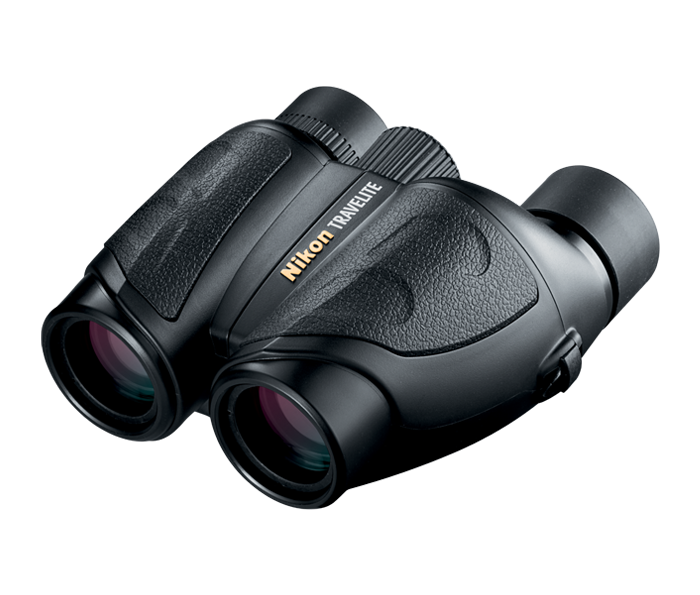
Explore this need in the finder →The Nikon TRAVELITE 12x25 is the highest-power member of the current Travelite VI 25 mm family. It weighs 9.7 oz and lists a 4.2° real field (220 ft at 1,000 yards), a 2.1 mm exit pupil, 11.1 mm eye relief and a 13.1 ft close-focus distance. Consider it when a compact pair with 12x magnification matters more than a wide scene or nearby focus. Higher power also makes a steady handheld view more demanding; the cited specifications do not establish built-in stabilization or weather sealing.
More subject scale, less actual scene
Nikon publishes a 4.2° real field for this model. The field width is 220 ft at 1,000 yards, compared with 262 ft for the 10x25 and 293 ft for the 8x25. That makes the 12x view the narrowest of the family, so it is less forgiving when you are trying to locate a moving subject or scan a broad playing field. Nikon’s 47.5° apparent field describes the view through the eyepiece, not a wider landscape; the actual scene remains narrower than in either lower-power sibling.
The 2.1 mm exit pupil is the smallest in this 25 mm line, and Nikon lists a relative-brightness index of 4.4. Both are published optical specifications, not independent measures of what a person sees, but they make the design trade-off clear: compared with the family’s 8x25, less exit pupil accompanies the higher magnification. Do not assume the 12x label means a better general-purpose image, especially in dim conditions.
Since this is a handheld instrument, be realistic about steadiness. Any hand movement is more visible at higher magnification, so lean on a rail or rest your hands when possible. Nikon’s reviewed US page and family specifications do not list an image stabilizer. If a stable view is essential rather than simply desirable, use the finder’s stabilization filter and compare a model whose stabilization is explicitly documented; do not treat the 12x25 Travelite as stabilized.
Fit and minimum focus deserve a close look
Eye relief is 11.1 mm, the same listed figure as the 10x25 and shorter than the 8x25’s 14 mm. Some users who wear glasses may not see the full field comfortably at this distance. The number is a specification, not a guarantee of fit, so try it with your own eyewear if you need to keep glasses on. The listed interpupillary range is 56–72 mm.
The minimum focus distance is 13.1 ft, farther than the 9.8 ft listed for the 8x25 and 10x25. That matters for close subjects such as a bird on a nearby feeder or a detail across a small room: if it is nearer than the listed minimum, this model may not focus on it. It is intended for more distant viewing than its siblings, not close observation.
Portable optics are not automatically all-weather optics
At 9.7 oz, the 12x25 is only 0.4 oz heavier than the 8x25 and 0.2 oz heavier than the 10x25. The global family table lists a 110 × 118 × 54 mm body. Those figures support a light carrying brief, but they cannot tell you whether the instrument fits a particular pocket, case or hand. The family page describes a central focus mechanism, Porro prisms, multilayer-coated aspherical lenses, rubber armor, carbon fibre incorporated into the body material and a click-type diopter adjustment ring.
The specifications reviewed here do not state that the 12x25 is waterproof, nitrogen-filled or fogproof. If rain resistance or wet-deck use is essential, select a binocular with an explicit water rating; do not infer one from rubber armor. Nikon also does not establish ED glass, tripod compatibility or exact package contents in the sources reviewed. A quick seller image is not proof that a particular case or accessory comes with the purchase.
Alternatives if the priorities change
Choose the Travelite 10x25 if you want less magnification, a wider 5.0° scene and the same 11.1 mm eye relief, or the 8x25 if the broadest field and longer 14 mm eye relief matter more. For a published weather rating in a compact 12x model, check other manufacturers and exact models rather than assuming the Travelite has one. If you need image stabilization, Nikon’s separate STABILIZED 12x25 S is a different product family and has its own battery and weather considerations; consult that exact review before treating it as an alternative.
The right reason to choose the 12x25 is that the higher fixed magnification fits your main, relatively distant targets and you accept the narrow real field, small exit pupil and longer near-focus distance. It is not the flexible choice when your outing moves from close subjects to broad scenes. The three-model comparison can help decide whether the added reach is worth those compromises.
For exact values, see Nikon’s TRAVELITE 12x25 US listing and the TRAVELITE VI family specifications. This is not a hands-on stabilization, steadiness or optical-resolution test.
Key specifications
Key details at a glance
| Magnification | 12× |
|---|---|
| Objective diameter | 25 mm |
| Real field of view | 4.2° |
| Apparent field of view | 47.5° |
| Field width at 1,000 m | 73 m |
| Eye relief | 11.1 mm |
More specifications and setup details
| Exit pupil | 2.1 mm |
|---|---|
| Close focus distance | 13.1 ft |
| Manufacturer-published weight | 9.7 oz |
| Lens and prism coatings | Nikon's global TRAVELITE VI page describes multilayer-coated aspherical lenses. It does not establish ED glass, phase correction, dielectric mirror coating, all-surface prism coatings, or oil/water-repellent objective and eyepiece surfaces. |
| Water and fog protection | The inspected exact US page and global family page do not state waterproofing, nitrogen filling, fogproofing or a rated immersion depth. These capabilities remain unknown, not assumed absent or present. |
| Published weight note | Nikon lists 9.7 oz on the exact US page and 275 g on the global family page. The US page lists 4.3 × 4.6 in; the family page gives 110 × 118 × 54 mm. |
| Package contents | The cited product pages do not establish exact package contents. Do not infer a case, strap, lens covers or other supplied items from a product image; verify a seller's stated package if an accessory matters. |
Use the exact model’s instructions for operating limits, supplied equipment and version differences.
Sources for this review
Sources for this assessment
- Nikon USA current binocular directory; TRAVELITE series filter reports three configurations and a current 12x25 product tile
- Nikon USA exact TRAVELITE 12x25 product page, product 7279
- Nikon global TRAVELITE VI 25 mm family specifications and feature description
- Nikon Binocular General Instructions (Detailed), not a product-specific Travelite manual
- Dated CPSC exact-name query for Nikon Travelite 12x25
Choose your optical trade-off first.
Choose viewing purpose first, then magnification, objective size, scene width and any fit, weather or mounting constraint. A direct-Sun requirement is separate: only exact manufacturer-confirmed solar binoculars can pass it.