
On this page
A broad-scene 25 mm choice without electronics
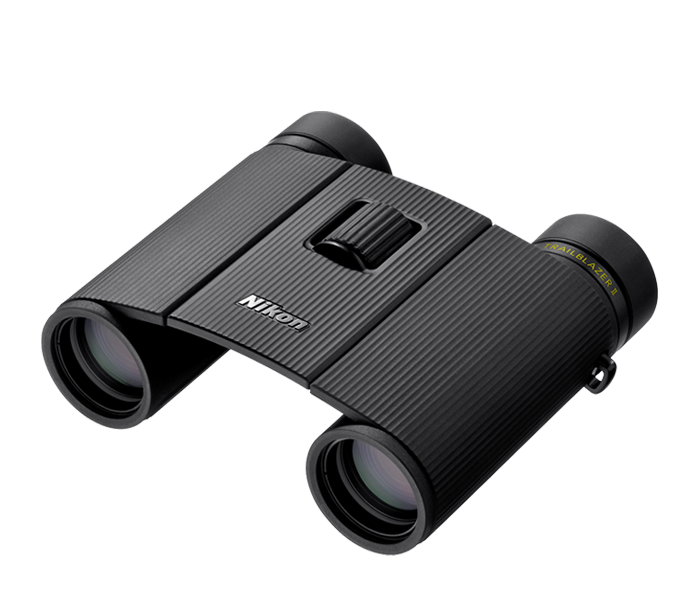
The TRAILBLAZER II 8x25 brings an 8.3° field and waterproof construction to the compact 25 mm choice. It is lighter and wider than the stabilized 10x25 sibling, but trades away stabilization and higher fixed power; confirm your own eye position with glasses.
Explore the needs this model fits
Your needs, this model
Does it fit your priorities?
Does the 8x25 offer the wider real scene of the two TRAILBLAZER II sizes?
Yes. Nikon publishes 8.3° and 145 m at 1,000 m, versus 6.5° and 114 m for the 10x25. That makes the 8x model a wider starting view, not a promise of better edge sharpness.
Explore this need in the finder →Is the 8x25 the closer-focusing TRAILBLAZER II size?
Yes. Nikon lists 8.2 ft for the 8x25 and 11.5 ft for the 10x25. It is the better of these two for nearby details, but neither is a macro instrument.
Explore this need in the finder →Can it meet a waterproof 8x25 brief without implying underwater use?
Yes. Nikon rates it waterproof to 1 m for 10 minutes and explicitly says it is not intended for underwater use.
Explore this need in the finder →The Nikon TRAILBLAZER II 8x25 is the easier-sweeping member of Nikon’s current two-model compact family: 8x power, a published 8.3-degree real field and a 10.9-ounce body. Its fold-up design and waterproof, nitrogen-filled construction make it a plausible pack or travel companion, but the 25 mm objectives and 10 mm eye relief set clear limits. Pick it for portability and subject-finding, not as a low-light replacement for a larger binocular.
A compact binocular that is easier to scan with
Eight power and 8.3 degrees of real field give this model the wider view of the two TRAILBLAZER II choices. Nikon lists a field width of 145 m at 1,000 m. The broad sweep is useful when you are still finding a bird in foliage, following movement across a playing field, or checking a scene while walking. Its apparent field is 60.3 degrees, a specification about how broad the view seems at the eyepiece rather than the actual width of landscape. Neither number is a claim about edge sharpness.
Compared with the 10x25, this 8x version gives up some subject scale but makes the scene easier to reacquire after you lower the binocular. Lower magnification also tends to be less demanding of hand steadiness. These are consequences of the power and field figures, not a promise that every observer will find the view equally comfortable. For moving subjects or casual sightseeing, the wider 8x view is the more forgiving place to start.
Portability is the main reason to choose it
Nikon lists the instrument at 310 g (10.9 oz), with an unfolded body of about 100 × 114 × 44 mm. The same dimensions table shows a narrower folded width, about 69 mm, and a folded depth of about 55 mm. The dual-hinge fold-up arrangement is useful in a small day pack or jacket pocket; it does not turn the binocular into a flat, credit-card-sized object. The weight is for the instrument, and Nikon’s product page does not establish which case, caps or strap are in every retail box.
The 25 mm objectives help keep the package small, but the 3.1 mm exit pupil and Nikon’s relative-brightness index of 9.6 are much more modest than the figures for full-size 8x42 binoculars. Those are optical geometry and a manufacturer index, not a field measurement at dusk. If regular wildlife viewing continues after sunset or you want more margin in dim conditions, a larger objective is a more suitable direction.
What the weather rating does—and does not—mean
Nikon describes the TRAILBLAZER II family as waterproof and nitrogen-filled, with a 1 m (3.3 ft) / 10-minute submersion limit. Nikon also says it is not intended for underwater use. That distinction suits rain, spray and ordinary outdoor transitions far better than diving or leaving the instrument submerged. Rubber armoring and an aluminum-alloy body add grip and a more protected exterior, but neither makes it indestructible or maintenance-free.
The family page lists turn-and-slide rubber eyecups and a large focus knob. The 56–72 mm interpupillary range gives a concrete fit boundary: set the two barrels until the view merges into one circle, rather than judging fit by the folded body alone. A published 10 mm eye-relief figure is short enough that glasses wearers should try the view with their own frames. It does not establish that every frame can see the full field.
How it compares with a larger Nikon 8x
The current PROSTAFF P3 8x30 is a helpful alternative when the Trailblazer’s 25 mm objectives or short relief feel restrictive. Nikon lists the P3 at 8.7 degrees real field, 456 ft at 1,000 yd, 16.75 oz and 15.4 mm of eye relief. The Trailblazer II weighs about 5.9 oz less and folds smaller; the P3 offers a slightly broader published field and more stated eye relief in a larger body. If the binocular stays in a pack all day, the Trailblazer’s reduced mass matters. If glasses fit, a longer observation session or greater light-gathering margin matters more, inspect the P3 or an 8x42 before deciding.
Who should move to the 10x25 instead?
Choose the TRAILBLAZER II 10x25 if you deliberately want more magnification in the same listed weight. It shows a smaller real scene—6.5 degrees and 114 m at 1,000 m—and a 2.5 mm exit pupil. That tighter view can make a distant sign or stationary subject look larger, but it also magnifies hand movement and makes subject acquisition less relaxed. Nikon lists 11.5 ft as the 10x25’s closest focus, compared with 8.2 ft here, so this 8x model is the closer-focusing choice for nearby objects.
Bottom line
The 8x25 is for people who will actually carry a small waterproof binocular and value a wide, quick-to-scan view over extra reach, long eye relief or dim-light margin. It is not the right choice if an essential requirement is more than 10 mm of published eye relief, a confirmed accessory in the box, or frequent dusk use. Compare the real trade: a 10.9-ounce folding body versus the fuller view and longer relief of a larger 8x model. If the view works with your face and the smaller aperture fits your outings, this is the more relaxed of the two Trailblazer II powers.
Model-specific specifications: Nikon TRAILBLAZER II 8x25. Family construction and dimensions: Nikon TRAILBLAZER II family page.
Key specifications
Key details at a glance
| Magnification | 8× |
|---|---|
| Objective diameter | 25 mm |
| Real field of view | 8.3° |
| Apparent field of view | 60.3° |
| Field width at 1,000 m | 145 m |
| Eye relief | 10 mm |
More specifications and setup details
| Exit pupil | 3.1 mm |
|---|---|
| Close focus distance | 8.2 ft |
| Manufacturer-published weight | 10.9 oz |
| Lens and prism coatings | Nikon describes multilayer-coated optics on the exact model page. The inspected source set does not establish ED glass, phase correction, dielectric coating, all-surface multi-coating, or oil/water-repellent objective and eyepiece surfaces; these details remain unknown. |
| Water and fog protection | Nikon describes the TRAILBLAZER II family as waterproof, nitrogen-filled and fogproof, rated to 1 m / 3.3 ft for up to 10 minutes. Nikon explicitly says it is not intended for underwater use. |
| Published weight note | Nikon publishes 310 g / 10.9 oz for this model. The family release provides unfolded body dimensions and folded dimensions; the displayed length/width/depth describe unfolded size. |
| Package contents | Nikon product sources reviewed do not establish the package contents. Do not infer accessories from product photography; confirm box contents with the exact seller if any item is essential. |
| Manufacturer-rated waterproof | Yes |
Use the exact model’s instructions for operating limits, supplied equipment and version differences.
Sources for this review
Sources for this assessment
Choose your optical trade-off first.
Choose viewing purpose first, then magnification, objective size, scene width and any fit, weather or mounting constraint. A direct-Sun requirement is separate: only exact manufacturer-confirmed solar binoculars can pass it.
Your needs, this model
25 mm binoculars: compact 8x or stabilized 10x
Choose it when: Its listed 8.3° real field is substantially wider than the stabilized Nikon's 5.4° figure, and its 10.9 oz instrument weight is lower.
25 mm binoculars: compact 8x or stabilized 10x →