
On this page
Your needs, this model
Does it fit your priorities?
Does the P7 12x50 give a wider apparent field while narrowing the real scene compared with P7 10x50?
Yes. Nikon lists 60.8° apparent and 5.6° real field (98 m at 1,000 m) for 12x50; the 10x50 is 55.3° apparent and 6° real (105 m). The 12x50 offers more magnification, a 4.2 mm exit pupil and 16.4 mm eye relief.
Explore this need in the finder →Is the P7 12x50 diopter ring explicitly locking?
Yes. Nikon confirms a locking diopter ring for this exact P7 configuration. Its 16.4 mm eye relief is shorter than the 10x model's 19.3 mm, so glasses fit still deserves a real-world check.
Explore this need in the finder →Does the exact P7 12x50 source establish ED glass or an included tripod adapter?
No. The inspected P7 sources do not state ED glass, and Nikon describes the TRA-3 as optional without listing standard box contents. Both are unknown rather than assumed yes/no for the exact package.
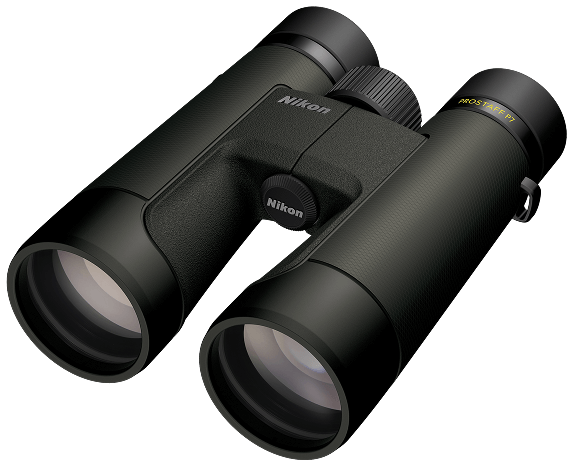
Explore this need in the finder →The PROSTAFF P7 12x50 combines the family’s 12x configuration with a 60.8° apparent field, locking diopter ring and repellent lens coatings. Its appeal is the larger-looking, more distant view from a stationary position; the price of that choice in practical terms is a narrower real field, shorter eye relief and more visible hand movement than the 10x P7.
Higher magnification changes more than apparent size
Nikon publishes a 5.6° real field, 98 metres at 1,000 metres, 60.8° apparent field and 4.2 mm exit pupil for this 12x50. The P7 10x50 is 6° real, 105 metres at 1,000 metres and 55.3° apparent with a 5 mm exit pupil. If you watch a distant boat, ridge or bird already in sight, extra magnification may be welcome. If you must locate a moving subject quickly, the 10x view keeps more of the actual landscape in the field and generally asks less of your hands.
Nikon lists a 16.4 mm eye relief for the 12x. The 10x value is 19.3 mm. The family is described as long-eye-relief, but that phrase cannot settle whether your own glasses fit the eyepiece. Try the 12x model with your actual eyewear, adjust the eyecup positions and look for a full circular field before deciding. A listed 50 mm objective is not a substitute for checking the eye point.
The P7 features that matter in use
The P7 has a confirmed locking diopter ring. The exact P7 50 mm manual makes the setting sequence clear: focus the left eye with the center wheel, extend the right eyecup and ring to release the lock, pull the ring up to adjust the right-eye focus, then push it down to lock. That guards against accidental turns while carrying or handing over the binocular; it does not freeze center focus, and another observer may need to reset the diopter.
Oil- and water-repellent treatment on the objectives and eyepieces is another explicit P7 feature. It can resist smudges; it is not a scratch warranty. Nikon also names multilayer coating on lenses and prisms, phase correction and dielectric high-reflective prism coating. The specific P7 50 mm pages do not establish ED glass. That information gap does not prove a lack of ED, but it means an ED-required shortlist should not treat P7 as a confirmed match.
Full-size carrying and weight correction
The P7 body is listed at 169 × 133 × 58 mm. Nikon’s February 2026 release gives 645 g / 22.8 oz. Its current product detail page displays 645 oz under weight, matching the pattern of a gram value appearing in an ounces field; this review uses the feature-summary and release value of 22.8 oz. That is the instrument weight. Nikon’s exact-model manual lists one binocular, an eyepiece cap, two objective lens caps, a strap and a soft case as supplied items; a retailer may create a separate bundle.
Close focus is listed at 14.8 feet. For a closer subject, consider whether you will be outside that distance before choosing this size. A 12x pair can be compelling for a wide open space but cumbersome for a short walk if you find yourself fighting both hand movement and subject acquisition. A tripod with the right fitting may help at a fixed station; Nikon calls the TRA-3 optional. It is not named in the P7 manual’s supplied-items list, so verify any US retail bundle before assuming the adapter is included.
Outdoor protection, with a limit
Nikon states a waterproof rating to 1 metre for up to 10 minutes and nitrogen filling for fog resistance, and its P7 family page says the series is not intended for underwater use. Rain and damp conditions are within the stated role, but this should not be read as a diving rating or permission to spray the barrels under pressure. After wet use, wipe the exterior and give it time to dry before storing. Keep optics free of abrasive grit; a clean blower or soft brush is a safer first step than wiping dust around the lens.
Where the finder can point next
If you want 12x and the expansive apparent view but prefer ED glass to be documented, compare the M5 12x50. It shares the 12x, 60.8° apparent field, 5.6° real field and 16.4 mm eye relief; Nikon explicitly names ED for that M5 size. The P7’s published weight is 22.8 oz, just below the M5 12x50’s 22.9 oz, while the P7 has the confirmed locking diopter and repellent outer lenses.
If the binocular is mainly for fast-moving birds, walking or glasses use, compare the 10x50 alternatives. Both have a 6° real field and longer 19.3 mm eye relief. The P7 10x50 is 22.2 oz and has the same P7 handling features; the M5 10x50 is 22.6 oz with confirmed ED glass. If you are unsure that you can hold 12x steady, try it before buying. Neither a coating nor a lock corrects motion in the hands, and a binocular chosen for a spec sheet is not automatically more enjoyable on your usual outing.
Exact-model operating reference: Nikon Download Center — PROSTAFF P7 10x50/12x50 instruction manual listing (English text included in the PDF).
Key specifications
Key details at a glance
| Magnification | 12× |
|---|---|
| Objective diameter | 50 mm |
| Real field of view | 5.6° |
| Apparent field of view | 60.8° |
| Field width at 1,000 m | 98 m |
| Eye relief | 16.4 mm |
More specifications and setup details
| Exit pupil | 4.2 mm |
|---|---|
| Close focus distance | 14.8 ft |
| Manufacturer-published weight | 22.8 oz |
| Phase coatings confirmed | Yes |
| Locking diopter ring confirmed | Yes |
| Lens and prism coatings | The P7 family page and 2026 launch release confirm multilayer coating on all lenses and prisms, dielectric and phase-correction prism coatings, and oil/water-repellent treatment on the objective and eyepiece lenses. Nikon's 50 mm P7 documentation inspected here does not name ED glass, so that feature remains unknown rather than false. |
| Water and fog protection | Nikon rates the body waterproof to 1 m / 3.3 ft for up to 10 minutes, states nitrogen filling and fog resistance, and says this series is not intended for underwater use. This is not diving equipment. |
| Tripod use | Nikon identifies the TRA-3 as an optional tripod adapter. It is not named in the model manual's supplied-items list; because this archive is the Japanese Download Center model-family record and US retail bundles may differ, a particular US package's adapter inclusion remains unknown. |
| Published weight note | The Nikon US product page displays 645 oz in a weight field, an apparent unit-label error. Its feature summary says 22.8 oz and the February 2026 launch table reports 645 g / 22.8 oz; this assessment uses 22.8 oz, not 645 oz. |
| Package contents | The exact model-family manual lists Binocular ×1, Eyepiece cap ×1, Objective lens caps ×2, Strap ×1, Soft case ×1 as items supplied. It does not name the optional TRA-3 adapter. Since US retailer bundle variations are not established by the Japanese Download Center manual, adapter inclusion in a particular US box remains unknown; confirm the seller's exact package. |
| Manufacturer-rated waterproof | Yes |
Use the exact model’s instructions for operating limits, supplied equipment and version differences.
Sources for this review
Sources for this assessment
- Nikon USA PROSTAFF P7 12x50 product page
- Nikon US launch announcement and four-model 50 mm comparison
- Nikon USA PROSTAFF P7 family feature page
- Nikon general binocular instructions, 936C_3_2107, English pp. 7–10
- Nikon Download Center PROSTAFF P7 10x50_12x50
- Nikon PROSTAFF P7 10x50/12x50 Instruction Manual, 1039C_1_2601
- CPSC Recall Retrieval API exact product-name query
- CPSC Recall Retrieval API exact product-name query
- CPSC Recalls API information
- Nikon USA Service Advisories index
- Nikon USA selected-binocular service advisory, 2023 (updated 2024)
- Nikon USA Sport & Recreational Optics strap advisory, 2022
- CPSC Recall Retrieval Web Services Programmer’s Guide
Choose your optical trade-off first.
Choose viewing purpose first, then magnification, objective size, scene width and any fit, weather or mounting constraint. A direct-Sun requirement is separate: only exact manufacturer-confirmed solar binoculars can pass it.