
On this page
A compact model with three individually confirmed features
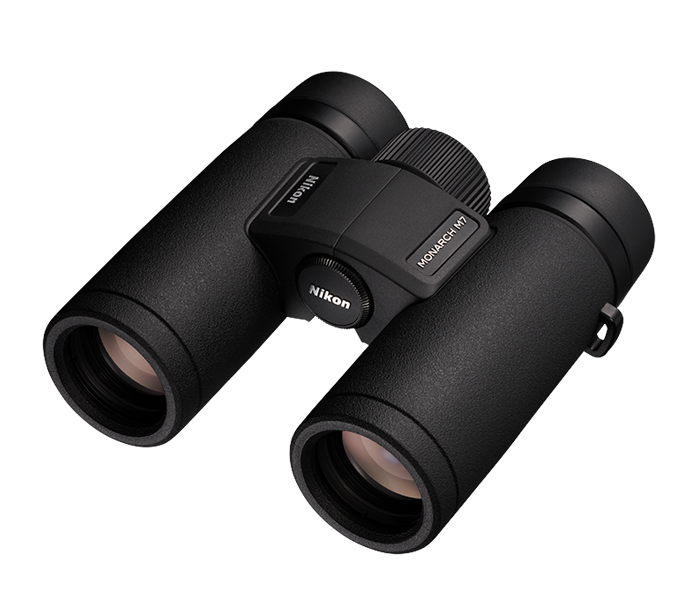
The MONARCH M7 8x30 combines ED glass, phase coating and a locking diopter in an exact 30 mm configuration. Its 8.3° field and 16.4 oz listed mass favor compact, broad scanning, while 15.1 mm eye relief needs a personal glasses-fit check.
Explore the needs this model fits
Your needs, this model
Does it fit your priorities?
Does the 8x30 keep the M7 line’s broadest real scene in a compact body?
Yes. Nikon lists 435 ft at 1,000 yd and 8.3° real field, matching the M7 8x42 while using the smaller 30 mm objective. The specification describes scene width, not measured edge quality.
Explore this need in the finder →Is ED glass and a locking diopter confirmed for this exact 8x30?
Yes. The exact Nikon US product page marks ED glass and locking diopter as present; the M7 manual describes how to unlock, set and relock the right-eye ring.
Explore this need in the finder →Can it meet a rainy-day handheld plan with close focus at 7 ft or nearer?
Yes. Nikon rates it waterproof to 1 m for 10 minutes and fogproof, while its published close focus is 6.6 ft. The manual prohibits underwater use and strong water pressure.
Explore this need in the finder →The Nikon MONARCH M7 8x30 pairs an eight-power view with a compact 30 mm roof-prism body. Nikon publishes a 435-foot field at 1,000 yards, a 60.3-degree apparent field and a 16.4 oz weight. The wider scene and smaller body suit daytime birding, travel or wildlife walks where carrying bulk matters; the 3.8 mm exit pupil and 15.1 mm eye relief are the costs of that compact format.
A broad scene in a small body
For locating a bird in a hedge or keeping a moving subject in view, the M7 8x30 offers the same 435-foot real field at 1,000 yards that Nikon lists for its M7 8x42. Eight-power magnification gives a broad view without the narrower framing of a 10x instrument. Its apparent field is 60.3 degrees; apparent and real fields are different descriptions, so use the 435-foot figure when comparing how much landscape fits across the view. Neither figure is a sharpness test or a promise that every person will see the entire field at once.
At 4.7 inches long and 16.4 oz, the 8x30 is the lightest M7 configuration. It is substantially easier to pack than either 42 mm model, while retaining central focus, a locking right-eye diopter and the M7’s documented ED glass. Nikon also describes oil- and water-repellent coatings on the objective and eyepiece lenses. These features make this an unusually capable small format on paper, not a substitute for checking optical fit or handling in person.
What the compact format gives up
The 30 mm objective produces a 3.8 mm exit pupil; the M7 8x42 is 5.3 mm. Those numbers describe the image beam leaving the eyepiece, not a measured low-light score. If twilight wildlife watching or a more forgiving eye position in changing light is central, the larger 8x42 is the more appropriate comparison. It adds 7.2 oz and nearly an inch of length, and still covers the same 435 feet at 1,000 yards.
Eye relief is 15.1 mm. Nikon’s manual recommends fully retracting the click-stop eyecups for eyeglass wearers, with two intermediate positions available. That setup instruction does not guarantee that every frame will allow the whole field to remain visible; the M7 8x42’s 17.1 mm figure gives more stated distance. If you wear glasses while observing, try the eyecup position with your own frames before committing.
Close focus is approximately 6.6 feet, suitable for nearer subjects than the two 42 mm M7 sizes, which are rated to about 8.2 feet. It still is not a macro instrument, and the published distance is not an independent test of focus smoothness or near-field clarity.
ED glass, lens care and weather boundaries
The exact Nikon USA page lists ED glass, phase coating, dielectric coating and a locking diopter for this 8x30. Nikon describes ED glass as reducing chromatic aberration and color fringing; that is a design feature, not proof of edge-to-edge resolution or a guarantee that color fringing disappears in every scene. The repellent surface treatment can help ordinary smudges and water spots release more easily, but it does not make the glass scratch-proof. Use a blower and suitable lens-cleaning materials rather than rubbing dry grit across the lenses.
The M7 manual rates the instrument waterproof to 1 m / 3.3 ft for up to 10 minutes and fogproof with nitrogen filling. It explicitly says not to use it underwater or expose it to strong water pressure. Treat the rating as protection for rain and accidental immersion within the stated limit, not permission to snorkel with it. After a wet outing, wipe moisture away before adjusting the focus or eyepieces.
The manual lists the binocular, eyepiece cap, two objective caps, soft case and neck strap as supplied. Nikon’s M7 launch information describes tripod adapters as optional; the adapter is not listed among those standard items. This review therefore treats handheld use as the ready-to-go plan and does not imply an adapter is in the box.
Which M7 should you compare?
Choose the M7 10x30 if extra magnification matters more than the widest real scene: it covers 351 feet at 1,000 yards, has a 3.0 mm exit pupil and weighs 16.6 oz. Choose the 8x42 if you want the 435-foot scene plus a 5.3 mm exit pupil and 17.1 mm eye relief, and accept the larger body. Choose the 10x42 when you want ten-power in a full-size instrument; it gives 362 feet and a 4.2 mm exit pupil. The M7 size comparison puts all four side by side. For a light pack and quick scanning in daylight, the 8x30 is the clear compact choice; for glasses, dusk or longer stationary sessions, assess the 8x42 first.
Exact-model facts: Nikon MONARCH M7 8x30 product page. Setup and size-specific family values: Nikon MONARCH M7 manual listing.
Key specifications
Key details at a glance
| Magnification | 8× |
|---|---|
| Objective diameter | 30 mm |
| Real field of view | 8.3° |
| Apparent field of view | 60.3° |
| Field width at 1,000 m | 145 m |
| Eye relief | 15.1 mm |
More specifications and setup details
| Exit pupil | 3.8 mm |
|---|---|
| Close focus distance | 6.6 ft |
| Manufacturer-published weight | 16.4 oz |
| ED glass confirmed for this exact model | Yes |
| Phase coatings confirmed | Yes |
| Locking diopter ring confirmed | Yes |
| Lens and prism coatings | The exact Nikon USA page confirms ED glass, phase and dielectric coatings for this configuration. The MONARCH M7 family page describes oil- and water-repellent objective and eyepiece lens surfaces. The family release says all optical surfaces are multilayer coated; these are manufacturer feature descriptions, not independent optical measurements. |
| Water and fog protection | Nikon’s MONARCH M7 family manual rates all four covered configurations waterproof to 1 m / 3.3 ft for up to 10 minutes and fogproof/nitrogen-filled. It allows rain, humidity and dust, but explicitly says not underwater and warns against strong water pressure. |
| Tripod use | Nikon’s 2021 M7/M5 launch release says an optional tripod adapter enables tripod attachment (TRA-3/Adaptor H, hard type); the instruction manual does not list an adapter as standard equipment. No tripod adapter is claimed as included. |
| Published weight note | The current Nikon USA exact-model page publishes 16.4 oz (465 g); this is Nikon's stated value, not an independent measurement. The 2021 manual table rounds the gram value to 465 g. |
| Package contents | The M7 family manual lists the binocular, eyepiece cap, two objective caps, soft case and neck strap. Nikon calls the tripod adapter optional; a seller-added bundle may contain different extras. |
| Manufacturer-rated waterproof | Yes |
| Tripod adapter in package | No |
Use the exact model’s instructions for operating limits, supplied equipment and version differences.
Sources for this review
Sources for this assessment
- Nikon USA MONARCH M7 8x30 exact US product page
- Nikon USA MONARCH M7 family features and four-size US family listing
- Nikon MONARCH M7 8x30/10x30/8x42/10x42 instruction manual
- Nikon 2021 MONARCH M7/M5 US launch release with optional tripod adapters and family specifications
- Nikon official download center for MONARCH M7 manual
- CPSC exact model-name recall query for Nikon MONARCH M7 8x30
Choose your optical trade-off first.
Choose viewing purpose first, then magnification, objective size, scene width and any fit, weather or mounting constraint. A direct-Sun requirement is separate: only exact manufacturer-confirmed solar binoculars can pass it.
Your needs, this model
30 mm ED binoculars: compare compact 8x and 10x models
Choose it when: This M7 offers the widest-field end of the compact 8x examples and confirms the complete three-feature stack.
30 mm ED binoculars: compare compact 8x and 10x models →30 mm binoculars with ED glass, phase coating and a locking diopter
Choose it when: The exact M7 manual confirms all three required features in this compact 8x configuration, which has the wider listed real field.
30 mm binoculars with ED glass, phase coating and a locking diopter →Binoculars with exact-model ED glass confirmation
Choose it when: Nikon's exact model documentation confirms ED glass; the 8x30 combines that feature with a broad listed real field in a compact body.
Binoculars with exact-model ED glass confirmation →