
On this page
A higher-power 30 mm model with the M7 feature stack
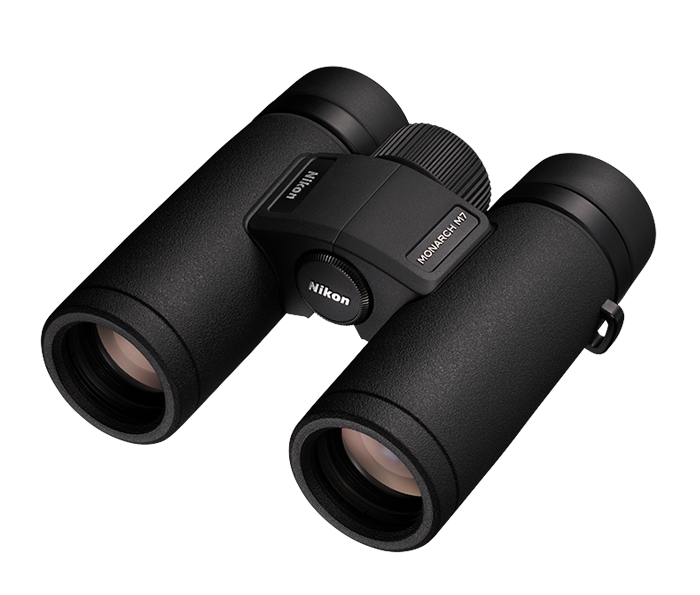
The MONARCH M7 10x30 confirms ED glass, phase coating and a locking diopter in a 16.6 oz instrument. Its real field is 6.7°, narrower than the 8x30’s 8.3°; select the extra fixed power only if that framing trade suits your use.
Your needs, this model
Does it fit your priorities?
Does this compact M7 provide ten-power without switching to a 42 mm body?
Yes. The exact US product page identifies the MONARCH M7 10x30, with a 351 ft field at 1,000 yd and a 16.6 oz listed weight.
Explore this need in the finder →Are ED glass and a locking diopter documented on the 10x30 itself?
Yes. Nikon lists both features for product 16764; they are not being inferred from another M7 size. The M7 manual gives the separate ring adjustment steps.
Explore this need in the finder →Will its published relief, close focus and weight suit a light 10x setup?
Its 15.8 mm eye relief, approximately 6.6 ft close focus and 16.6 oz published weight meet a modest compact-use screen, but glasses compatibility still depends on the wearer.
Explore this need in the finder →The Nikon MONARCH M7 10x30 is the compact M7 for viewers who prefer ten-power magnification. Nikon lists a 351-foot field at 1,000 yards, a 60.7-degree apparent field and a weight of 16.6 oz. It keeps the M7’s confirmed ED glass, locking diopter and weather protection in a short body, but trades away some scene width, exit-pupil size and comfort margin compared with the 8x30 and full-size models.
More magnification, narrower real field
Ten-power magnification brings distant subjects larger in the view than an 8x binocular, which can be useful for identifying details at a distance when the instrument is held steadily. The corresponding real field is narrower: 351 feet at 1,000 yards versus 435 feet for the M7 8x30 and 8x42. A narrow field makes reacquiring a moving bird less forgiving, so the 10x30 is a better fit for deliberate observation than for rapid scanning across a wide flock or sports field.
Its apparent field is 60.7 degrees, but that should not be read as a real-scene width. Nikon’s 351-foot figure is the practical comparison for how much landscape you see at once. The specification cannot tell you whether the view’s edge is sharp, how much hand shake you will notice or whether the eyecups fit your face; those are reasons to handle it if possible.
The compact body weighs 16.6 oz and measures 4.7 inches long. That is only 0.2 oz more than the 8x30, making the 10x30 the portable option when added magnification is worth a modest weight difference. The 3.0 mm exit pupil is the family’s smallest. It does not amount to a lab brightness measurement, but it is a real geometric compromise for low-light viewing or users who want a more generous eye-position window.
Eye relief and the view through glasses
Nikon lists 15.8 mm of eye relief, slightly more than the 8x30’s 15.1 mm but less than either 42 mm model. The M7 instruction manual says glasses wearers should use the eyecups fully retracted, with two click stops available between the extended and retracted positions. A specification alone cannot guarantee that your glasses will let you see the full circle without vignetting. If glasses remain on while viewing, check this exact configuration with your frames; if longer relief is a priority, compare the M7 8x42’s 17.1 mm rather than assuming all M7 eyecups feel the same.
The 10x30 focuses to approximately 6.6 feet. That is a closer stated limit than the 42 mm models’ 8.2 feet, although it does not make this an instrument for close-up photography or insects. Central focus handles distance changes, while a separate right-eye diopter ring is set to compensate for the difference between your eyes.
Features that are actually documented
The exact product page confirms ED glass, a roof prism, phase and dielectric coatings, waterproof/fogproof construction and a locking diopter. Nikon’s M7 family page describes a water- and oil-repellent layer on both objective and eyepiece lenses, textured rubber armor, and fiberglass-reinforced polycarbonate resin. The diopter lock lets you preserve your adjustment after setting it; it does not lock the center focus. ED glass is a documented optical design choice, but Nikon’s page is not an independent resolution test and it should not be converted into a promise of perfect color correction.
For setup, the manual instructs you to lift the diopter ring to unlock, adjust the right eye, then press the ring back down. Its eyecups have two intermediate stops, useful when fully retracted or extended is not the most comfortable eye position. The supplied list includes a soft case, neck strap, eyepiece cap and two objective caps. Nikon describes the tripod adapter as optional, so do not treat one as standard equipment.
Weather protection without an underwater claim
Nikon rates the M7 10x30 to 1 m / 3.3 ft for up to 10 minutes and calls it fogproof and nitrogen-filled. The manual says it can be used in rain, humidity and dust, but must not be used underwater or exposed to strong water pressure. For birding from a damp trail or a rainy sports sideline, that is useful protection. It is not a marine submersion guarantee, and the manual advises wiping moisture from moving parts before operating them.
When to choose another M7
Pick the 8x30 when a broad scene and a steadier handheld view are more important than added magnification. Move to the 10x42 if you want 10x with a 4.2 mm exit pupil and 362 feet of field, accepting a 24 oz body. The 8x42 is the most comfortable starting point for a wide view and longer eye relief, but it does not provide the 10x framing. See the four-size M7 guide for the exact differences. The 10x30 makes sense for bright-light travel or wildlife observation where compact carry matters and you will have time to steady and point it; it is not the automatic choice for dusk, eyeglass comfort or fast subject tracking.
Exact-model facts: Nikon MONARCH M7 10x30 product page. Setup and size-specific family values: Nikon MONARCH M7 manual listing.
Key specifications
Key details at a glance
| Magnification | 10× |
|---|---|
| Objective diameter | 30 mm |
| Real field of view | 6.7° |
| Apparent field of view | 60.7° |
| Field width at 1,000 m | 117 m |
| Eye relief | 15.8 mm |
More specifications and setup details
| Exit pupil | 3 mm |
|---|---|
| Close focus distance | 6.6 ft |
| Manufacturer-published weight | 16.6 oz |
| ED glass confirmed for this exact model | Yes |
| Phase coatings confirmed | Yes |
| Locking diopter ring confirmed | Yes |
| Lens and prism coatings | The exact Nikon USA page confirms ED glass, phase and dielectric coatings for this configuration. The MONARCH M7 family page describes oil- and water-repellent objective and eyepiece lens surfaces. The family release says all optical surfaces are multilayer coated; these are manufacturer feature descriptions, not independent optical measurements. |
| Water and fog protection | Nikon’s MONARCH M7 family manual rates all four covered configurations waterproof to 1 m / 3.3 ft for up to 10 minutes and fogproof/nitrogen-filled. It allows rain, humidity and dust, but explicitly says not underwater and warns against strong water pressure. |
| Tripod use | Nikon’s 2021 M7/M5 launch release says an optional tripod adapter enables tripod attachment (TRA-3/Adaptor H, hard type); the instruction manual does not list an adapter as standard equipment. No tripod adapter is claimed as included. |
| Published weight note | The current Nikon USA exact-model page publishes 16.6 oz (470.6 g); this is Nikon's stated value, not an independent measurement. The 2021 manual table rounds the gram value to 471 g. |
| Package contents | The M7 family manual lists the binocular, eyepiece cap, two objective caps, soft case and neck strap. Nikon calls the tripod adapter optional; a seller-added bundle may contain different extras. |
| Manufacturer-rated waterproof | Yes |
| Tripod adapter in package | No |
Use the exact model’s instructions for operating limits, supplied equipment and version differences.
Sources for this review
Sources for this assessment
- Nikon USA MONARCH M7 10x30 exact US product page
- Nikon USA MONARCH M7 family features and four-size US family listing
- Nikon MONARCH M7 8x30/10x30/8x42/10x42 instruction manual
- Nikon 2021 MONARCH M7/M5 US launch release with optional tripod adapters and family specifications
- Nikon official download center for MONARCH M7 manual
- CPSC exact model-name recall query for Nikon MONARCH M7 10x30
Choose your optical trade-off first.
Choose viewing purpose first, then magnification, objective size, scene width and any fit, weather or mounting constraint. A direct-Sun requirement is separate: only exact manufacturer-confirmed solar binoculars can pass it.
Your needs, this model
30 mm ED binoculars: compare compact 8x and 10x models
Choose it when: The M7 10x30 is the triple-feature option among 10x candidates when phase coating and a locking diopter matter along with ED.
30 mm ED binoculars: compare compact 8x and 10x models →30 mm binoculars with ED glass, phase coating and a locking diopter
Choose it when: This exact model confirms the same feature stack in a higher-power configuration, with only 0.2 oz more listed body weight.
30 mm binoculars with ED glass, phase coating and a locking diopter →Binoculars with ED glass, phase coatings and a locking diopter
Choose it when: The exact M7 manual confirms the same requested features in a higher-power 30 mm configuration, adding only 0.2 oz to the listed body mass.
Binoculars with ED glass, phase coatings and a locking diopter →