
On this page
Your needs, this model
Does it fit your priorities?
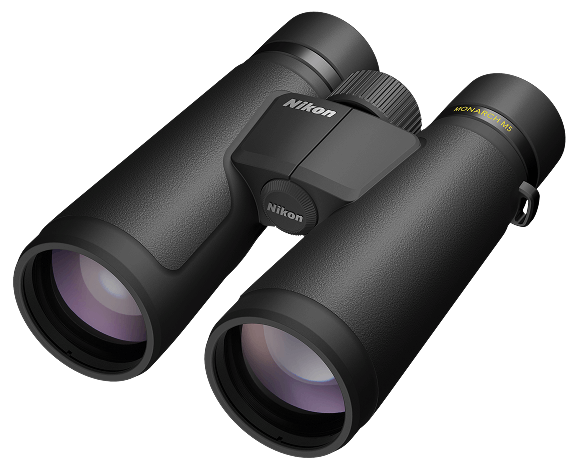
Does the M5 12x50 deliver 12x magnification and a more expansive apparent field?
Yes. Nikon lists 12x and 60.8° apparent field. Its real field is 5.6° (98 m at 1,000 m), narrower than the 10x50's 6° (105 m). The exit pupil is 4.2 mm and eye relief 16.4 mm.
Explore this need in the finder →Is ED glass confirmed for the M5 12x50 rather than inferred from the series name?
Yes. Nikon's launch release identifies ED glass for both new M5 50 mm sizes. The same evidence does not establish ED glass for the P7 50 mm sizes.
Explore this need in the finder →Can I tripod-mount the 12x50, and is the adapter confirmed in the standard box?
Nikon says the optional TRA-3 adapter enables a tripod connection. The product page does not list the standard package contents, so a requirement for the adapter to be included cannot be confirmed.
Explore this need in the finder →The MONARCH M5 12x50 trades some scene width and eye relief for 12x magnification and a 60.8° apparent field. It keeps the M5 family’s confirmed ED-glass claim in a 50 mm roof-prism body, making it the M5 choice for open distances or a settled observation point rather than quick, casual scanning.
Reach comes with a narrower real field
The first comparison is not complicated, but the two field figures are easy to misread. Nikon lists 5.6° real field and 98 metres at 1,000 metres for this 12x50. Both 10x50 siblings list 6° and 105 metres. The 12x also has a 60.8° apparent field, while the 10x has 55.3°. The real figure describes the angular width of the scene; the apparent figure describes the view through the eyepiece. If you track birds in clutter or search a long shoreline, the wider real scene of 10x models may be easier to sweep. If the subject is already located and distant, 12x can give more apparent size and an expansive eyepiece view.
Do not treat “12x” as an automatic upgrade. Hand movement is more obvious as magnification rises, and the higher number can make a fast-moving subject harder to keep in view. A supported lookout can help with long stationary observations. Nikon names the TRA-3 as an optional fitting; it is not among the items named in the M5 manual’s supplied-items list, so check a US retailer’s bundle rather than assuming it is included.
The M5 difference is a confirmed ED-glass statement
Nikon specifically says the new M5 10x50 and 12x50 use ED glass, and describes the M5 optical system with multilayer-coated lenses and prisms plus dielectric high-reflective and phase-correction prism coatings. That gives the M5 12x50 a documented optical-material feature to compare with the P7. Nikon’s inspected US P7 pages do not confirm ED glass for the 50 mm P7s; they do not justify presenting P7 as an opposite, confirmed no-ED configuration. The right conclusion is a positive M5 claim and an unknown P7 detail.
The listed exit pupil is 4.2 mm and relative-brightness index 17.6, compared with 5 mm and 25 for the 10x50s. Those values explain a specification difference but are not a direct low-light test or a promise that the M5 12x will look dim. Objective diameter, coatings, light transmission, sky conditions and your own vision all affect a real scene.
Eye relief deserves a personal check
The stated eye relief is 16.4 mm, 2.9 mm shorter than the 10x50 figure. The exact M5 50 mm manual describes four-position turn-and-slide eyecups and recommends full retraction for glasses, with two intermediate click stops for fine positioning. That helps explain how to start, not guarantee a full field: try the exact pair with your usual glasses and check for a complete circle without pressing the spectacle lenses against the oculars.
Close focus is listed at 14.8 feet. If your main subjects are close feeder birds or nearby butterflies, that may be more important than the 12x reach. The 12x50 is best considered for distant and mostly stationary viewing; it is not automatically the best option because its objective is 50 mm.
Body size, weight and weather limits
Nikon’s February 2026 specifications give dimensions of 166 × 133 × 58 mm and weight 650 g / 22.9 oz. The current Nikon US product page appears to place the gram value in an “oz” field, showing 650 oz; the press release and feature summary correct the intended ounces to 22.9. That is the instrument weight, not the carry-system total. The exact-model manual lists a binocular, one eyepiece cap, two objective caps, a strap and a soft case among items supplied; confirm any seller-added bundle separately.
Nikon rates the body to 1 metre for 10 minutes and says nitrogen filling resists fog; the M5 family is not for underwater use. The exact manual says to wipe water promptly and, after beach or seaside use, remove sand or salt with a cloth lightly dampened in fresh water, then dry thoroughly. It also advises protecting the binocular from sudden temperature changes and storing it in a dry, ventilated place. The rubber-armored, fiberglass-reinforced polycarbonate body is lighter than many full-size builds, not indestructible.
Who should choose it over its alternatives?
Pick this configuration when 12x reach and the 60.8° apparent field are higher priorities than the wider 10x real field, and when the M5’s ED-glass documentation matters. The PROSTAFF P7 12x50 also lists 12x, 60.8° apparent field and 5.6° real field, but its published weight is 22.8 oz and its page confirms a locking diopter ring and water-repellent objective and eyepiece surfaces. P7 ED status remains unconfirmed in the source set.
For moving subjects, a wider field or a longer stated eye point, compare the M5 10x50 or P7 10x50. The P7 10x50 is the lightest listed member of this four-model group at 22.2 oz; the M5 10x50 is 22.6 oz and has the 10x field with ED glass. If 12x becomes unsteady in your hands, neither high-apparent-field marketing nor an optical coating will remove hand movement. Try the magnification first, then let the feature difference settle a close choice.
Exact-model operating reference: Nikon Download Center — MONARCH M5 10x50/12x50 instruction manual listing (English text included in the PDF).
Key specifications
Key details at a glance
| Magnification | 12× |
|---|---|
| Objective diameter | 50 mm |
| Real field of view | 5.6° |
| Apparent field of view | 60.8° |
| Field width at 1,000 m | 98 m |
| Eye relief | 16.4 mm |
More specifications and setup details
| Exit pupil | 4.2 mm |
|---|---|
| Close focus distance | 14.8 ft |
| Manufacturer-published weight | 22.9 oz |
| ED glass confirmed for this exact model | Yes |
| Phase coatings confirmed | Yes |
| Lens and prism coatings | Nikon specifies ED glass, multilayer coatings on all lenses and prisms, and dielectric high-reflective multilayer plus phase-correction prism coatings for the M5 50 mm models. The page does not establish the P7's ED status or an M5 diopter-lock feature. |
| Water and fog protection | Nikon rates the body waterproof to 1 m / 3.3 ft for up to 10 minutes, states nitrogen filling and fog resistance, and says this series is not intended for underwater use. This is not diving equipment. |
| Tripod use | Nikon identifies the TRA-3 as an optional tripod adapter. It is not named in the model manual's supplied-items list; because this archive is the Japanese Download Center model-family record and US retail bundles may differ, a particular US package's adapter inclusion remains unknown. |
| Published weight note | The Nikon US product page displays 650 oz in a weight field, an apparent unit-label error. Its feature summary says 22.9 oz and the February 2026 launch table reports 650 g / 22.9 oz; this assessment uses 22.9 oz, not 650 oz. |
| Package contents | The exact model-family manual lists Binocular ×1, Eyepiece cap ×1, Objective lens caps ×2, Strap ×1, Soft case ×1 as items supplied. It does not name the optional TRA-3 adapter. Since US retailer bundle variations are not established by the Japanese Download Center manual, adapter inclusion in a particular US box remains unknown; confirm the seller's exact package. |
| Manufacturer-rated waterproof | Yes |
Use the exact model’s instructions for operating limits, supplied equipment and version differences.
Sources for this review
Sources for this assessment
- Nikon USA MONARCH M5 12x50 product page
- Nikon US launch announcement and four-model 50 mm comparison
- Nikon USA MONARCH M5 family feature page
- Nikon general binocular instructions, 936C_3_2107, English pp. 7–10
- Nikon Download Center MONARCH M5 10x50_12x50
- Nikon MONARCH M5 10x50/12x50 Instruction Manual, 1037C_1_2601
- CPSC Recall Retrieval API exact product-name query
- CPSC Recall Retrieval API exact product-name query
- CPSC Recalls API information
- Nikon USA Service Advisories index
- Nikon USA selected-binocular service advisory, 2023 (updated 2024)
- Nikon USA Sport & Recreational Optics strap advisory, 2022
- CPSC Recall Retrieval Web Services Programmer’s Guide
Choose your optical trade-off first.
Choose viewing purpose first, then magnification, objective size, scene width and any fit, weather or mounting constraint. A direct-Sun requirement is separate: only exact manufacturer-confirmed solar binoculars can pass it.