
On this page
Full-size HG 8x42 field and carry tradeoff
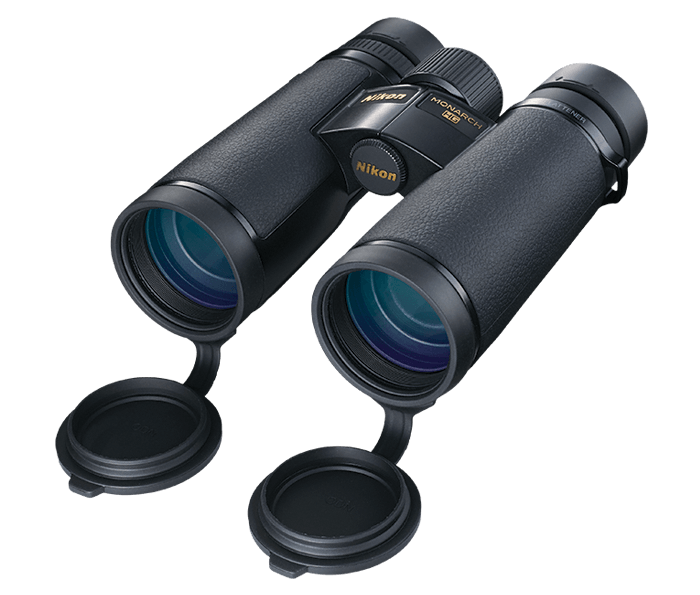
The MONARCH HG 8x42 keeps the HG family’s 8.3° real field while using a 42 mm objective; its 23.5 oz listed weight and longer eye-relief figure differ from the lighter 30 mm version. Choose by intended carry and eye fit, not by treating aperture or ED glass as a brightness test.
Explore the needs this model fits
Your needs, this model
Does it fit your priorities?
Is the wide-field 8x42 combination more important than the compact 30 mm body?
Yes. Nikon lists an 8.3° real field / 435 ft at 1,000 yd and a 5.3 mm exit pupil for the 8x42. The 23.5 oz weight is about 7.6 oz above the 8x30, although the published field is the same.
Explore this need in the finder →Do you need confirmed ED glass and a locking diopter, with weight capped at 24 oz?
The exact 16027 Nikon page confirms ED glass and locking-diopter control; the manual reports 23.5 oz. The diopter ring lifts to adjust and pushes down to lock. Weight is Nikon’s specification, not an independent measurement.
Explore this need in the finder →Does it suit a rainy handheld plan with close focus to seven feet?
Nikon’s exact four-size HG manual gives 5 m / 10 minute waterproof construction, nitrogen filling and 6.6 ft close focus. It is still not for underwater use or high-pressure water.
Explore this need in the finder →Nikon’s MONARCH HG 8x42 is the full-size version for shoppers who want an 8x binocular with a wide real scene and a larger exit pupil than the compact HG 8x30. Both models are listed at 8.3° and 435 feet at 1,000 yards. The 42 mm objective changes the exit pupil from 3.8 to 5.3 mm and the stated eye relief from 16.2 to 17.8 mm; it also raises manufacturer-listed weight from 15.9 to 23.5 ounces. Those numbers make the choice unusually clear: the 8x42 buys aperture and eye-relief margin with a larger carry burden.
Wide 8x viewing with more aperture
The HG 8x42 is the most compelling option in this family for a person who expects to watch through changing light or wants a comparatively generous eye position, while keeping the real field wide. Nikon lists a relative-brightness index of 28.1 and a 5.3 mm exit pupil. Those values are not independent evidence of a brighter or sharper image, but the exit-pupil difference is a real geometric consequence of 42 mm objectives at 8x rather than 30 mm at 8x.
The real field is 8.3° (435 feet at 1,000 yards) and the apparent field is 60.3°. Nikon markets a field-flattener lens system with the aim of a sharp, clear view toward the edges. The field-width number measures how broad the scene is, not whether a sample will look sharp all the way to its boundary. No laboratory resolution, contrast or low-light test is claimed here.
For a birding walk or wildlife watch where a wider field helps locate movement, the 8x power is the more natural choice over 10x. If a larger image of distant details matters more, compare the HG 10x42—but its published field narrows to 6.9° / 362 feet and its exit pupil to 4.2 mm.
Body and handling trade-offs
Nikon identifies the 8x42 as product 16027. The exact US page lists ED glass, phase-correction coating, dielectric high-reflective roof-prism coating, a locking diopter, waterproof/fogproof construction and a magnesium-alloy body. The manual confirms 665 g / 23.5 oz, 145 × 131 × 56 mm, and a 56–74 mm interpupillary adjustment range. These are published specifications. Whether the bridge, weight and eyecups feel comfortable is individual, not something a listing can prove.
The HG 8x42 and MONARCH M7 8x42 have the same published 8.3° / 435-foot real field, and both list ED glass and a locking diopter. The HG is distinguished here by its magnesium body and a 5 m / 10-minute immersion rating in the exact HG manual; the M7 manual gives its own separate and lower 1 m / 10-minute rating. That does not mean either binocular can be used underwater. The HG is 23.5 oz versus the M7’s 23.6 oz in the manufacturer-published figures, while its listed eye relief is longer than the M7’s 17.1 mm. That tenth-ounce difference is not a meaningful weight advantage; the aperture, water limit, handling and fit are better reasons to compare them. Compare those details, not product-line labels alone.
Its eyecups turn and slide, with two intermediate click stops. Nikon’s manual recommends full retraction for glasses but allows either intermediate stop to fine-tune the eye position. The 17.8 mm eye-relief number is useful when screening a shortlist, but does not guarantee full-field visibility with every frame shape.
Setup, package and water rules
Adjust interpupillary distance before focusing. Set the left-side view with the central focusing ring, then lift the right diopter ring, rotate it to balance the other eye, and push it down to lock. The manual lists the binocular, eyepiece cap, two objective caps, two objective rubber rings, a case and neck strap. Do not assume that every online listing includes the same extras; seller bundles can differ.
Nikon’s four-model HG manual rates the series to 5 m / 16.4 ft for up to 10 minutes and says it is nitrogen-filled. It permits rain, humidity and dust, yet explicitly prohibits underwater use and strong water pressure such as running water. Dry moisture before changing moving parts, and follow the manual’s cleaning directions. The rating is not an invitation to submerge a binocular deliberately.
For a used 8x42, check Nikon’s 2022 strap service advisory using both the serial and strap marking. Certain HG 8x42 serial ranges and strap codes are listed for replacement, but the advisory states that only affected straps are replaced and that the binocular body is not affected. The exact unit’s serial and strap need to be checked; the model name alone does not establish eligibility.
Who should prefer the 8x30 or 10x42?
If you carry optics for long stretches, the HG 8x30 keeps the same published real field for 7.6 ounces less and retains 6.6-foot close focus. Its smaller exit pupil and shorter eye relief are the price of that portability. The 10x42 moves to more magnification while retaining 42 mm objectives, but narrows the real scene and weighs half an ounce more. The HG 8x42 is the balanced choice only if the broader 8x scene and full-size aperture genuinely justify its size for you.
Tripod adaptability or an included adapter is not established by the exact product page or HG manual reviewed here. If a mount is essential, confirm the exact compatible accessory and package with Nikon before ordering rather than treating general binocular construction as proof. Otherwise, choose this model for handheld wide-field 8x viewing with a full-size objective and respect for the manufacturer’s water limits.
Key specifications
Key details at a glance
| Magnification | 8× |
|---|---|
| Objective diameter | 42 mm |
| Real field of view | 8.3° |
| Apparent field of view | 60.3° |
| Field width at 1,000 m | 145 m |
| Eye relief | 17.8 mm |
More specifications and setup details
| Exit pupil | 5.3 mm |
|---|---|
| Close focus distance | 6.6 ft |
| Manufacturer-published weight | 23.5 oz |
| ED glass confirmed for this exact model | Yes |
| Phase coatings confirmed | Yes |
| Locking diopter ring confirmed | Yes |
| Lens and prism coatings | Nikon’s HG 30 mm family page describes ED glass, multilayer coating over all lenses/prisms, a field flattener and scratch-resistant objective/eyepiece coatings. The exact HG 42 mm pages list ED glass, phase-correction and dielectric high-reflective roof-prism coatings, and the same field-flattener architecture. The manual table supports the exact model optical numbers; these remain manufacturer claims, not measured image tests. |
| Water and fog protection | The exact four-configuration HG manual rates each model waterproof to 5 m for up to 10 minutes and nitrogen-filled; it allows rain, humidity and dust but prohibits underwater use and strong water pressure. Nikon’s HG 30 mm family and 42 mm pages describe scratch-resistant lens protection. |
| Published weight note | Published Nikon manual values are 450 g / 15.9 oz for both 30 mm models, 665 g / 23.5 oz for 8x42, and 680 g / 24.0 oz for 10x42. These are manufacturer specifications, not independent measurements. |
| Package contents | Nikon English MONARCH HG manual p.2 lists the binocular, eyepiece cap, two objective caps, two objective rubber rings, case and neck strap. Seller-added bundles may differ. |
| Manufacturer-rated waterproof | Yes |
Use the exact model’s instructions for operating limits, supplied equipment and version differences.
Sources for this review
Sources for this assessment
Choose your optical trade-off first.
Choose viewing purpose first, then magnification, objective size, scene width and any fit, weather or mounting constraint. A direct-Sun requirement is separate: only exact manufacturer-confirmed solar binoculars can pass it.
Your needs, this model
42 mm binoculars: Nikon HG 8x or 10x
Choose it when: The 8x42 keeps the full-size objective while listing the wider real field and longer eye relief of these two HG configurations.
42 mm binoculars: Nikon HG 8x or 10x →