
On this page
Wide-field 30 mm ED glass in the HG configuration
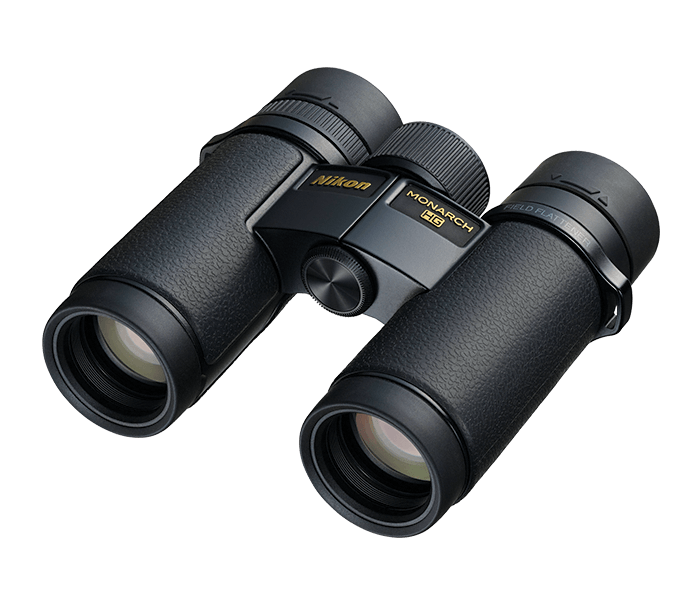
The MONARCH HG 8x30 combines confirmed ED glass with an 8.3° real field and a 15.9 oz listed weight. Its 30 mm objective keeps the body lighter than the HG 42 mm models, while published eye relief and exit pupil remain fit and geometry details rather than performance guarantees.
Explore the needs this model fits
Your needs, this model
Does it fit your priorities?
Does the 8x30 preserve the HG 8x42’s broad 435-foot field while staying below 16 ounces?
Yes. Nikon lists 8.3° / 435 ft at 1,000 yd, a 450 g (15.9 oz) body, 3.8 mm exit pupil and 16.2 mm eye relief. The field number gives the scene width, not a laboratory rating of edge sharpness.
Explore this need in the finder →Can glasses and a light carry limit both be part of the shortlist?
The published 16.2 mm eye relief and 15.9 oz mass meet a 16 mm minimum and 16 oz ceiling. That narrows the fit, but actual full-field comfort still depends on your frames and eye position.
Explore this need in the finder →Is it a weather-resistant handheld choice that focuses within seven feet?
Yes by Nikon’s manual: it is waterproof to 5 m for 10 minutes, nitrogen-filled, intended for rain/humidity/dust, and focuses to 6.6 ft. Nikon explicitly says it cannot be used underwater or exposed to strong water pressure.
Explore this need in the finder →The MONARCH HG 8x30 is the compact member of Nikon’s high-end roof-prism family, but it keeps the broad field width of the full-size 8x42. Nikon publishes 8.3° and 435 feet at 1,000 yards for both models. The 30 mm version weighs 15.9 ounces on the manufacturer’s specification table, against 23.5 ounces for the 8x42. That combination is the point: wide, fixed 8x viewing without carrying a full-size 42 mm binocular.
Quick assessment: wide field without the full-size weight
This is a good shortlist candidate for birding, wildlife and travel when the instrument will be carried between observations. It offers a roof-prism body, central focus, ED glass, a field-flattener design, a locking diopter and a published 6.6-foot close-focus distance. Nikon describes the 30 mm body as magnesium alloy with rubberized panels. These are manufacturer-listed features, not measurements of edge sharpness, contrast or durability.
If a light carry and broad real scene are both firm requirements, the 8x30 is easier to justify than the 10x30. It weighs the same as its 10x sibling but shows a wider real field and has a larger exit pupil and longer stated eye relief. You can use the 8x30 finder preset to see which other models meet those limits.
What the numbers mean in use
The 8x30’s 3.8 mm exit pupil is the arithmetic result of its objective and magnification; Nikon also lists a relative-brightness index of 14.4. Neither number is an independent low-light test. A 42 mm 8x model has a larger 5.3 mm exit pupil and a higher published brightness index, so it offers more pupil margin as light fades. The practical cost is weight: the HG 8x42 is 7.6 ounces heavier, even though it has the same listed 435-foot field.
Eye relief is 16.2 mm. That is the manufacturer’s distance, not a guarantee that a particular eyeglass frame will show the entire view. Nikon’s instructions say to retract the eyecups for glasses; two intermediate click positions are also available. Try the eye position with your usual glasses before deciding that any published number assures a comfortable fit.
The 8x30’s field-flattener claim matters to shoppers who value a wide scene, but the phrase “sharp to the periphery” is Nikon’s product description, not a result we independently tested. The listed 435 feet is scene width at a specified distance. It does not tell you how crisp the image will look from center to edge.
Setup and weather limits
The manual describes an uncomplicated setup: set your interpupillary distance, focus the left side with the central ring, then lift the right-eye diopter ring to unlock it, rotate to set the right side, and push the ring down to lock. Once adjusted, that lock helps preserve your setting during packing. The eyecups turn and slide, and the manual documents two intermediate stops. Standard listed items are the binocular, eyepiece cap, two objective caps, two objective rubber rings, a case and neck strap; retailer-added bundles can differ.
All four HG models share Nikon’s 5 m / 10-minute waterproof specification and nitrogen fill. The manual permits use in rain, dust and humidity, but explicitly says not to use the binocular underwater or expose it to strong water pressure. After a wet outing, wipe moisture away before moving the focus or diopter parts. Those cautions are more useful than treating “waterproof” as a blank cheque.
One ownership detail applies to older used HG units: Nikon’s service advisory identifies some straps by both serial-number range and strap code for replacement. Nikon says the body is unaffected; the notice concerns qualifying straps only. Check the actual serial and strap marking against Nikon’s current instructions rather than treating every HG as affected.
Who should choose another configuration?
Choose the HG 10x30 if extra magnification is more important than scanning area; the trade is 362 feet at 1,000 yards, a 3.0 mm exit pupil and 15.2 mm eye relief, with the same 15.9-ounce stated weight. Consider the HG 8x42 if you spend more time in dim conditions or want longer eye relief and accept a larger instrument. If you prefer a 30 mm body but your most important requirement is the widest possible scene, compare 8x models first rather than assuming that a larger apparent-field number means a wider landscape.
The HG is not a confirmed tripod package: Nikon’s exact manual does not list a tripod adapter among standard items, and no compatible adapter or in-box support is established here. If mounting is essential, check that requirement against an exact manufacturer listing before buying. For a handheld, weather-resistant 8x30 with unusually broad published field coverage for its size, however, this is the most coherent HG fit.
Key specifications
Key details at a glance
| Magnification | 8× |
|---|---|
| Objective diameter | 30 mm |
| Real field of view | 8.3° |
| Apparent field of view | 60.3° |
| Field width at 1,000 m | 145 m |
| Eye relief | 16.2 mm |
More specifications and setup details
| Exit pupil | 3.8 mm |
|---|---|
| Close focus distance | 6.6 ft |
| Manufacturer-published weight | 15.9 oz |
| ED glass confirmed for this exact model | Yes |
| Locking diopter ring confirmed | Yes |
| Lens and prism coatings | Nikon’s HG 30 mm family page describes ED glass, multilayer coating over all lenses/prisms, a field flattener and scratch-resistant objective/eyepiece coatings. The exact HG 42 mm pages list ED glass, phase-correction and dielectric high-reflective roof-prism coatings, and the same field-flattener architecture. The manual table supports the exact model optical numbers; these remain manufacturer claims, not measured image tests. |
| Water and fog protection | The exact four-configuration HG manual rates each model waterproof to 5 m for up to 10 minutes and nitrogen-filled; it allows rain, humidity and dust but prohibits underwater use and strong water pressure. Nikon’s HG 30 mm family and 42 mm pages describe scratch-resistant lens protection. |
| Published weight note | Published Nikon manual values are 450 g / 15.9 oz for both 30 mm models, 665 g / 23.5 oz for 8x42, and 680 g / 24.0 oz for 10x42. These are manufacturer specifications, not independent measurements. |
| Package contents | Nikon English MONARCH HG manual p.2 lists the binocular, eyepiece cap, two objective caps, two objective rubber rings, case and neck strap. Seller-added bundles may differ. |
| Manufacturer-rated waterproof | Yes |
Use the exact model’s instructions for operating limits, supplied equipment and version differences.
Sources for this review
Sources for this assessment
Choose your optical trade-off first.
Choose viewing purpose first, then magnification, objective size, scene width and any fit, weather or mounting constraint. A direct-Sun requirement is separate: only exact manufacturer-confirmed solar binoculars can pass it.
Your needs, this model
30 mm ED binoculars: compare compact 8x and 10x models
Choose it when: The HG 8x30 shares the M7’s published 8.3° real field and is 0.5 oz lighter by the manufacturer’s listing.
30 mm ED binoculars: compare compact 8x and 10x models →30 mm binoculars: broad 8x or closer 10x framing
Choose it when: Among the exact 30 mm options, this 8x model pairs a broad published real field with a 15.9 oz listed instrument weight.
30 mm binoculars: broad 8x or closer 10x framing →