
On this page
More 10x framing in the 42 mm HG body
The MONARCH HG 10x42 gives higher fixed power than the 8x42 with a 6.9° real field and 24.0 oz listed weight. Its field is narrower than the 8x42’s, while eye relief and exit pupil also differ; try the exact model at your eyecup setting if fit matters.
Explore the needs this model fits
Your needs, this model
Does it fit your priorities?
Does the 10x42 combine a full-size objective with the HG’s 10x field and apparent-view figures?
Yes. The exact US page lists 10x, 42 mm, 6.9° real field, 62.2° apparent field and 362 ft at 1,000 yd. The wider apparent number does not change the narrower real scene compared with the 8x42.
Explore this need in the finder →Can it meet a 10x42 brief requiring confirmed ED glass, a locking diopter and no more than 24 oz?
Yes on published specifications: Nikon lists ED glass, locking-diopter control and 24 oz for product 16028. Its field is 362 ft and eye relief 17 mm, so it does not retain the 8x42’s wider real scene or 17.8 mm eye relief.
Explore this need in the finder →Will the 10x42 handle rain and focus inside seven feet?
The HG family manual rates all four configurations to 5 m for up to 10 minutes and lists a 6.6 ft close-focus distance. It also prohibits underwater use and strong water pressure; that boundary matters as much as the rating.
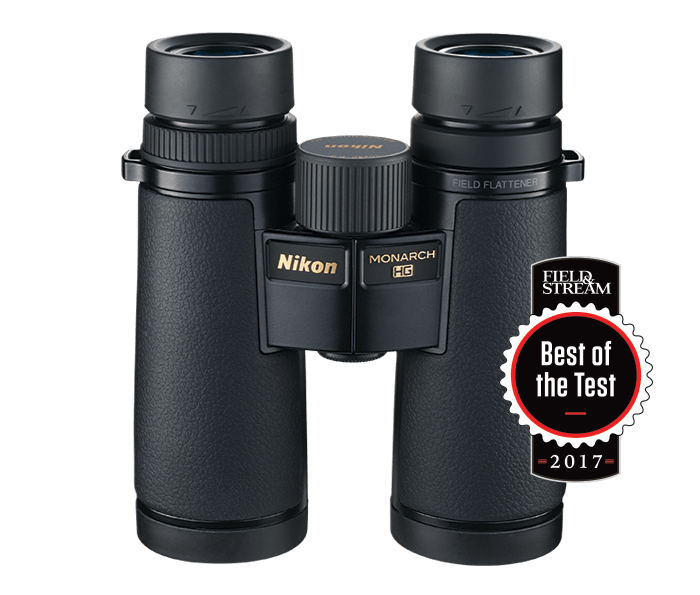
Explore this need in the finder →The MONARCH HG 10x42 is the family’s higher-power full-size choice. Nikon specifies a 6.9° real field, 362 feet at 1,000 yards, a 4.2 mm exit pupil and 17 mm eye relief. It weighs 24 ounces by the manufacturer’s table. The 10x image enlargement is useful when distant details matter, but the field is narrower than the HG 8x42’s and the instrument is heavier than either 30 mm option. It is a deliberate reach-over-sweep selection, not a universal upgrade.
Compare it with the 8x42 before choosing
Both HG 42 mm models use a 42 mm objective, share the same 6.6-foot close-focus figure, field-flattener design, magnesium-alloy body, locking diopter and Nikon’s 5 m / 10-minute water rating. The 10x42’s real field is 6.9° / 362 feet, while the 8x42 is 8.3° / 435 feet. The 10x has a 62.2° apparent field compared with 60.3° for the 8x, but the smaller real-field value is still the relevant one when asking how much of the landscape appears at once.
The 10x42’s 4.2 mm exit pupil is smaller than the 8x42’s 5.3 mm, and eye relief is 17 rather than 17.8 mm. In return, the higher magnification makes a distant object look larger under comparable conditions. Higher power can also make hand motion more visible. These figures explain the trade, but they cannot predict a person’s steadiness, comfort or preferred view.
Against the HG 10x30, the 10x42 preserves the same published real field, apparent field and 6.6-foot close focus. Its advantages on paper are a larger exit pupil (4.2 rather than 3 mm) and longer eye relief (17 rather than 15.2 mm). Its cost is 8.1 ounces of additional stated weight, which is noticeable if every ounce matters in a travel bag.
Optical and body features, without lab claims
The Nikon USA page for product 16028 lists ED glass, phase-correction and dielectric high-reflective prism coatings, roof prisms, waterproof/fogproof construction and the locking diopter. Nikon says multilayer coating is applied to lenses and prisms and describes light transmission of up to 92% or higher. That is a manufacturer claim, not a transmission measurement performed for this review.
The body is magnesium alloy with rubberized panels. At 680 g / 24 ounces and 145 × 131 × 56 mm, it is the largest and heaviest of the four HG configurations in the manual table. A 42 mm objective may be appealing for the larger exit pupil, but the product does not make the 10x field broad or the carry light. If an 8x view, wider tracking field or lighter weight dominates, select another model before you pay extra for specifications that do not answer your need.
The 17 mm eye-relief figure is a useful filter, particularly for glasses wearers, but it is not an assurance of a complete view through every frame. The manual describes turn-and-slide eyecups and two intermediate positions. Try the position with your usual glasses if you can; the eyewear and your eye placement matter as much as the number on the page.
Set the diopter and respect the water rating
Set the binocular’s interpupillary width first. Focus one eye with the center ring, then lift the right-eye diopter ring, adjust the other eye, and press the ring down to lock it. This keeps a personal correction from being bumped as easily in a bag. Nikon’s manual lists one binocular, an eyepiece cap, two objective caps, two objective rubber rings, a case and a neck strap as supplied items. A third-party bundle is not necessarily identical.
The four-model manual says the HG series can tolerate immersion to 5 m for up to 10 minutes and is nitrogen-filled. It allows humid, dusty and rainy conditions but says the binocular cannot be used underwater and warns against strong water pressure. Dry the body before adjusting movable pieces. These limits should be followed even when a rating sounds generous.
For used HG units, Nikon’s strap service advisory lists model-specific serial thresholds and strap identification codes. Nikon says the body is unaffected and that only qualifying straps receive replacement. Consult the actual serial and strap code against the manufacturer’s instructions. The advisory is not a body recall.
Who this size suits—and what to compare
The 10x42 is for someone willing to manage a 24-ounce binocular for extra apparent reach while retaining a 42 mm objective and a 4.2 mm exit pupil. It suits long-distance wildlife or event viewing better on paper than the 8x30 if magnification is the decisive factor. It is a weaker fit for quick broad-field scanning or someone who dislikes a heavier neck carry.
Compare the HG 8x42 if locating movement and maintaining a wide real scene matter more. Compare the HG 10x30 if portability beats the 42 mm’s aperture and extra eye relief. Other 10x42 models may be less expensive, but their exact objective, field, eye relief, water construction and confirmed features should be compared field by field; a series name or price alone cannot establish equivalence. If you require a tripod, Nikon’s exact HG documents checked here do not establish a compatible adapter or in-box mount. Verify it directly rather than assuming support.
Key specifications
Key details at a glance
| Magnification | 10× |
|---|---|
| Objective diameter | 42 mm |
| Real field of view | 6.9° |
| Apparent field of view | 62.2° |
| Field width at 1,000 m | 121 m |
| Eye relief | 17 mm |
More specifications and setup details
| Exit pupil | 4.2 mm |
|---|---|
| Close focus distance | 6.6 ft |
| Manufacturer-published weight | 24 oz |
| ED glass confirmed for this exact model | Yes |
| Phase coatings confirmed | Yes |
| Locking diopter ring confirmed | Yes |
| Lens and prism coatings | Nikon’s HG 30 mm family page describes ED glass, multilayer coating over all lenses/prisms, a field flattener and scratch-resistant objective/eyepiece coatings. The exact HG 42 mm pages list ED glass, phase-correction and dielectric high-reflective roof-prism coatings, and the same field-flattener architecture. The manual table supports the exact model optical numbers; these remain manufacturer claims, not measured image tests. |
| Water and fog protection | The exact four-configuration HG manual rates each model waterproof to 5 m for up to 10 minutes and nitrogen-filled; it allows rain, humidity and dust but prohibits underwater use and strong water pressure. Nikon’s HG 30 mm family and 42 mm pages describe scratch-resistant lens protection. |
| Published weight note | Published Nikon manual values are 450 g / 15.9 oz for both 30 mm models, 665 g / 23.5 oz for 8x42, and 680 g / 24.0 oz for 10x42. These are manufacturer specifications, not independent measurements. |
| Package contents | Nikon English MONARCH HG manual p.2 lists the binocular, eyepiece cap, two objective caps, two objective rubber rings, case and neck strap. Seller-added bundles may differ. |
| Manufacturer-rated waterproof | Yes |
Use the exact model’s instructions for operating limits, supplied equipment and version differences.
Sources for this review
Sources for this assessment
- Nikon USA exact MONARCH HG 10x42 product page
- Nikon USA current binocular category; MONARCH HG filter lists four current results
- Nikon MONARCH HG 8x30/10x30/8x42/10x42 English instruction manual
- Nikon 2022 Technical Service Advisory for straps
- CPSC exact model-name recall query for Nikon MONARCH HG 10x42
Choose your optical trade-off first.
Choose viewing purpose first, then magnification, objective size, scene width and any fit, weather or mounting constraint. A direct-Sun requirement is separate: only exact manufacturer-confirmed solar binoculars can pass it.
Your needs, this model
42 mm binoculars: Nikon HG 8x or 10x
Choose it when: This configuration is the 10x choice in the same 42 mm HG family, with nearly the same listed instrument weight as the 8x42.
42 mm binoculars: Nikon HG 8x or 10x →