
On this page
A compact 10x ED option with narrower framing
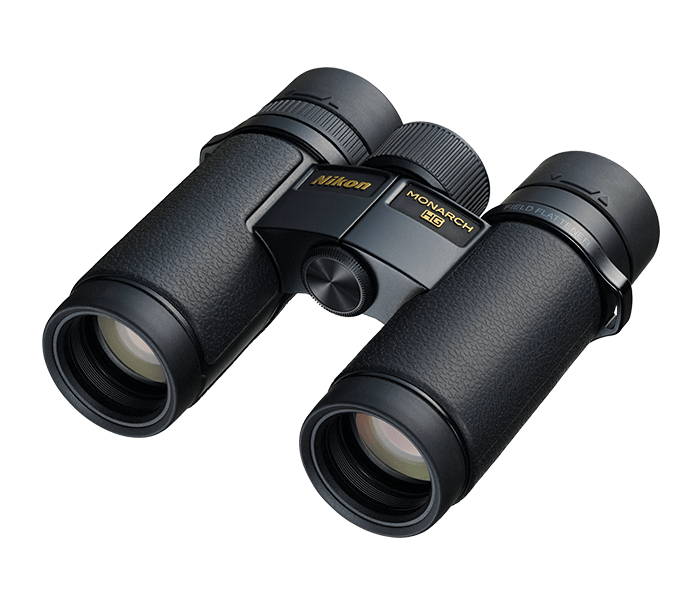
The MONARCH HG 10x30 keeps the 30 mm, 15.9 oz body while increasing fixed power over the 8x sibling; its real field is 6.9°. ED glass is confirmed for this exact SKU, but phase coating is not established in the reviewed record, so do not infer it from the ED label.
Explore the needs this model fits
Your needs, this model
Does it fit your priorities?
Do you want the 10x30’s greater magnification in a 15.9-ounce body?
Yes. Nikon identifies this as product 16576 with fixed 10x, 30 mm objectives and 450 g / 15.9 oz published weight. Choose it for a 10x compact configuration, not for the broadest real scene.
Explore this need in the finder →Does its 15.2 mm eye-relief figure fit a 15 mm minimum while keeping weight under 16 oz?
The manual’s published 15.2 mm and 15.9 oz figures meet those numeric limits. They do not guarantee that every eyeglass wearer will see the full field; try your own frame position if possible.
Explore this need in the finder →Is it waterproof and close-focusing enough for a wet feeder or rainy walk?
Nikon specifies 6.6 ft close focus and rates the entire HG family waterproof to 5 m for 10 minutes and nitrogen-filled. This is weather protection, not permission for underwater viewing or forceful rinsing.
Explore this need in the finder →The Nikon MONARCH HG 10x30 keeps the 30 mm family’s compact 15.9-ounce specification but trades away the 8x30’s wider real view. Its 10x magnification is paired with a 6.9° real field, 362 feet at 1,000 yards, a 3.0 mm exit pupil and 15.2 mm of stated eye relief. This is a reach-first compact binocular, not the easiest HG for tracking a bird across a broad scene or for viewing through glasses.
Choose it for 10x reach, not a wider landscape
The apparent-field figure can be misleading if it is read without the real field. Nikon lists 62.2° apparent field for this model, compared with 60.3° for the HG 8x30, yet the actual angular scene is narrower at 6.9° instead of 8.3°. Apparent field describes the view’s presentation through the eyepiece; real field describes how much of the scene is visible. If your main task is locating moving wildlife, that difference is more relevant than the larger apparent-field number.
On the other hand, 10x makes distant subjects look larger than 8x when other viewing conditions are comparable. That can be useful for stationary details. It also tends to make hand movement more noticeable, so a higher-power choice is not automatically easier for prolonged handheld use. The 10x30 weighs exactly the same as Nikon’s 8x30 on the family table, so there is no weight penalty for choosing the higher magnification within this pair.
For this exact model, Nikon publishes ED glass, a field-flattener system, a magnesium-alloy body, a locking diopter and scratch-resistant objective and eyepiece surfaces in the 30 mm family description. The page does not provide an independent resolution or color-fringing test. Treat those features as design information, not as proof that every observer will see a particular result.
Where the compact body helps—and where it does not
The 450 g / 15.9 oz specification is markedly lower than the HG 10x42’s 680 g / 24 oz. Both have 10x magnification, a 6.9° real field, 362 feet at 1,000 yards and a 62.2° apparent field. The 42 mm model’s larger objective raises the exit pupil from 3.0 to 4.2 mm and its stated eye relief from 15.2 to 17.0 mm. Those are useful differences for a shopper who accepts the extra 8.1 ounces in exchange for more aperture and a longer eye-relief figure.
A 3.0 mm exit pupil is the smallest in the HG family. Nikon’s relative-brightness index is 9.0. These are calculated or published specification values, not a low-light comparison measured in a lab. If twilight viewing or a forgiving eyeglass setup is essential, move up to a 42 mm model or compare another exact 10x configuration with longer stated eye relief.
At 15.2 mm, eye relief may work for some glasses wearers and may not work for others. Nikon advises retracting the eyecups for glasses and permits two intermediate click positions for finer placement. Frame depth, facial fit and the position of your eyes matter; the specification cannot settle those personal fit questions in advance.
Adjustment, supplied items and water boundary
Nikon’s English HG manual covers the 10x30 specifically. The binocular focuses centrally; the right-eye diopter ring lifts to unlock, rotates for correction, and pushes down to hold the setting. For setup, align the barrels to your interpupillary distance first, focus with one eye at a time, and only then lock the right side. The manual lists a case, neck strap, eyepiece cap, two objective caps and two objective rubber rings in the standard set. A retailer’s kit may add or substitute items.
The HG family is specified for 5 m of immersion for up to 10 minutes, with nitrogen filling, but Nikon is equally explicit that this is not a tool for underwater observation. Do not direct pressurized water at the body. Wipe moisture away before adjusting moving parts, and follow the manual’s lens-care instructions. Its 6.6-foot close focus can be relevant at a feeder or for nearby details, but it does not turn the binocular into a macro instrument.
Older used examples deserve one additional check: Nikon’s service advisory lists strap codes and serial thresholds for a strap-replacement program. The advisory says the optics body is not affected and the action is limited to qualifying straps. It is a model-and-unit check, not a reason to classify every HG 10x30 as recalled.
Alternatives by priority
For an 8x compact with a wider real field, compare the HG 8x30: same stated weight, 435-foot field, 3.8 mm exit pupil and 16.2 mm eye relief. For a 10x view with more aperture and longer eye relief, the HG 10x42 retains the same field figures while moving to a 4.2 mm exit pupil and 17 mm eye relief. That larger version is not a small change in a daypack: its published weight is 24 ounces.
Shoppers who want a wide apparent view can select that preference in the finder, but should not use it as a stand-in for a wide real field. The 10x30 suits the person whose own priority is fixed 10x reach in a short, light body and who can accept the smaller exit pupil, narrower real view and shorter eye-relief figure.
Key specifications
Key details at a glance
| Magnification | 10× |
|---|---|
| Objective diameter | 30 mm |
| Real field of view | 6.9° |
| Apparent field of view | 62.2° |
| Field width at 1,000 m | 121 m |
| Eye relief | 15.2 mm |
More specifications and setup details
| Exit pupil | 3 mm |
|---|---|
| Close focus distance | 6.6 ft |
| Manufacturer-published weight | 15.9 oz |
| ED glass confirmed for this exact model | Yes |
| Locking diopter ring confirmed | Yes |
| Lens and prism coatings | Nikon’s HG 30 mm family page describes ED glass, multilayer coating over all lenses/prisms, a field flattener and scratch-resistant objective/eyepiece coatings. The exact HG 42 mm pages list ED glass, phase-correction and dielectric high-reflective roof-prism coatings, and the same field-flattener architecture. The manual table supports the exact model optical numbers; these remain manufacturer claims, not measured image tests. |
| Water and fog protection | The exact four-configuration HG manual rates each model waterproof to 5 m for up to 10 minutes and nitrogen-filled; it allows rain, humidity and dust but prohibits underwater use and strong water pressure. Nikon’s HG 30 mm family and 42 mm pages describe scratch-resistant lens protection. |
| Published weight note | Published Nikon manual values are 450 g / 15.9 oz for both 30 mm models, 665 g / 23.5 oz for 8x42, and 680 g / 24.0 oz for 10x42. These are manufacturer specifications, not independent measurements. |
| Package contents | Nikon English MONARCH HG manual p.2 lists the binocular, eyepiece cap, two objective caps, two objective rubber rings, case and neck strap. Seller-added bundles may differ. |
| Manufacturer-rated waterproof | Yes |
Use the exact model’s instructions for operating limits, supplied equipment and version differences.
Sources for this review
Sources for this assessment
- Nikon USA exact MONARCH HG 10x30 product page
- Nikon USA current binocular category; MONARCH HG filter lists four current results
- Nikon MONARCH HG 8x30/10x30/8x42/10x42 English instruction manual
- Nikon 2022 Technical Service Advisory for straps
- CPSC exact model-name recall query for Nikon MONARCH HG 10x30
Choose your optical trade-off first.
Choose viewing purpose first, then magnification, objective size, scene width and any fit, weather or mounting constraint. A direct-Sun requirement is separate: only exact manufacturer-confirmed solar binoculars can pass it.
Your needs, this model
30 mm ED binoculars: compare compact 8x and 10x models
Choose it when: The HG 10x30 is the lighter listed 10x30 in this group, with a 6.9° real field and exact-model ED confirmation.
30 mm ED binoculars: compare compact 8x and 10x models →30 mm binoculars: broad 8x or closer 10x framing
Choose it when: The 10x30 keeps the 30 mm body weight while providing a higher fixed power for users who prefer more subject scale.
30 mm binoculars: broad 8x or closer 10x framing →