
On this page
A miniature 6x for wide framing and close subjects
The MIKRON 6x15 is the only exact 6x match, listed at 4.5 oz with an 8.0° real field and a 2 ft closest-focus figure. Its 10.1 mm eye relief is short, and the exact page does not establish waterproof protection, so treat it as a compact dry-use possibility rather than a glasses-fit or weather guarantee.
Explore the needs this model fits
Your needs, this model
Does it fit your priorities?
Does the MIKRON 6x15 have the wider real scene of the two current MIKRON sizes?
Yes. Nikon lists an 8° real field and 140 m at 1,000 m, versus 7° and 122 m for the 7x15. This is scene width, not a claim about image sharpness.
Explore this need in the finder →Can the 6x15 meet a three-foot maximum closest-focus requirement?
Nikon lists a two-foot closest-focus distance for this exact 6x model, so it clears a three-foot maximum. It is still binocular viewing, not macro photography.
Explore this need in the finder →Can this exact MIKRON satisfy an essential waterproof-rating requirement?
Nikon does not publish a waterproof rating on the inspected exact product page. Treat that as unconfirmed, so the model does not pass an essential waterproof filter.
Explore this need in the finder →The Nikon MIKRON 6x15 M CF is an unusually small, fixed-power Porro binocular intended for moments when carrying almost nothing matters more than collecting light. It weighs 4.5 ounces, has a published 8-degree real field and focuses to a stated 2 feet. That combination suits a daytime museum, a distant detail on a city walk or a small event binocular; it is a poor substitute for a full-size pair for wildlife at dusk. Its 15 mm objectives, short 10.1 mm eye relief and unconfirmed weather protection are real limits, not details to overlook because the body is charmingly small.
A miniature instrument with a broad scene
Nikon lists six-power magnification, a 15 mm objective and an 8-degree real field, equal to 140 m at 1,000 m. The broad scene and moderate magnification make it easier to bring a small object into view than a higher-power compact might be. The 45.5-degree apparent field is a separate eyepiece specification; it does not mean the scene is 45.5 degrees wide. A stated 2-foot closest-focus distance is useful for nearby displays and architectural details, though it cannot turn binoculars into a macro lens or magnifying loupe.
The 6x15 is the lower-power member of Nikon's two-size MIKRON listing. Against the black 7x15 M CF, it gives up one step of enlargement in return for a wider real field: 8 degrees and 140 m per kilometre versus 7 degrees and 122 m. The difference is most relevant when locating a performer or a detail that is not yet centered. It is not an image-quality test, and no maker-published field claim establishes how sharp the extreme edges look to every viewer.
It earns its place by being light
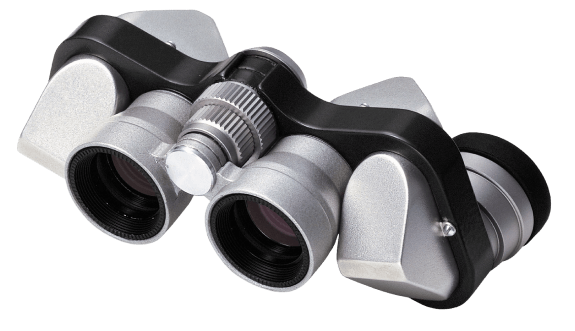
The product page calls the 6x15 an ultra-compact miniature, describes a silver aluminum finish and lists a 4.5-ounce (130 g) instrument weight. Nikon prints its dimensions as 1.8 by 4.2 inches under “Size (Length x Width).” Because the axis order is unusual for this shape, keep that published pair as printed rather than treating it as a measured pocket fit; the illustration shows the actual two-barrel body and center focusing wheel. It is a compact alternative for a coat pocket or small event bag, not a promise that it will disappear into every pocket without catching on other objects.
That low mass is a meaningful contrast with a conventional 8x25 such as Nikon's TRAVELITE 8x25, listed at 9.3 ounces with 25 mm objectives and 14 mm eye relief. The Travelite weighs about twice as much but provides a larger objective, longer stated relief and a full 8x view. For longer outdoor sessions, moving wildlife or changing light, the larger instrument is usually the more useful direction. The MIKRON makes sense when the best binocular is the one a person is willing to bring to a concert, gallery or short walk.
Small optics call for modest expectations
The 2.5 mm exit pupil is the objective diameter divided by the magnification. Nikon also lists a relative-brightness index of 6.3; that is a manufacturer specification, not a measured ranking of real-world image quality. A 15 mm front lens is not much light-collecting area, so this is not the tool to choose for dim woods, late-evening birding or sky observation. A larger 8x30 or 8x42 gives the observer more optical aperture and more comfortable viewing margin, at the cost of bulk and weight.
Eye relief is listed at 10.1 mm. That is short enough that people who keep prescription glasses on should try the actual view with their frames rather than assume the entire field will remain visible. A published relief figure cannot establish compatibility with a particular face, glasses frame or eye position. Nikon gives a 56–72 mm interpupillary range, which helps set a concrete fit boundary, but the comfort of the small eyepieces still needs an in-person check when possible.
Keep its limits visible
The inspected US product page does not publish a waterproof or fogproof rating, stabilization, a tripod interface or the exact items supplied in the box. That means the 6x15 should not be recommended when rain resistance, a fixed mount, an included strap or an included case is essential. Nikon's global Download Center explains that it only offers downloads for products it lists, and the product page does not show a MIKRON manual link in its support area. Exact model-specific instructions and package contents therefore remain unverified here; generic binocular guidance is not a substitute for them.
Nikon describes a multilayer coating and the classic compact Porro form. It does not provide an independent viewing test, edge-performance measurement or evidence that the finish is weatherproof. The exact-page-linked cutout shows the silver two-barrel model, but Nikon does not say whether it is a photograph or render; it cannot prove what is in the retail box. If a specific carrying accessory or instruction booklet is important, confirm it against the seller's exact package description before purchase.
Who should choose it?
Choose the MIKRON 6x15 M CF when the priorities are an especially light 6x instrument, a broad published scene and useful close focus in a dry, handheld outing. It is more suited to cultural outings and daytime detail checks than all-day birding. Choose the 7x15 if a little more magnification matters more than scene width, but read its contradictory close-focus claims carefully. Choose a larger 8x25 or 8x30 if longer eye relief, twilight margin or extended observation matters more than the 6x15's 4.5-ounce body.
Exact US model and specifications: Nikon MIKRON 6x15 M CF. Nikon's current catalogue identifies two MIKRON configurations; its direct product pages are 6x15 and 7x15. Alternative specification comparison: Nikon TRAVELITE 8x25.
Key specifications
Key details at a glance
| Magnification | 6× |
|---|---|
| Objective diameter | 15 mm |
| Real field of view | 8° |
| Apparent field of view | 45.5° |
| Field width at 1,000 m | 140 m |
| Eye relief | 10.1 mm |
More specifications and setup details
| Exit pupil | 2.5 mm |
|---|---|
| Close focus distance | 2 ft |
| Manufacturer-published weight | 4.5 oz |
| ED glass confirmed for this exact model | No |
| Lens and prism coatings | Nikon describes high-contrast multilayer coating on the exact product page; coating on every optical surface and other coating types are not established. |
| Water and fog protection | No manufacturer waterproof or fogproof rating appears on the inspected exact model page; environmental protection remains unknown and does not meet a required waterproof filter. |
| Published weight note | Nikon publishes weight for the instrument; it is not the packed kit weight. |
| Package contents | The exact page and inspected official sources do not establish a complete retail-box contents list. Confirm accessories with the exact seller if essential. |
Use the exact model’s instructions for operating limits, supplied equipment and version differences.
Sources for this review
Sources for this assessment

Choose your optical trade-off first.
Choose viewing purpose first, then magnification, objective size, scene width and any fit, weather or mounting constraint. A direct-Sun requirement is separate: only exact manufacturer-confirmed solar binoculars can pass it.
Your needs, this model
15 mm binoculars: choose between MIKRON 6x and 7x
Choose it when: The 6x15 is the more open-framing choice in this tiny pair: Nikon lists an 8.0° real field and 2 ft closest focus while keeping weight at 4.5 oz.
15 mm binoculars: choose between MIKRON 6x and 7x →Choosing a fixed 6x binocular
Choose it when: This exact MIKRON configuration is the single match for 6x. Its low instrument weight and short stated closest-focus distance make it a distinct compact option when 6x rather than a standard 8x or 10x is the intended power.
Choosing a fixed 6x binocular →