
On this page
Your needs, this model
Does it fit your priorities?
Which current 10x21 is the buying shortlist choice instead of this archived T01?
The T02 10x21 Black (16735) is current in Nikon USA’s filtered family. The T01 remains visible only as an archived reference and is not eligible for a current purchase match.
Explore this need in the finder →Can the archived T01 meet a waterproof requirement?
No. Nikon’s multilingual T01 manual says the product is not waterproof and advises avoiding rain and water drops.
Explore this need in the finder →Does the T01 have at least 9 mm of US-listed eye relief?
No. Nikon USA lists 8.4 mm; Nikon Japan lists 8.3 mm. Both fall below 9 mm.
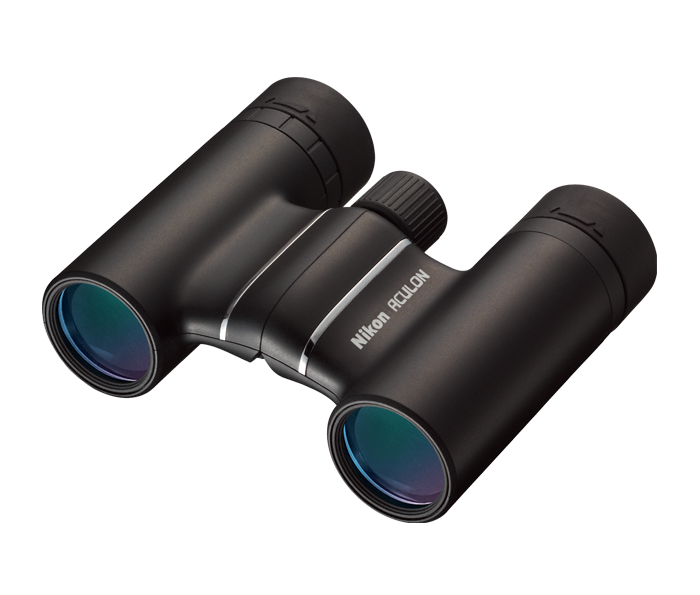
Explore this need in the finder →The Nikon ACULON T01 10x21 Black is an archived compact binocular that remains useful to identify when comparing an older unit or a secondhand listing. Its 10x21 roof-prism configuration is close to the current ACULON T02 10x21: both use 10x magnification, a 21 mm objective, a 5-degree real field and a 2.1 mm exit pupil. This is a model reference, not a current shopping recommendation. Nikon lists the T01 in its archived US binoculars section, and the exact page and manual give enough information to describe it without assuming that an old box, strap or coating is in new condition.
Small body, familiar 10x view
The US T01 page identifies SKU 8268 as the 10x21 Black and lists central focus, roof prisms, 5 degrees real field, 47.2 degrees apparent field, 87 metres at 1,000 metres, 9.8-foot close focus, 2.1 mm exit pupil, 8.4 mm eye relief, 3.4 by 4.1 inches and 6.8 ounces. Nikon’s Japanese specification page for the same named configuration reports 8.3 mm eye relief and 195 g, which is about 6.9 ounces. These are small differences between official sources, so the assessment gives greater weight to the US page for the US product while noting the other value rather than implying that every T01 unit has been weighed.
The technical resemblance to the current T02 10x21 is the main useful comparison. The T01’s published field, apparent field, exit pupil and closest focus align with the T02’s family specification; its US page is a fraction lighter and lists one tenth of a millimetre more eye relief, while the separate Japanese page reports a value closer to the T02. That is not evidence of a material comfort advantage. A buyer comparing used models should look at hinge looseness, focusing action, lens condition and included pieces on the actual item; those details are not settled by the model number.
Eye position and careful handling
The T01 manual covers the 8x21 and 10x21 versions. Its eyecup instructions say to retract the cups fully for glasses and extend them for bare eyes. The central focus and right-eyepiece diopter are independent controls: establish the right-eye correction once, then use the central focus wheel when the subject changes. At 8.4 mm on the US spec page (8.3 mm in Nikon’s Japan table), eye relief is short. Retraction is necessary for glasses but does not guarantee that a wearer will see the entire field. Anyone who must view with glasses should test the eyepoint before choosing this older compact.
The manual I found is multilingual but has no English section. Nikon’s Japanese safety text states that the T01 is not waterproof and says to avoid rain and water droplets; its operation and care guidance likewise warns against water, sand and mud. That means the T01 should be treated as a dry-use binocular. The manual’s age makes it especially important to inspect the particular unit: body condition, eyecup wear and the state of the case and strap can deteriorate even when a listing uses a complete-sounding model name.
When the finder should say no
The T01 does not belong in a current-product shortlist. It is marked reference-only so an archived black 10x21 can be compared with the current T02 without being presented as a fresh purchase. A water-protection requirement also rules it out: the manual says it is not waterproof. The finder can instead distinguish the current T02 sizes by 8x versus 10x, 21 mm objectives and real field; the 8x21 adds a broader view, a larger exit pupil and longer published eye relief, while the T02 10x21 keeps the 10x view and remains currently listed. If you are comparing a used T01 to a current option, the current model offers a more dependable route to a matching product and up-to-date package, not a guaranteed optical improvement over a well-kept T01.
What this reference can—and cannot—tell you
The documented specifications are useful for deciding whether a used T01 is the right class of binocular: tiny, fixed 10x, short eye relief, narrow real field and dry-use only. They do not establish how well a particular used sample holds alignment, whether the optics have internal haze, whether its eyecups still extend securely or whether a seller’s included accessories are original. The manual lists an instrument, hand strap, soft case and two eyepiece caps, but says objective caps are not included; that historical list should not be treated as a guarantee about the contents of a secondhand offer. A model-specific inspection is more important than a general claim that it is “like new.”
Identity and US specifications come from Nikon’s ACULON T01 10x21 Black page. The 10x21 / 8x21 family instructions are in Nikon’s official multilingual T01 manual; Nikon’s Japanese T01 specification page provides the second official measurement set.
Key specifications
Key details at a glance
| Magnification | 10× |
|---|---|
| Objective diameter | 21 mm |
| Real field of view | 5° |
| Apparent field of view | 47.2° |
| Field width at 1,000 m | 87 m |
| Eye relief | 8.4 mm |
More specifications and setup details
| Exit pupil | 2.1 mm |
|---|---|
| Close focus distance | 9.8 ft |
| Manufacturer-published weight | 6.8 oz |
| Lens and prism coatings | The exact T01 sources inspected here do not establish the full lens or prism coating stack, ED glass, phase correction, dielectric mirror treatment or oil/water repellency. |
| Water and fog protection | Nikon’s exact T01 manual is multilingual but contains no English section. The inspected Japanese text says the T01 is not waterproof and says to avoid rain or water drops; the manual provides no waterproof depth rating. |
| Published weight note | Nikon USA lists 6.8 oz on the archived exact US page; Nikon Japan’s exact T01 specification lists 195 g (about 6.9 oz). Values are not silently averaged; US value retained for US page display and both source entries are documented. |
| Package contents | The multilingual family manual lists a soft case, hand strap and two eyepiece caps, with no objective caps. Verify the individual older unit; this list is not an assurance about a secondhand seller’s carton. |
| Manufacturer-rated waterproof | No |
Use the exact model’s instructions for operating limits, supplied equipment and version differences.
Sources for this review
Sources for this assessment
Choose your optical trade-off first.
Choose viewing purpose first, then magnification, objective size, scene width and any fit, weather or mounting constraint. A direct-Sun requirement is separate: only exact manufacturer-confirmed solar binoculars can pass it.