
On this page
Your needs, this model
Does it fit your priorities?
Does the TrueTimber KANATI keep a 10x25 view in a sub-10-ounce body?
Yes. The exact US product 16641 is 10x25 and Nikon lists it at 9.7 oz / 275 g. That makes it a compact carry, not a stabilized or waterproof model.
Explore this need in the finder →Does this exact KANATI meet a 12 mm minimum eye-relief need and a closest-focus limit of 10 feet?
Nikon’s exact KANATI page and the shared A30 manual agree on 13 mm eye relief and 9.8 ft close focus, so its published values clear those numeric thresholds. The eye-relief figure still cannot guarantee comfort with every glasses frame.
Explore this need in the finder →Can the KANATI be required to meet an essential waterproof rating?
No. The inspected sources publish no waterproof depth or rating, and the A30 manual says to avoid rain and water splashes. Its outdoor camouflage appearance is not protection evidence.
Explore this need in the finder →The Nikon ACULON A30 10x25 TrueTimber KANATI is a light, folding 10x binocular with a camouflage exterior rather than a different magnification or objective size from the Black A30. Nikon lists it at 9.7 ounces, with a 5-degree real field and a 262-foot view at 1,000 yards. Its best case is a dry-weather outing where a small packable optic and a 10x view matter; its camouflage finish may be appealing for hunting gear, but it does not add optical performance or weather protection.
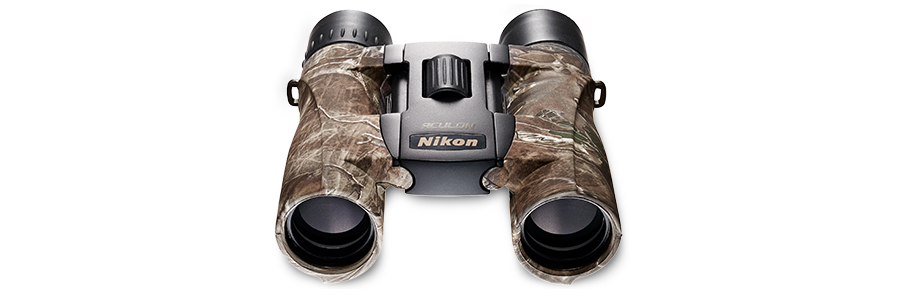
Image source and model notes
A 10x25 compact with a hunting-oriented finish
This configuration uses a roof prism and a central focus wheel. Nikon describes multilayer-coated lenses and a dual-hinge design; the foldable body is about 4.8 by 4.5 inches, with the shared A30 manual listing 1.7 inches in thickness. At 9.7 ounces (275 g), it is light enough for a small day pack without needing a neck strap during every walk. The TrueTimber finish is the visible difference to the Black model; it does not establish that the binocular is sealed, ruggedized for impact, or superior in low light.
The 10x power is the main viewing tradeoff. Nikon publishes a 5-degree real field—262 feet at 1,000 yards—which is narrower than a typical 8x25 view. More enlargement can help when a distant subject is already in view, while less surrounding scene can make it harder to locate or follow a fast-moving subject. Ten-power also makes hand movement more apparent than lower magnification. If the goal is relaxed scanning or locating birds in branches, an 8x25 is often a more forgiving handheld choice; if 10x reach and compact packing are deliberate priorities, the KANATI fits that brief.
Useful fit figures, with no universal glasses guarantee
Nikon’s exact KANATI page and the A30 family manual agree on the key 10x25 values: 13 mm eye relief, 2.5 mm exit pupil, 9.8-foot closest focus and 9.7-ounce weight. The stated eye relief is longer than the exact Black A30 page’s 10.6 mm figure, but 13 mm still cannot guarantee full-field comfort with every frame. If glasses are essential, fold the rubber eyecups down as the manual instructs and try the view if possible. The eye relief is a published measurement, not a promise about a particular prescription or bridge fit.
A 9.8-foot close-focus claim helps with nearby details, not macro viewing. Nikon’s 6.3 relative-brightness figure is a geometric rating associated with the 2.5 mm exit pupil; it is not a measured low-light score. A small objective gathers less light than 42 mm field binoculars, and nothing in the product page establishes transmission, edge sharpness or color fidelity. Treat the compact size and listed specifications as the evidence—not as a substitute for lab testing.
Setup and moisture limits
The shared English manual covers the ACULON A30 8x25 and 10x25. It shows how to merge the two images by setting interpupillary distance, focus the left eye with the center wheel and balance the right eye with the diopter-adjusting right eyecup. For glasses, fold the rubber eyecups down; for bare-eye viewing, extend them. The manual says not to rotate the controls beyond their limits, and it cautions against looking at the Sun through the instrument.
The manual also warns users to avoid rain, water splashes, sand and mud. Nikon does not provide a waterproof depth or duration, and the reviewed sources do not establish fogproofing. That makes the KANATI a fair-weather tool even though its camouflage pattern evokes outdoor use. A wet hunt, boat deck or exposed rainy trail calls for a model with a verified protection rating instead. After damp use, Nikon says to dry the instrument at room temperature, keep it in a cool, dry place and clean lens surfaces gently with a soft cloth or oil-free brush.
The manual’s standard box list is the binocular, neck strap, soft case and two eyepiece caps; objective lens caps are not included. It does not confirm a tripod adapter or tripod socket for the exact unit. Check the seller’s own included-items list for bundles and verify an open-box item, because accessories may have been lost even when they appeared in the original package.
How it differs from the Black A30
Both current US listings are named A30 10x25, weigh 9.7 ounces and publish the same real field. The KANATI’s exact product page agrees with Nikon’s shared manual on 13 mm eye relief and 9.8-foot close focus. Nikon’s Black page gives 10.6 mm and 8.2 feet, while the manual repeats the KANATI-family values for the 10x25. Since the source record does not explain whether that difference reflects an error or a distinct production specification, this review does not transfer the KANATI values to the Black body. Read the Black A30 review if that is the finish you are considering.
Use the finder’s 10x and 25 mm choices to compare these as compact fixed-power models. A minimum 12 mm eye-relief choice or a maximum 10-foot close-focus limit can keep the KANATI in consideration but cannot safely qualify the conflicting Black data. A six-degree real-field requirement removes both A30 10x25s, and an essential waterproof rating removes both. If you need the broader view or reliable rain protection, compare a separately documented 8x25 such as Nikon’s current TRAILBLAZER II 8x25. The KANATI makes most sense when the finish is wanted, the 10x framing suits the task, and the outing remains dry.
Sources: Nikon’s exact US ACULON A30 10x25 TrueTimber KANATI page, Nikon’s A30 family specifications, and the ACULON A30 8x25 / 10x25 instruction manual. The page-linked manufacturer product image visibly shows the KANATI body; photo/render status is not specified.
Key specifications
Key details at a glance
| Magnification | 10× |
|---|---|
| Objective diameter | 25 mm |
| Real field of view | 5° |
| Apparent field of view | 47.2° |
| Field width at 1,000 m | 87 m |
| Eye relief | 13 mm |
More specifications and setup details
| Exit pupil | 2.5 mm |
|---|---|
| Close focus distance | 9.8 ft |
| Manufacturer-published weight | 9.7 oz |
| Lens and prism coatings | Nikon identifies multilayer-coated lenses for the ACULON A30 family and for the TrueTimber KANATI page. No evidence establishes ED glass, phase correction, dielectric prism treatment or water/oil-repellent objective/eyepiece coatings for this exact 10x25. |
| Water and fog protection | The inspected Nikon manual warns against rain, water splashes, sand and mud. No waterproof depth, fogproof rating or fill gas is published in the exact sources; an essential waterproof requirement does not match. |
| Published weight note | Exact US page and shared A30 family manual list 9.7 oz / 275 g. Listed instrument weight is not a packed weight. |
| Package contents | The family manual gives the listed standard items, not the actual condition of a used, open-box or retailer-bundled unit. Confirm its own contents. |
Use the exact model’s instructions for operating limits, supplied equipment and version differences.
Sources for this review
Sources for this assessment
- Nikon USA current US ACULON filtered family listing
- Nikon USA exact US product page for ACULON A30 10x25 TrueTimber KANATI (product 16641)
- Nikon global ACULON A30 family specifications
- Nikon ACULON A30 8x25 / 10x25 shared instruction manual, English panel
- CPSC exact-name recall query for ACULON A30 10x25 TrueTimber KANATI
Choose your optical trade-off first.
Choose viewing purpose first, then magnification, objective size, scene width and any fit, weather or mounting constraint. A direct-Sun requirement is separate: only exact manufacturer-confirmed solar binoculars can pass it.