
On this page
Your needs, this model
Does it fit your priorities?
What range does the A211 8–18x42 cover?
It is the lower-starting A211 zoom: 8x through 18x with 42 mm objectives. Nikon’s listed 4.6° field and 241 feet at 1,000 yards are at the 8x setting; the source does not provide an equivalent high-power field here.
Explore this need in the finder →How do the 8–18x42 eye-relief sources differ?
Nikon’s product page gives 10.3 mm at 8x, while the manual gives 9.8 mm. Because those exact sources conflict, this assessment does not claim a single resolved eye-relief figure.
Explore this need in the finder →Does its zoom range mean the field stays wide at 18x?
No. Only the published low-power field is used here; Nikon’s cited figure does not describe 18x, and increased power narrows the view. Focus at high power before zooming, as the manual directs.
Explore this need in the finder →The archived ACULON A211 8–18x42 is a variable-power Porro binocular with a lever on top of the bridge and a 42 mm objective. Nikon lists its 4.6° real field and 241-foot width at the low 8x setting; it does not give a corresponding 18x field in the reviewed table. The long close-focus distance, short and conflicting eye-relief figures, 29.1-ounce weight and non-waterproof construction limit its use.
Variable power changes the job
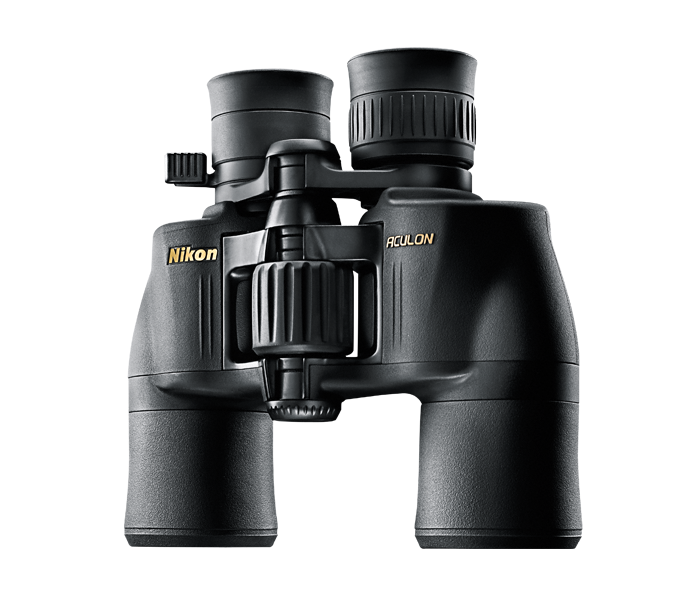
The 8–18x range lets an owner use the wider, lower-power setting to find a subject, then add magnification for a more stationary look. Nikon’s manual specifically says to adjust focus at a higher magnification before changing power, which helps reduce blur during the change. The zoom lever is visible on the exact manufacturer image, and the manual identifies fold-back eyecups for both A211 zoom models. This is a distinct operating sequence from the fixed A211 sizes, whose eyecups turn and slide.
At the minimum setting, Nikon publishes a 4.6° real field, or 241 feet at 1,000 yards, and an apparent field of 35.6°. Those numbers apply at 8x; the product information reviewed here does not supply a field width at 18x. Do not present the low-power field as if it described the full range. The exit pupil spans 5.3 mm at 8x to 2.3 mm at 18x, while Nikon gives a relative-brightness figure of 28.1 at the low setting only.
Changing power is useful when distance and target detail vary, but this model is not image stabilized. Higher magnification also makes movement more noticeable, and a narrower field can make it harder to find a moving subject. It is better thought of as a flexible adjustment for deliberate viewing than a promise that every setting will be easy to hold steady.
Fit and close focus are not compact-binocular strengths
The 8–18x42 measures 6.4 by 7.3 inches and weighs 29.1 ounces. Its 42 mm front lenses do not make the body small or light. A tripod adapter is not included in the A211 manual’s package list for this size; the TRA-2 is specified as separately sold. If a steady high-power viewing plan is essential, account for the support separately and confirm that a used package actually contains what its seller claims.
Close focus is about 42.7 feet, far longer than the fixed A211 8x42 or 10x42. That makes it poorly suited to a nearby feeder or close garden subjects. Nikon’s product page lists 10.3 mm eye relief at 8x, while the shared A211 manual lists 9.8 mm at the same minimum setting. These exact-source values conflict, so this review does not pick one as definitive. Either number is short for glasses; the fold-back eyecups do not guarantee a comfortable full-field view with every frame.
Environmental and package limits
The A211 manual says the family is not waterproof. No fogproof or nitrogen-filled rating is established by the reviewed exact sources. Keep the binocular dry and avoid rain or splashes. This is a material limit for an outdoor zoom that might otherwise look like a universal travel option.
The manual’s standard item list contains the binocular, eyepiece cap, objective caps, soft case and neck strap. It lists the TRA-2 adapter as included only with the fixed 16x50 and the 10–22x50 zoom. A package claim about an adapter for the 8–18x42 would need independent seller evidence.
Reference use and current alternatives
Nikon marks the 8–18x42 as archived in its US binocular catalogue and product data. This page is therefore a model reference for an existing 8251 unit, not a purchase recommendation; it has no retailer link. Its variable range, high-power focus routine and close-focus limit distinguish it from the 10–22x50, which starts at a higher power, carries a 50 mm objective and has different weight, field, eye relief and package details.
For a current shortlist, the Nikon ACTION ZOOM 10–22x50 is a separate present-day product, not a direct substitute by name alone. It offers a different range and objective size. If broad field, short-range focus, eye relief, waterproofing or light carry is essential, compare current fixed-power binoculars against those requirements instead of assuming that zoom flexibility solves them all. Owners of the A211 8–18x42 should follow the manual’s high-power-first focus routine, keep it dry and use the lower setting to acquire subjects before moving up.
Primary references: Nikon USA’s exact ACULON A211 8–18x42 page, the Nikon archived-binoculars directory and the A211 manual listing.
Key specifications
Key details at a glance
| Objective diameter | 42 mm |
|---|---|
| Real field of view | 4.6° |
| Apparent field of view | 35.6° |
| Close focus distance | 42.7 ft |
| Manufacturer-published weight | 29.1 oz |
| Lens and prism coatings | Nikon describes multilayer-coated lenses for ACULON A211. The reviewed exact sources do not establish ED glass, phase coating, dielectric coating, or nitrogen filling for this model. |
More specifications and setup details
| Water and fog protection | The A211 instruction manual explicitly says the binocular is not waterproof and cautions against rain and water splashes. Treat the model as dry-weather equipment. |
|---|---|
| Tripod use | Nikon identifies the TRA-2 as required for tripod mounting; the standard manual package does not include it for this exact configuration. |
| Manufacturer-rated waterproof | No |
| Tripod adapter in package | No |
Use the exact model’s instructions for operating limits, supplied equipment and version differences.
Sources for this review
Sources for this assessment
- Official Nikon US ACULON A211 8-18x42 product page
- Official Nikon Download Center listing the ACULON A211 Instruction Manual
- Nikon ACULON A211 Instruction Manual; English controls and specification pages inspected
- CPSC dated exact-product-name recall query (empty result; not a future guarantee)
- Nikon product-page-linked original image associated with exact ACULON A211 configuration

Choose your optical trade-off first.
Choose viewing purpose first, then magnification, objective size, scene width and any fit, weather or mounting constraint. A direct-Sun requirement is separate: only exact manufacturer-confirmed solar binoculars can pass it.