
On this page
Your needs, this model
Does it fit your priorities?
Does the 7x35 have the A211 family’s widest listed fixed-model field?
Yes. Nikon gives it a 9.3° real field and 488 feet at 1,000 yards. That broad sweep belongs to this exact archived 7x35 configuration, not to the 7x50.
Explore this need in the finder →Is the 7x35 the lightest exact configuration in the nine-model A211 group?
Nikon lists 24.2 ounces. That is lower than the A211 8x42 at 26.8 ounces and the full-size 50 mm models, though instrument weight is not a field-handling test.
Explore this need in the finder →Can it be treated as weather-sealed because its body is rubber-armored?
No. The A211 manual says the binocular is not waterproof. Rubber armor is not a water-resistance rating; this archive’s operating plan is dry weather only.
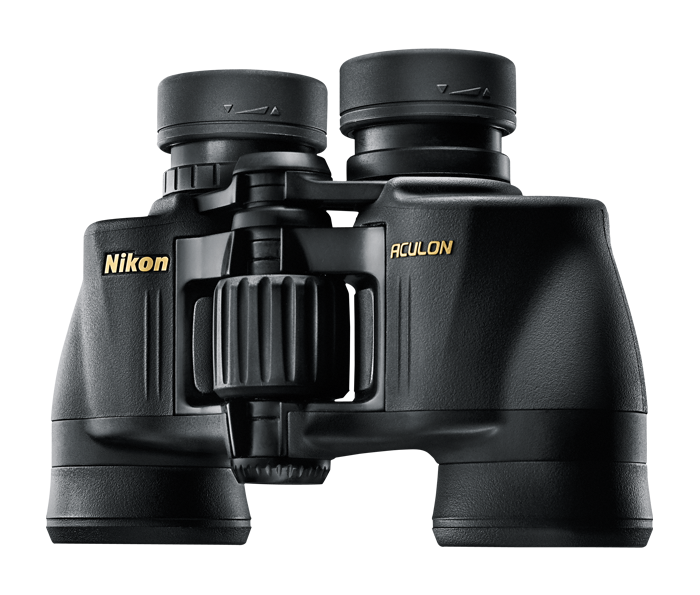
Explore this need in the finder →The archived ACULON A211 7x35 pairs modest 7× magnification with an exceptionally wide published 9.3° real field. It is the lightest A211 model in this nine-size family, but it is still a reference-only, non-waterproof Porro binocular with short stated eye relief; this page helps identify and understand an existing pair, not choose a current purchase.
A broad view is its defining specification
Nikon lists a 488-foot field at 1,000 yards, equivalent to 9.3° real field. That is unusually wide in this library and helps explain the 7x35’s role: keeping more of a moving scene visible while using less magnification than a 10x or 12x model. It can be a useful specification for a current owner scanning a treeline, looking across a sports field or trying to keep a bird in view while it moves between branches. The lower power is generally a more forgiving starting point for handheld use than high-power binoculars, although no field-stability test is claimed here.
Do not confuse real field with the apparent field through the eyepiece. The published apparent figure is 59.3°, not the expansive figure suggested by the 9.3° landscape field alone. The 7x50 shares a lower-power character, but its real field is only 6.4°. The A211 7x35 is the family member to identify when actual scene width, rather than a 50 mm objective, is the primary distinction.
Small objective, conventional handling
The 35 mm objective and 5 mm exit pupil make this more compact on paper than the full-size 50 mm models, but not pocket-sized. Nikon publishes 4.6 inches in length, 7.3 inches in width and 24.2 ounces. Its 7×35 format is considerably easier to carry than the 31–34 ounce A211 50 mm versions. The body uses a Porro-prism layout and central focus; a separate diopter adjustment lets the owner set the right-eye focus for unequal eyesight. Nikon lists a 56–72 mm interpupillary range.
That portability comes with a short 11.8 mm eye-relief figure. Glasses wearers may find it difficult to see the full field from behind their frames. Nikon’s shared A211 manual says the fixed-power models have turn-and-slide eyecups and advises glasses wearers to retract them. The exact point where your eye sees the entire scene depends on your frames and face, so the number is a warning to check fit, not a guarantee of comfort. For a new purchase, compare the current-reference 8x42 models and their separately documented fit; do not treat them as optical equivalents.
Nearby subjects and weather are important limits
Nikon’s exact page and A211 manual list a minimum focus of about 16.4 feet. That is useful for more distant subjects but will not bring a feeder, small plant or nearby butterfly into focus at arm’s length. If close subjects matter, select a current model with a shorter, verified close-focus distance rather than assuming the 35 mm objective improves near focus.
The manufacturer’s manual explicitly says the A211 family is not waterproof. A textured body or outdoor brand name does not establish rain sealing, fog resistance or nitrogen filling. Keep this model dry and do not use it as a marine or wet-weather pair. For an existing-owner plan, the manual lists the binocular, eyepiece cap, objective caps, soft case and neck strap; it does not list a tripod adapter for the 7x35. A TRA-2 adapter is separately sold if the owner wants stationary support.
How to use this reference page
Use the exact 8244 designation to distinguish this model from the A211 8x42 and other 35 mm compacts. Its 9.3° real field, 7× power and 24.2 ounce published weight define a wide-scene, lower-magnification design—not a promise of dusk performance. Nikon’s relative-brightness index of 25 is a specification, not a measured brightness result or a prediction of what every eye will see.
This is an archive reference because Nikon lists the A211 among archived binoculars. There is no purchase link here. For a current shortlist, compare the ACTION 8x42 if broad field and modest power are priorities, or choose a waterproof-rated model if weather protection is essential. The A211 is most useful today for recognizing an existing binocular, understanding its operating limits and deciding what a genuinely current alternative must improve.
Primary references: Nikon USA’s exact ACULON A211 7x35 page, Nikon’s binocular directory and archived-products list, and the ACULON A211 Download Center manual listing.
Key specifications
Key details at a glance
| Magnification | 7× |
|---|---|
| Objective diameter | 35 mm |
| Real field of view | 9.3° |
| Apparent field of view | 59.3° |
| Eye relief | 11.8 mm |
| Exit pupil | 5 mm |
More specifications and setup details
| Close focus distance | 16.4 ft |
|---|---|
| Manufacturer-published weight | 24.2 oz |
| Lens and prism coatings | Nikon describes multilayer-coated lenses for ACULON A211. The reviewed exact sources do not establish ED glass, phase coating, dielectric coating, or nitrogen filling for this model. |
| Water and fog protection | The A211 instruction manual explicitly says the binocular is not waterproof and cautions against rain and water splashes. Treat the model as dry-weather equipment. |
| Tripod use | Nikon identifies the TRA-2 as required for tripod mounting; the standard manual package does not include it for this exact configuration. |
| Manufacturer-rated waterproof | No |
| Tripod adapter in package | No |
Use the exact model’s instructions for operating limits, supplied equipment and version differences.
Sources for this review
Sources for this assessment
- Official Nikon US ACULON A211 7x35 product page
- Official Nikon Download Center listing the ACULON A211 Instruction Manual
- Nikon ACULON A211 Instruction Manual; English controls and specification pages inspected
- CPSC dated exact-product-name recall query (empty result; not a future guarantee)
- Nikon product-page-linked original image associated with exact ACULON A211 configuration

Choose your optical trade-off first.
Choose viewing purpose first, then magnification, objective size, scene width and any fit, weather or mounting constraint. A direct-Sun requirement is separate: only exact manufacturer-confirmed solar binoculars can pass it.