
On this page
Your needs, this model
Does it fit your priorities?
What is the trade-off of the A211 16x50’s higher fixed power?
Nikon lists a 4.2° real field, 220 feet at 1,000 yards and 3.1 mm exit pupil. The model also has a 29.5-foot close focus and weighs 32.6 ounces; stronger magnification can make hand movement more apparent.
Explore this need in the finder →Is a tripod adapter confirmed in the original Nikon package?
Yes. Unlike the other fixed A211 sizes, the standard manual package lists a TRA-2 with the 16x50. A particular used item may not retain the accessory, so verify what is actually present.
Explore this need in the finder →Does its supplied tripod adapter make it waterproof or fogproof?
No. The adapter is a mounting accessory; the manual’s not-waterproof warning still applies, and Nikon does not establish fogproofing for this configuration in the reviewed sources.
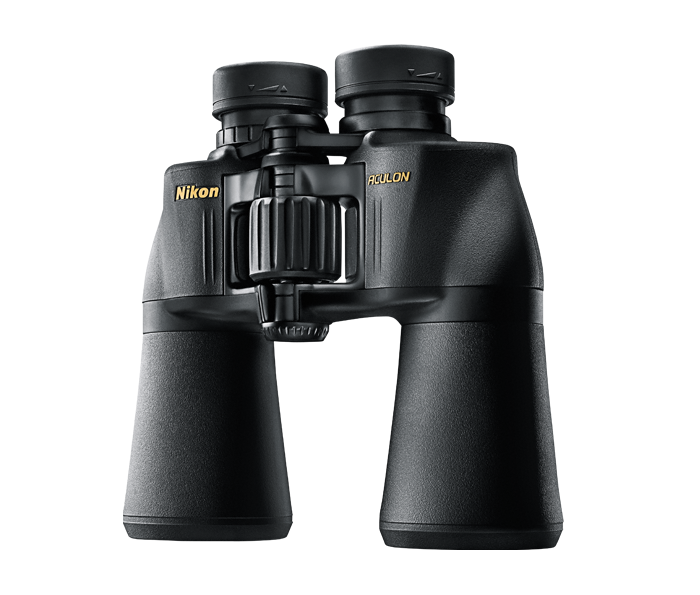
Explore this need in the finder →The ACULON A211 16x50 is the highest fixed magnification in the archived A211 family. Nikon lists a 4.2° real field, 220 feet at 1,000 yards, a 3.1 mm exit pupil and 32.6 ounces. Its 12.6 mm eye relief is short, but the shared manual identifies a TRA-2 tripod adapter as supplied with this size—a meaningful distinction for an owner planning stationary use.
High fixed power means a tighter actual field
The A211 16x50 gives more magnification than the other fixed 50 mm A211 sizes, but its real field narrows to 4.2°. Nikon lists a 60.8° apparent field, compared with 57.2° for the A211 12x50. The 16x50 therefore has the wider apparent-field figure while showing a narrower real scene. That difference is a useful reason to look at both numbers when evaluating binoculars.
At 220 feet across 1,000 yards, the real field can make reacquiring a moving subject more demanding than with the 7x50 or 10x50. Higher magnification can make a distant target look larger, but it also magnifies hand motion. Nikon does not describe image stabilization for the A211 16x50, and this review includes no handheld test. A steady position or a tripod is a more sensible plan for long looks than assuming high power will be comfortable in every posture.
The published 3.1 mm exit pupil and 9.6 relative-brightness index are the smallest/lowest of the fixed A211 family. These values should not be read as a measure of total image quality or a prediction of dusk performance. They are comparative optical specifications that help explain the design, not substitute for eyesight or a measured test.
Tripod support is the unusually complete package
Nikon’s exact manual marks the TRA-2 tripod adapter as supplied with the 16x50. It is the only fixed A211 configuration in the table with that named adapter included; the 10–22x50 zoom also has it. The rest of the common list is a binocular, eyepiece cap, objective caps, soft case and neck strap. This is a material package difference if an owner is building a stationary viewing setup, but it does not make the optical assembly waterproof or guarantee that a pre-owned package still contains every piece.
The body is 7 by 7.8 inches and Nikon publishes a 32.6-ounce weight. It is one of the heaviest A211 fixed sizes. The 12.6 mm eye relief is short for glasses wearers; the manual’s turn-and-slide eyecups retract for glasses, but fit still depends on the wearer. The central focus wheel, separate diopter and 56–72 mm interpupillary range apply to the shared fixed-power manual family.
Long-distance limits and care
Close focus is about 29.5 feet, the longest published distance among the fixed A211 sizes. It is a poor fit for a nearby feeder or short-range nature observation. The manufacturer says the A211 is not waterproof; avoid rain and splashes and do not assume fog resistance or nitrogen filling. Keep the optics dry and use the included adapter only with the correct tripod instructions.
How to compare it with current models
Nikon’s directory lists the A211 16x50 among archived binoculars, so this review is a reference-only aid for an existing 8250 unit rather than a product recommendation. It has no purchase link. When considering a current high-power pair, compare the exact current model’s real field, weight, eye relief, close focus, adapter and water rating. The current ACTION 16x50 is not a substitute by name alone; its own verified data and package details need to be compared on their own merits.
The A211 16x50 is most relevant for an owner who has a compatible tripod plan and understands the tight real field, long minimum focus, heavy body and dry-weather limit. If any of those are essential deal-breakers, identify a current alternative before buying accessories or relying on a used seller’s description. A manual-confirmed adapter in the original package is useful; it cannot compensate for an unsuitable viewing routine.
Primary references: Nikon USA’s exact ACULON A211 16x50 page, the Nikon archived-binoculars directory and the official A211 manual listing.
Key specifications
Key details at a glance
| Magnification | 16× |
|---|---|
| Objective diameter | 50 mm |
| Real field of view | 4.2° |
| Apparent field of view | 60.8° |
| Eye relief | 12.6 mm |
| Exit pupil | 3.1 mm |
More specifications and setup details
| Close focus distance | 29.5 ft |
|---|---|
| Manufacturer-published weight | 32.6 oz |
| Lens and prism coatings | Nikon describes multilayer-coated lenses for ACULON A211. The reviewed exact sources do not establish ED glass, phase coating, dielectric coating, or nitrogen filling for this model. |
| Water and fog protection | The A211 instruction manual explicitly says the binocular is not waterproof and cautions against rain and water splashes. Treat the model as dry-weather equipment. |
| Tripod use | The standard manual package lists the Nikon TRA-2 adapter with this exact configuration. |
| Manufacturer-rated waterproof | No |
| Tripod adapter in package | Yes |
Use the exact model’s instructions for operating limits, supplied equipment and version differences.
Sources for this review
Sources for this assessment
- Official Nikon US ACULON A211 16x50 product page
- Official Nikon Download Center listing the ACULON A211 Instruction Manual
- Nikon ACULON A211 Instruction Manual; English controls and specification pages inspected
- CPSC dated exact-product-name recall query (empty result; not a future guarantee)
- Nikon product-page-linked original image associated with exact ACULON A211 configuration

Choose your optical trade-off first.
Choose viewing purpose first, then magnification, objective size, scene width and any fit, weather or mounting constraint. A direct-Sun requirement is separate: only exact manufacturer-confirmed solar binoculars can pass it.