
On this page
Your needs, this model
Does it fit your priorities?
Does the A211 10x42 publish the same 6° real field as its contemporary ACTION 10x42?
Both exact pages state 6°, though the A211 and ACTION are distinct optical and body designs. Their field number alone does not establish equal image quality or handling.
Explore this need in the finder →Is this the lighter A211 10x size?
At 26.8 ounces, the 10x42 is lighter than the 10x50’s published 31.7 ounces, while keeping the same nominal 10x power. Its objective is smaller and its listed field narrower than the 8x42’s.
Explore this need in the finder →Does its rubber armor confirm rain protection?
No. The A211 manual says the product is not waterproof. The model is retained for dry-weather reference and should not meet an essential wet-use requirement.
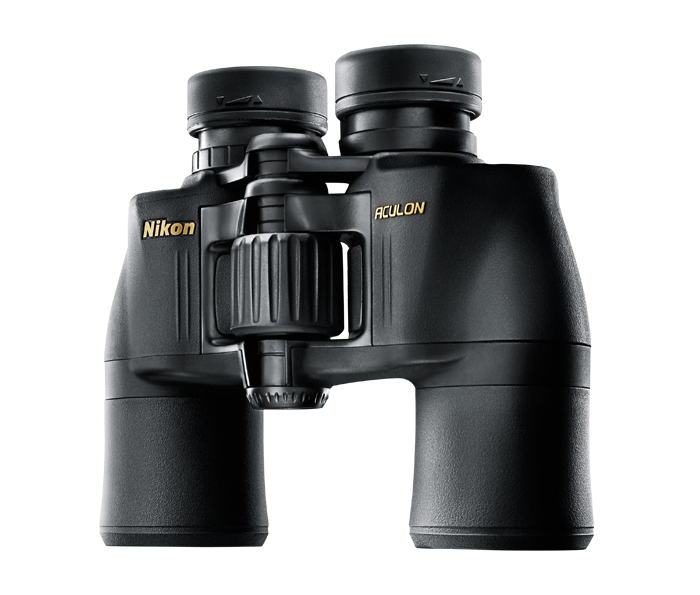
Explore this need in the finder →The archived ACULON A211 10x42 is a conventional 10× Porro binocular with a 42 mm objective and a published 6° real field. Its listed 314-foot view and 26.8-ounce weight make it a recognizable full-size alternative to pocket compacts, but 11.6 mm of eye relief and no waterproof rating narrow its usefulness. Treat this as a model-identification and existing-owner reference, not a current shopping recommendation.
Ten power in the 42 mm size
Nikon gives the 10x42 a 6° real field, or 314 feet at 1,000 yards. That field is smaller than the A211 8x42’s 8° and 420 feet, but it adds magnification while keeping the package in the same 42 mm class. The 4.2 mm exit pupil is also smaller than the 8x42’s 5.3 mm. Those are useful differences when a viewer is choosing between the two existing A211 models: the 10x42 favors a more enlarged subject, while the 8x42 gives a broader landscape window.
The 55.3° apparent-field figure is narrower than the A211 8x42’s 58.4°, so the 10x42 does not offer a wider-looking eyepiece view just because it magnifies more. Real and apparent fields describe different things. The actual scene angle matters for following movement; apparent field describes the presentation through the eyepiece. Neither number says how sharp the image will look to your eyes or how easy the binocular will be to hold at a particular distance.
Focus, fit and weight
This model uses a central focusing ring and Porro prisms. Nikon lists a 16.4-foot close-focus distance, 11.6 mm eye relief, 56–72 mm interpupillary adjustment and 26.8 ounces. The shared A211 manual specifies turn-and-slide eyecups for fixed-power sizes and recommends retracting them for glasses wearers. With only 11.6 mm of stated eye relief, eyeglass wearers should expect to test the viewing position rather than assume they can see the full field.
The 16.4-foot close-focus minimum is more useful for nearby subjects than the 50 mm A211 sizes, several of which focus at 23–29.5 feet. It still is not a close-up instrument for insects on a nearby flower or a bird a few yards from a window. If near focus is essential, check the published distance of each current alternative before using the objective diameter as a substitute for that fact.
Nikon’s exact page lists 26.8 ounces. The length and width are 5.7 by 7.3 inches, so the body is not a pocket option. The A211 manual says the family is not waterproof; do not take it into rain, spray or conditions where water exposure is a normal part of the plan. It does not confirm a fogproof or nitrogen-filled rating either.
Tripod support is an extra
Nikon says the TRA-2 tripod adapter is available separately for this configuration. The manual’s supplied-items list names the binocular, eyepiece cap, objective caps, soft case and neck strap; it lists the adapter as included only with the 16x50 and 10–22x50 models. A retailer-added bundle is a different package and has not been verified here. If an adapter is required for a stationary setup, do not presume it arrived with an A211 10x42.
Who should keep this reference nearby?
This page is useful to someone identifying an existing 8246 model, comparing the A211 10x42 with its 8x42 sibling or checking what must be purchased separately for a supported tripod setup. Its 10x/42 mm/6° combination is a clear specification profile, but the archived line is not presented as a currently available choice. There is no shopping link attached.
For a current 10x42 shortlist, compare the ACTION 10x42 and MONARCH M5 10x42 on the exact points this older model does not settle: weather protection, weight, field width, close focus and glasses fit. A 10x label alone does not make these instruments interchangeable. If waterproofing is essential, the A211 is out; if the old pair is already yours, protect it from moisture and use the manual’s focus and eyecup guidance rather than expecting current-model sealing.
Primary references: Nikon USA’s exact ACULON A211 10x42 page, the Nikon archived-binoculars list, and the official A211 manual listing.
Key specifications
Key details at a glance
| Magnification | 10× |
|---|---|
| Objective diameter | 42 mm |
| Real field of view | 6° |
| Apparent field of view | 55.3° |
| Eye relief | 11.6 mm |
| Exit pupil | 4.2 mm |
More specifications and setup details
| Close focus distance | 16.4 ft |
|---|---|
| Manufacturer-published weight | 26.8 oz |
| Lens and prism coatings | Nikon describes multilayer-coated lenses for ACULON A211. The reviewed exact sources do not establish ED glass, phase coating, dielectric coating, or nitrogen filling for this model. |
| Water and fog protection | The A211 instruction manual explicitly says the binocular is not waterproof and cautions against rain and water splashes. Treat the model as dry-weather equipment. |
| Tripod use | Nikon identifies the TRA-2 as required for tripod mounting; the standard manual package does not include it for this exact configuration. |
| Manufacturer-rated waterproof | No |
| Tripod adapter in package | No |
Use the exact model’s instructions for operating limits, supplied equipment and version differences.
Sources for this review
Sources for this assessment
- Official Nikon US ACULON A211 10x42 product page
- Official Nikon Download Center listing the ACULON A211 Instruction Manual
- Nikon ACULON A211 Instruction Manual; English controls and specification pages inspected
- CPSC dated exact-product-name recall query (empty result; not a future guarantee)
- Nikon product-page-linked original image associated with exact ACULON A211 configuration

Choose your optical trade-off first.
Choose viewing purpose first, then magnification, objective size, scene width and any fit, weather or mounting constraint. A direct-Sun requirement is separate: only exact manufacturer-confirmed solar binoculars can pass it.