
On this page
Your needs, this model
Does it fit your priorities?
What distinguishes the A211 10–22x50 from the 8–18x42?
The 10–22x50 begins at higher 10x power, reaches 22x and uses 50 mm objectives. Its 3.8°/199-foot field is published at 10x; its larger objective and reach come with a 33.9-ounce listed weight and 49.2-foot close focus.
Explore this need in the finder →Is the TRA-2 adapter listed in the 10–22x50 package?
Yes. The manual lists it with this zoom, unlike 8–18x42 and other A211 configurations. Verify it is still present when identifying a secondhand package.
Explore this need in the finder →Should the 10x field figure be read as the view at 22x?
No. The 3.8° and 199 feet at 1,000 yards are at 10x. The A211 manual recommends focusing at high power before changing zoom; the wide low-power field does not promise an equally wide high-power scene.
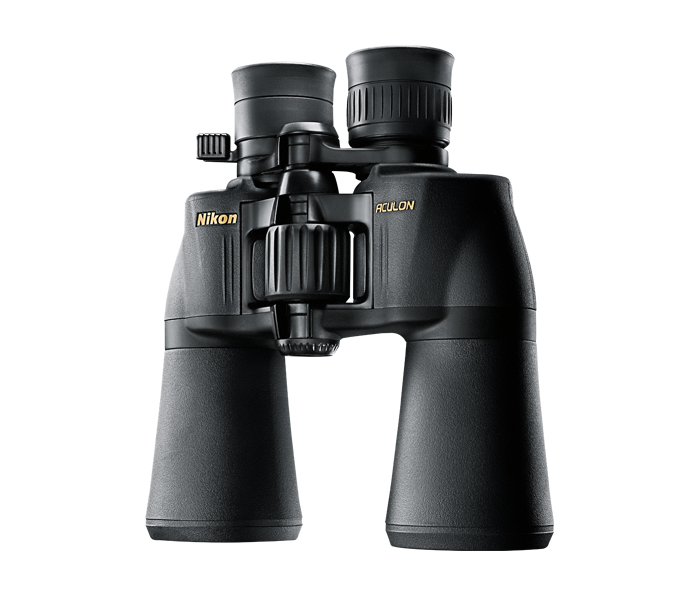
Explore this need in the finder →The archived ACULON A211 10–22x50 is the wider-range A211 zoom and the largest objective in the family’s variable-power pair. Nikon lists the field, 199 feet at 1,000 yards, exit pupil, brightness and eye relief at the low 10x setting; the manual supplies a TRA-2 adapter for this exact model. Its 33.9-ounce body, 49.2-foot close-focus distance, very short eye relief and non-waterproof construction make the operating plan deliberate rather than general-purpose.
Start at ten power, then zoom for detail
The 10–22x range covers noticeably more magnification than a fixed 10x50, but the field specification is only given at the 10x starting point: 3.8° real, 36.7° apparent and 199 feet at 1,000 yards. Nikon lists a 5.0 mm exit pupil and relative-brightness index of 25 at 10x. The exit pupil narrows to 2.3 mm at 22x according to the manufacturer’s range. There is no published high-setting field value in the exact sources reviewed, so do not assume that the 199-foot scene remains visible after zooming in.
Nikon’s manual recommends focusing at a higher magnification before changing power, to minimize blur when zooming. In practice, that means setting up the instrument carefully before using the lever, not treating the range as a one-touch solution to every change in viewing distance. The higher setting can enlarge a distant subject, but also magnifies hand movement and makes target acquisition more demanding. This is not an image-stabilized binocular.
The fold-back eyecups are specific to the A211 zoom models. The 8.6 mm eye-relief figure is stated at the minimum 10x setting and is especially short for glasses wearers. The manual tells glasses wearers to fold the eyecup ends back. Frame shape and eye position still decide whether the whole field is visible, and there is no basis to promise comfortable high-power viewing from the specification alone.
Stationary setup and in-box support
This model is 7.8 by 7.8 inches and weighs 33.9 ounces according to Nikon. It is the heaviest A211 listed here, before strap, case or any other accessory. The family manual says the TRA-2 adapter is supplied with the 10–22x50, distinguishing it from the 8–18x42, for which the same adapter is sold separately. The manual’s base list also includes the binocular, eyepiece cap, objective caps, soft case and neck strap.
That adapter makes tripod mounting a documented option, but it does not resolve the instrument’s close-focus limitation. Nikon lists a minimum focus of about 49.2 feet—the longest distance in the nine-model A211 table. Nearby birds, plants and window-side subjects can remain too close to focus. The 50 mm objectives do not override this specification.
Weather and archived status
Nikon’s manual expressly says the A211 is not waterproof. The 10–22x50 is not a safe choice for rain, boat spray or damp observation simply because a large objective is often associated with outdoor use. The exact sources reviewed do not establish fogproof or nitrogen-filled construction for this model. Keep it dry and follow Nikon’s care instructions.
The product data marks the 10–22x50 as archived, and Nikon places the A211 line in its archived-binoculars section. It remains useful as an identification reference for an existing 8252 unit, but this review is not a current purchase recommendation and contains no shopping link. Its zoom lever and included tripod adapter are model-specific details that should not be assumed for another binocular with a similar range.
Compare the actual need, not just the range
A current owner who already has this model may value the ability to switch from 10x to 22x while observing a stationary distant subject. A new shopper should compare current 10–22x products and fixed-power alternatives by field at the acquisition setting, eye relief, close focus, weight, weather rating and exact package contents. The current ACTION ZOOM 10–22x50 is a separate design with materially different specifications; the shared range does not establish equivalence.
If the required use involves glasses, a subject inside 50 feet, wet weather or extended handheld viewing, those constraints are more important than the upper 22x number. The A211’s published limits may disqualify it even when magnification is appealing. Use this page to recognize the old product and follow its manual; make a current shortlist from models whose exact facts meet the whole operating plan.
Primary references: Nikon USA’s exact ACULON A211 10–22x50 page, Nikon’s archived binoculars list and the ACULON A211 manual listing.
Key specifications
Key details at a glance
| Objective diameter | 50 mm |
|---|---|
| Real field of view | 3.8° |
| Apparent field of view | 36.7° |
| Eye relief | 8.6 mm |
| Close focus distance | 49.2 ft |
| Manufacturer-published weight | 33.9 oz |
More specifications and setup details
| Lens and prism coatings | Nikon describes multilayer-coated lenses for ACULON A211. The reviewed exact sources do not establish ED glass, phase coating, dielectric coating, or nitrogen filling for this model. |
|---|---|
| Water and fog protection | The A211 instruction manual explicitly says the binocular is not waterproof and cautions against rain and water splashes. Treat the model as dry-weather equipment. |
| Tripod use | The standard manual package lists the Nikon TRA-2 adapter with this exact configuration. |
| Manufacturer-rated waterproof | No |
| Tripod adapter in package | Yes |
Use the exact model’s instructions for operating limits, supplied equipment and version differences.
Sources for this review
Sources for this assessment
- Official Nikon US ACULON A211 10-22x50 product page
- Official Nikon Download Center listing the ACULON A211 Instruction Manual
- Nikon ACULON A211 Instruction Manual; English controls and specification pages inspected
- CPSC dated exact-product-name recall query (empty result; not a future guarantee)
- Nikon product-page-linked original image associated with exact ACULON A211 configuration

Choose your optical trade-off first.
Choose viewing purpose first, then magnification, objective size, scene width and any fit, weather or mounting constraint. A direct-Sun requirement is separate: only exact manufacturer-confirmed solar binoculars can pass it.