
On this page
Your needs, this model
Does it fit your priorities?
Does the 8x30 EII have a broad published apparent field for scanning?
Yes. Nikon lists 63.2° apparent field and 8.8° real field for the 8x30 EII. These are separate field measures, and their figures do not establish edge sharpness. This 100th Anniversary SKU remains a reference-only model, not a current match.
Explore this need in the finder →Does the special metallic-gray edition meet an essential waterproof requirement?
No. Nikon's EII family product guide says the binocular is not waterproof and warns against rain and splashes. The anniversary finish and case do not change that. A current weather-rated 8x30 such as the P7 is the more defensible choice if water resistance is essential.
Explore this need in the finder →Is its published eye relief at least 14 mm for a strict glasses-fit minimum?
No. Nikon lists 13.8 mm for the 8x30 EII family, just below that selected threshold. The anniversary edition is not a current recommendation in any case; try another model with more published relief and verify fit with your own frames.
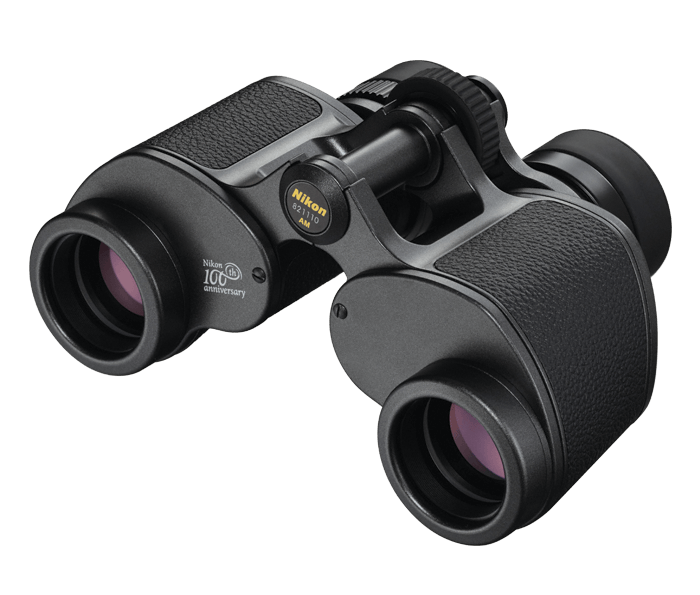
Explore this need in the finder →The Nikon 8x30 EII 100th Anniversary (US product 16046) is an archived commemorative version of Nikon’s classic fixed-power Porro binocular, not a new optical generation or a current buying recommendation. Nikon identifies the special version by its metallic gray finish, anniversary logo, special strap and case, and a worldwide production limit of 400. Its 8x30 optical figures come from Nikon’s EII family specifications: an 8.8° real field, 63.2° apparent field and 13.8 mm eye relief. Nikon’s US page now marks product 16046 archived and unavailable.
What the anniversary edition changes
Nikon’s announcement calls this a commemorative edition of the 8x30 E II rather than a different magnification or optical configuration. The documented distinction is external and collector-oriented: a metallic gray finish, 100th Anniversary branding, and a special strap and case. Nikon limited production to 400 units worldwide. That can matter to someone who wants a commemorative piece or is identifying one already owned, but it is not evidence of higher resolution, improved low-light performance, or a different warranty. Nikon’s standard US product page is archived and out of stock, so this entry is retained for reference rather than linked as a current purchase.
A fixed 8x30 Porro with an unusually open listed field
The EII’s central-focus Porro design is built around a broad view rather than a compact roof-prism shape. Nikon lists an 8.8° real field and a 63.2° apparent field for the 8x30. The real field describes the scene width; the apparent field describes how expansive that field looks through the eyepieces. Neither number promises edge-to-edge sharpness, and neither is a substitute for trying the binocular with your own eyes. Nikon’s 154 m field at 1,000 m, 3.8 mm exit pupil, and 14.4 relative-brightness index are published specifications, not independent measurements or guarantees of dusk performance.
Eight power is a useful middle ground for scanning branches, shorelines, or wildlife without the extra hand-motion visibility that often accompanies higher magnification. The 30 mm objectives keep this smaller than many 42 mm binoculars, but Nikon’s stated 575 g mass is still about 20.3 oz. It is a substantial hand-held instrument compared with slim travel compacts. Its die-cast magnesium-alloy body, multilayer-coated lenses and prisms, and lead- and arsenic-free Eco-glass are part of the documented EII family specification. This is a fixed 8x configuration, not a zoom binocular.
Fit, focusing and close observation
Nikon lists a 56–72 mm interpupillary adjustment range, a central focus ring, and a separate diopter ring. Set the hinge until the two circles merge into one, then use the diopter and center focus to accommodate the difference between your eyes and subject distance. The EII family guide also lists an approximate 3 m close-focus distance, which makes nearby nature observation possible without turning the binocular into a close-up lens. The short 13.8 mm eye relief is the main fit caution: eyeglass wearers should check whether their frames allow a full field before choosing this design. A number alone cannot guarantee that fit.
Keep the weather limitation in view
The EII family product guide explicitly says the binocular is not waterproof and warns against rain and water splashes. The anniversary finish and case do not change that restriction. This is a poor choice for marine viewing, wet-weather walks, or any outing where water resistance is essential. Treat it as a dry-condition instrument: keep it covered, dry it promptly if dampness occurs, and do not rinse the body. If a confirmed waterproof rating is a requirement, move to a current weather-resistant model instead of assuming an old premium finish is protected.
Alternatives for an active shortlist
For a current Nikon 8x30 with a similar field-oriented purpose, the PROSTAFF P7 8x30 is the practical comparison. Nikon lists its real field at 8.7° and apparent field at 62.6°, close to the EII’s published field figures, while its 17.1 oz mass is lighter. Its product-specific manual also confirms a waterproof and fogproof design rated for brief immersion, with limits against underwater use and strong water pressure. The two are not interchangeable: the EII has the classic Porro layout and commemorative finish, while the current P7 is the weather-resistant roof-prism alternative. If water resistance matters, the P7 is the safer documented choice; if a dry-use 100th Anniversary EII is already in your collection, the optical format and anniversary appointments are the reasons to keep it.
For a less demanding daytime outing where pocketable carry matters most, compare a compact 8x25 instead; it will be easier to pack but has smaller objectives and will not reproduce the EII’s 30 mm format or broad, immersive view. If a longer eye-relief figure or greater twilight margin is essential, compare a current 8x42 and check the actual eyecup fit rather than assuming the anniversary model’s rarity solves those needs. The 16046 makes most sense as a carefully identified dry-weather classic, not as a shortcut to those modern practical requirements.
Exact US identity and archived status: Nikon USA product 16046. Edition details and worldwide production limit: Nikon 100th Anniversary announcement. Optical and handling specifications are from Nikon’s 8x30E II / 10x35E II family page and EII family product guide; the US product page does not publish a separate 16046 specification table.
Key specifications
Key details at a glance
| Magnification | 8× |
|---|---|
| Objective diameter | 30 mm |
| Real field of view | 8.8° |
| Apparent field of view | 63.2° |
| Field width at 1,000 m | 154 m |
| Eye relief | 13.8 mm |
More specifications and setup details
| Exit pupil | 3.8 mm |
|---|---|
| Close focus distance | 9.8 ft |
| Manufacturer-published weight | 20.3 oz |
| Tripod use | Nikon's global EII family page says the binoculars can be attached to a tripod using an optional adapter. No exact adapter model or adapter-in-box status is established for US product 16046. |
| Manufacturer-rated waterproof | No |
Use the exact model’s instructions for operating limits, supplied equipment and version differences.
Sources for this review
Sources for this assessment
- Nikon USA exact US product page for 8x30 EII 100th Anniversary, product 16046
- Nikon USA archived binocular directory row for product 16046
- Nikon official 100th Anniversary Commemorative Models announcement
- Nikon official announcement of 100th Anniversary product sales period
- Nikon global 8x30E II / 10x35E II family specifications and features
- Nikon EII 8x30 / 10x35 family product guide, Chinese-language edition
Choose your optical trade-off first.
Choose viewing purpose first, then magnification, objective size, scene width and any fit, weather or mounting constraint. A direct-Sun requirement is separate: only exact manufacturer-confirmed solar binoculars can pass it.