
On this page
Your needs, this model
Does it fit your priorities?
Does the C.3 12x50 match a fixed 12x request with 50 mm objectives?
Yes. Maven identifies SKU C31250 as the 12X option and lists a 50 mm objective.
Explore this need in the finder →Does the listed 15 mm eye relief meet a 15 mm minimum?
Yes, it meets that exact published threshold; it does not meet an 18 mm minimum. Glasses fit remains individual.
Explore this need in the finder →Is the tripod adapter included if support is an essential in-box requirement?
No. Maven describes the family as tripod adaptable, while the linked C Series manual says the adapter is separate for models other than C.2.
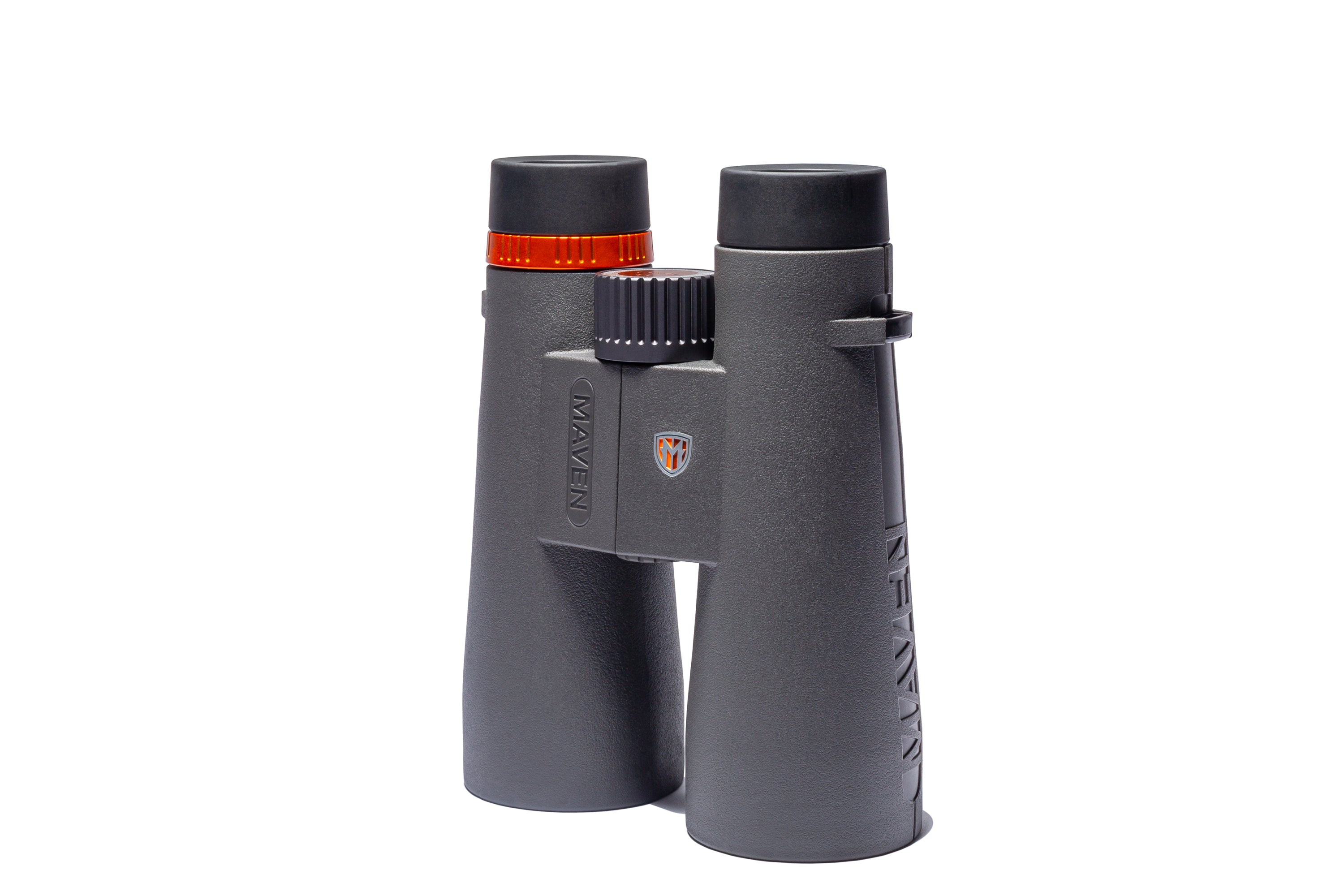
Explore this need in the finder →The Maven C.3 12x50 is the higher-power member of a fixed-magnification, 50 mm roof-prism family. Maven publishes a 4.8° real field (251 feet at 1,000 yards), a 57° apparent field, 4.2 mm exit pupil, 15 mm eye relief and 28-ounce weight. The 12x choice makes sense when you value added nominal enlargement for distant subjects and can hold or support the view. It is not automatically the better all-purpose binocular: the real scene is narrow, eye relief is shorter than the 10x50 sibling's, and hand movement becomes more conspicuous at higher power.
What twelve power changes
Both C.3 configurations use 50 mm objectives and the manufacturer lists the same 28-ounce body dimensions, but the magnification changes the viewing experience. The 12x50 has a 4.2 mm exit pupil, compared with 5 mm for the 10x50, and its real field is 4.8° rather than 5°. Its apparent field is 57° rather than 50°. A wider apparent field number does not mean more outside landscape is visible: the published real field remains slightly narrower. When you are scanning for a moving target or making quick transitions from one branch to another, this distinction can matter more than the larger magnification number.
At distance, extra enlargement can help make a small subject easier to inspect, but it also magnifies tremor. There is no built-in image stabilization listed. The manual supports a tripod adapter on C-series models other than C.2, with the adapter sold separately. If your planned use is long stationary watching from a blind, overlook or observation point, that compatibility can be useful; it is not an included tripod. For walking birding, travel or a shared family pair, compare the 10x50 or a lower-power 42 mm model before treating 12x as an automatic improvement.
Fit limits deserve attention
Maven lists 15 mm eye relief for the 12x50, compared with 19.5 mm for its 10x50. The 15 mm figure is an important caution for glasses wearers or anyone who needs a specific minimum eye relief. A questionnaire request of at least 18 mm should exclude this model even though its eyecups have multiple positions; the 10x50, at 19.5 mm, is the C.3 option that clears that published threshold. That still does not guarantee a comfortable field with a particular pair of glasses, so a real fit check matters if glasses use is non-negotiable.
Inter-pupillary adjustment is listed from 58 to 72 mm, near focus at 8.2 feet, and size at 5.3 by 6.6 by 2.4 inches. It weighs 28 ounces before any carried case or other accessories. This is not a compact travel optic, and its close-focus distance may be inconvenient for nearby subjects. If your ordinary outing involves a mixture of near garden viewing and distant scenery, the lower weight and shorter close focus of a smaller binocular may be more valuable than higher power.
Optical and weather specifications, carefully read
The exact table identifies ED objective elements, phase correction, dielectric prism coating, multi-position eyecups, a ±4 diopter correction range, and scratch/oil-resistant lens coating. It reports 89% light transmission, which should be treated as a manufacturer specification, not an independent measurement or a guarantee of a visible advantage over a competing model. The manufacturer calls the C.3 waterproof and fog-proof and lists an IPX7 pressure-test result of one meter for 30 minutes, with nitrogen purging. That is not a recommendation for underwater viewing or rough handling.
The C.3 12x50 page names a neoprene neck strap, lens caps and a double-layered microfiber storage bag as included items. It does not list the separate tripod adapter as part of that package. The C-series manual is linked from the manufacturer product page and covers central focusing, diopter adjustment, eyecup positioning and care. Use the focus wheel and diopter setting to tune the image for your eyes, and remove grit before cleaning lenses. Never point binoculars at the Sun or another intense light source.
How it compares with the 10x50 and 42 mm alternatives
Pick the C.3 12x50 over the 10x50 when the stronger nominal magnification is more important than pupil size, eye relief and scene width. Pick the 10x50 if you prefer a 5 mm exit pupil, 19.5 mm relief and the less demanding power for handheld scanning. The 12x50's 57° apparent figure may appeal to someone who prefers a broader-looking eyepiece view, but neither C.3 meets the guide's six-degree real-field choice or its 60-degree apparent-field choice. The two are not interchangeable just because they share a body and objective diameter.
The C.1 12x42 is another manufacturer-listed twelve-power option in Maven's range, while the C.1 10x42 is a more moderate 10x configuration. A 50 mm front lens alone does not settle the purchase decision. Compare objective size, power, real field, eye relief, near focus and weight together. In this family, the C.3 adds the larger objective but remains 28 ounces; the choice of 12x over 10x is the sharper trade in handling. If your must-haves include 18 mm eye relief, a six-degree real view, direct 1/4-20 tripod thread or an in-box adapter, this 12x50 is not the right match on the published evidence. If those are not essentials and you can support the view, its exact fixed-power configuration is a credible long-range outdoor option.
Maven C.3 12x50 product option · Maven C.3 specifications · Maven C Series manual. The two powers share the exact manufacturer's product family page and listed body dimensions; the separately linked specifications identify the power-specific optical figures.
Key specifications
Key details at a glance
| Magnification | 12× |
|---|---|
| Objective diameter | 50 mm |
| Real field of view | 4.8° |
| Apparent field of view | 57° |
| Eye relief | 15 mm |
| Exit pupil | 4.2 mm |
More specifications and setup details
| Close focus distance | 8.2 ft |
|---|---|
| Manufacturer-published weight | 28 oz |
| ED glass confirmed for this exact model | Yes |
| Phase coatings confirmed | Yes |
| Lens and prism coatings | Maven lists ED objective elements, fully multi-coated lenses, phase correction, dielectric reflective coating on the roof prisms and scratch/oil-resistant lens coating. These are manufacturer specifications, not independent optical measurements. |
| Water and fog protection | Manufacturer waterproof/fog-proof description and IPX7 1 m / 30 min pressure-test specification; do not infer underwater suitability. |
| Tripod use | Manufacturer lists tripod adaptability. The linked C Series manual says the adapter is sold separately for models other than C.2; the C.3 standard included-items list does not include it. |
| Published weight note | Maven’s exact C.3 specification table lists 28 oz for this 50 mm power. This is the listed instrument weight, not an independent weighing or packed-system mass. |
| Manufacturer-rated waterproof | Yes |
| Tripod adapter in package | No |
Use the exact model’s instructions for operating limits, supplied equipment and version differences.
Sources for this review
Sources for this assessment

Choose your optical trade-off first.
Choose viewing purpose first, then magnification, objective size, scene width and any fit, weather or mounting constraint. A direct-Sun requirement is separate: only exact manufacturer-confirmed solar binoculars can pass it.