
On this page
A lighter, wider 28 mm compact configuration
The Maven C.2 7x28 lists 12.4 oz and a 6.5° real field, favoring broad handheld scanning over the 10x sibling’s tighter view. The exact C.2 manual excludes tripod-adapter use, and stated eye relief is not an individual glasses-fit guarantee.
Explore the needs this model fits
Your needs, this model
Does it fit your priorities?
For a moving daytime subject, does the C.2 7x28 preserve the wider real scene and its 4 mm exit pupil?
Maven publishes 6.5° / 341 ft per 1,000 yd and a 4 mm exit pupil for the 7x28, versus 5° / 262 ft and 2.8 mm for its 10x28. The lower power is the wider-scanning C.2 choice, not an independent tracking test.
Explore this need in the finder →Does the 7x28 meet a 16 mm stated eye-relief minimum for a glasses wearer to test?
Maven lists 16 mm eye relief, 12.4 oz instrument weight and 7x power. This meets a 16 mm published minimum but cannot guarantee that every glasses frame sees the full field.
Explore this need in the finder →Will a waterproof ED compact below 13 oz fit if tripod support is not required?
Maven lists ED glass, waterproof/fogproof construction and 12.4 oz for the 7x28. The exact specifications say it is not tripod adaptable; the C Series manual excludes C.2 from tripod-adapter use.
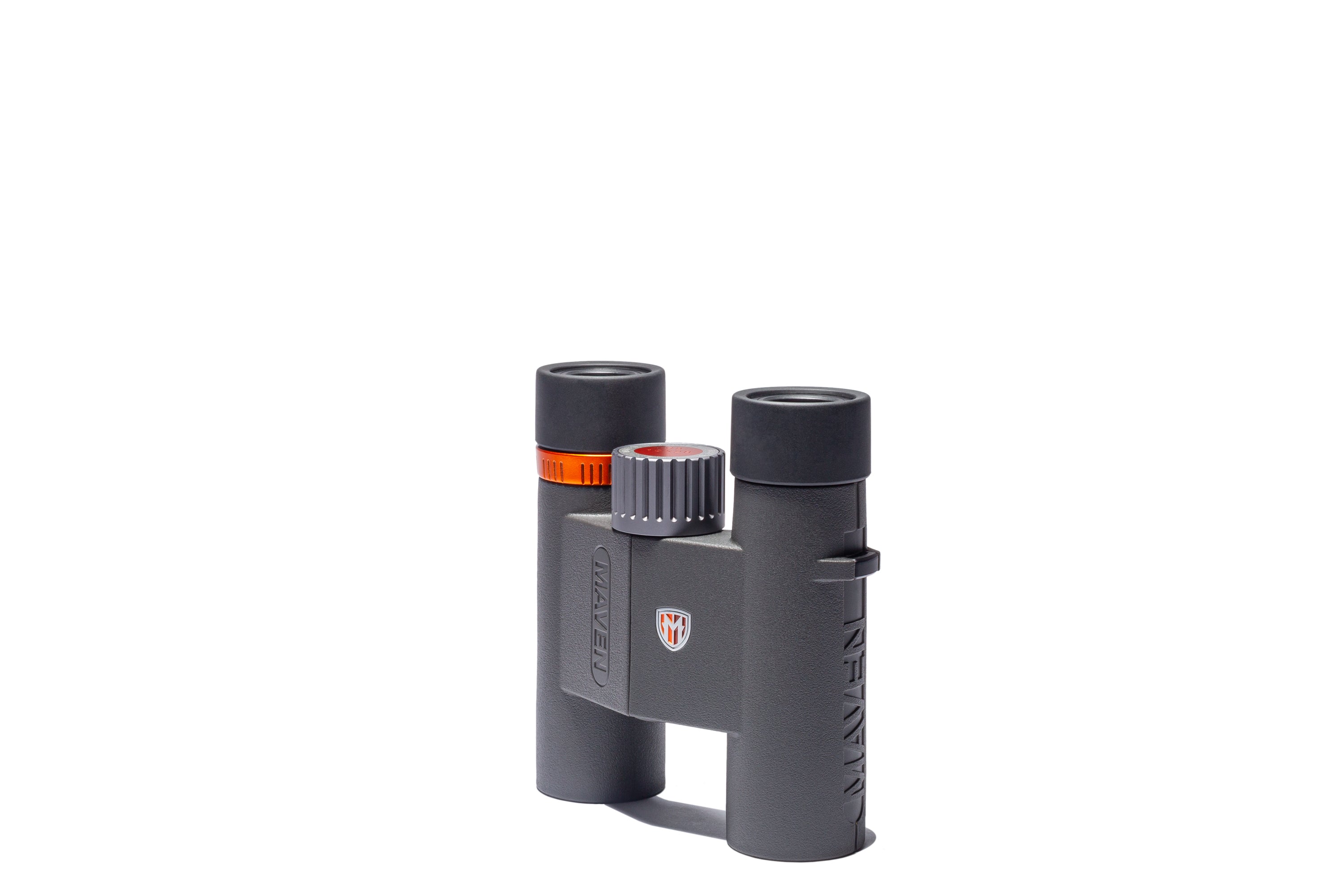
Explore this need in the finder →The Maven C.2 7x28 is the wide-view member of Maven’s compact 28 mm roof-prism pair. Its maker lists a 6.5° real field (341 feet at 1,000 yards), a 4 mm exit pupil, 16 mm of eye relief and a 12.4-ounce instrument weight. That combination makes it the more forgiving handheld choice for scanning a moving subject, but it is still a small-objective binocular: don’t mistake premium-sounding glass and waterproofing for a substitute for a larger optic in the last light.
Choose it when finding the subject matters more than extra reach
Seven power is the C.2’s lower fixed magnification. Compared with its 10x28 sibling, it shows a wider published scene: 6.5 degrees or 341 feet at 1,000 yards, rather than 5 degrees or 262 feet. The field difference is practical when panning along a shoreline, finding a bird in a hedge, or following play across a field. Lower magnification also tends to be less demanding to hold steadily. Those are consequences of the published configurations, not results from a hands-on test.
The two options share a 28 mm objective, but the 7x produces a 4 mm exit pupil against 2.8 mm for the 10x. That larger exit pupil is useful when your eye is not perfectly centered and gives the 7x the geometric advantage as daylight fades. It does not make this a true twilight tool. A 28 mm objective still collects less light than a 42 or 50 mm design, and the compact body is not a promise of a bright view at dusk.
What the specifications tell you—and what they don’t
Maven lists ED glass, fully multi-coated lenses, phase correction and a dielectric coating on the Schmidt-Pechan roof prisms. It also describes a polymer frame, scratch- and oil-resistant lens coating, nitrogen filling and waterproof/fogproof construction. Its specifications table gives a 1 m, 30-minute IPX7 pressure-test result. Treat that as a stated protection rating, not permission to use the binocular underwater. These are manufacturer specifications rather than independent measurements of edge sharpness, color fringing or transmission.
The listed 12.4 ounces is the binocular itself, not a measured packed weight with strap and case. Dimensions are given as 4.5 by 4.6 by 1.4 inches, with the table specifying width, height and depth; Maven’s headline rounds the size to 4.6 inches. The eye-relief figure is 16 mm and the interpupillary range 58–72 mm. Those numbers help narrow a shortlist, but glasses wearers should still test whether the eyecup position and their frames let them see the full image. The manufacturer’s near-focus figure is 9.8 feet, suitable for ordinary nearby wildlife or displays rather than very close tabletop work.
Setup is straightforward; mounting is not an option
Maven’s product page lists a neoprene neck strap, lens caps and a double-layered microfiber storage bag. The C Series manual explains how the barrels adjust to the viewer’s eye spacing, how the eyecups twist to set eye relief, and how to focus the left eye before fine-adjusting the right-eye diopter. That is useful if different people share the binocular or your eyes do not focus identically. The manual also cautions against pointing binoculars at the Sun or another bright light. For care, it recommends removing dust and grit before wiping glass and warns against cleaning optics with a shirt, tissue or heavy cotton cloth.
The overlooked constraint is support. Maven’s specification table says the C.2 is not tripod adaptable, and the manual expressly excludes it from the C Series tripod-adapter procedure. If you need a fixed mount, a stable long-duration watch, or an astronomy setup, do not choose this model. The 7x power is easier to steady than 10x, but the design remains handheld-only.
Alternatives and the trade you are making
Choose the C.2 10x28 instead when extra enlargement is more valuable than locating subjects quickly; accept its narrower published field and smaller exit pupil. If the 28 mm form is the priority but you regularly watch at dusk, compare a larger-objective model and accept its added bulk. In Maven’s premium compact B.7 line, the 8x25 has an even wider listed field, but the C.2’s 28 mm objective yields a larger 4 mm exit pupil than that B.7’s published 3.1 mm. This comparison is about stated geometry and specification, not a claim that one has been tested brighter.
The C.2 7x28 makes sense for daytime wildlife, sports and travel—the roles Maven itself recommends—when a light instrument and a broad view are the firm priorities. It is a poor fit if low-light viewing, tripod support or assured glasses fit is essential. No personal ownership or optical lab testing is claimed; use the published figures and manual to decide whether this compact’s particular compromises fit your outings.
Maven C.2 product page · Maven C.2 specifications · Maven C Series manual index. The product page links the manual and specification table for this family.
Key specifications
Key details at a glance
| Magnification | 7× |
|---|---|
| Objective diameter | 28 mm |
| Real field of view | 6.5° |
| Apparent field of view | 45.5° |
| Eye relief | 16 mm |
| Exit pupil | 4 mm |
More specifications and setup details
| Close focus distance | 9.8 ft |
|---|---|
| Manufacturer-published weight | 12.4 oz |
| ED glass confirmed for this exact model | Yes |
| Phase coatings confirmed | Yes |
| Lens and prism coatings | Maven lists ED glass, fully multi-coated lenses, phase correction, a dielectric prism reflective coating and scratch/oil-resistant lens coating. These are manufacturer specifications, not independent optical measurements. |
| Water and fog protection | Maven’s C.2 table states a 1 m / 30-minute IPX7 pressure-test result and the product page calls it waterproof/fogproof. This is not an underwater-viewing claim. |
| Tripod use | The exact product table says no tripod adaptability; the C Series manual expressly excludes C.2 from its tripod-adapter instructions. Do not pass an essential tripod-support requirement. |
| Published weight note | Maven’s exact specification row lists 12.4 oz for the 7x28 instrument. This is a manufacturer figure, not independent weighing or packed-system mass. |
| Manufacturer-rated waterproof | Yes |
Use the exact model’s instructions for operating limits, supplied equipment and version differences.
Sources for this review
Sources for this assessment
- Maven U.S. C.2 binocular product page
- Maven Shopify JSON for C.2 family
- Maven C.2 exact U.S. specifications table
- Maven C Series binocular manual (8-page PDF linked by exact C.2 page)
- Maven binocular comparison chart PDF (1 page)
- Maven U.S. binocular collection page
- Maven U.S. manuals index
- CPSC SaferProducts narrow exact-name query snapshot
Choose your optical trade-off first.
Choose viewing purpose first, then magnification, objective size, scene width and any fit, weather or mounting constraint. A direct-Sun requirement is separate: only exact manufacturer-confirmed solar binoculars can pass it.
Your needs, this model
28 mm binoculars: Maven C.2 7x or 10x
Choose it when: Its lower power, wider published real field and slightly lower listed weight favor scanning while keeping the 28 mm body compact.
28 mm binoculars: Maven C.2 7x or 10x →