
On this page
Your needs, this model
Does it fit your priorities?
Does the 12x42 favor magnification and apparent field over a broad real scene?
Yes: 12x and 60° apparent field are listed, but its real field is only 5° / 262 ft per 1,000 yd.
Explore this need in the finder →Can the 12x42 be stabilized on a compatible tripod?
Maven lists tripod adaptability; its manual requires a separately sold adapter.
Explore this need in the finder →Does the 12x42 satisfy a viewer needing at least 16 mm of stated eye relief?
No. Its 15 mm specification falls below that threshold; the 8x42 and 10x42 have longer published relief.
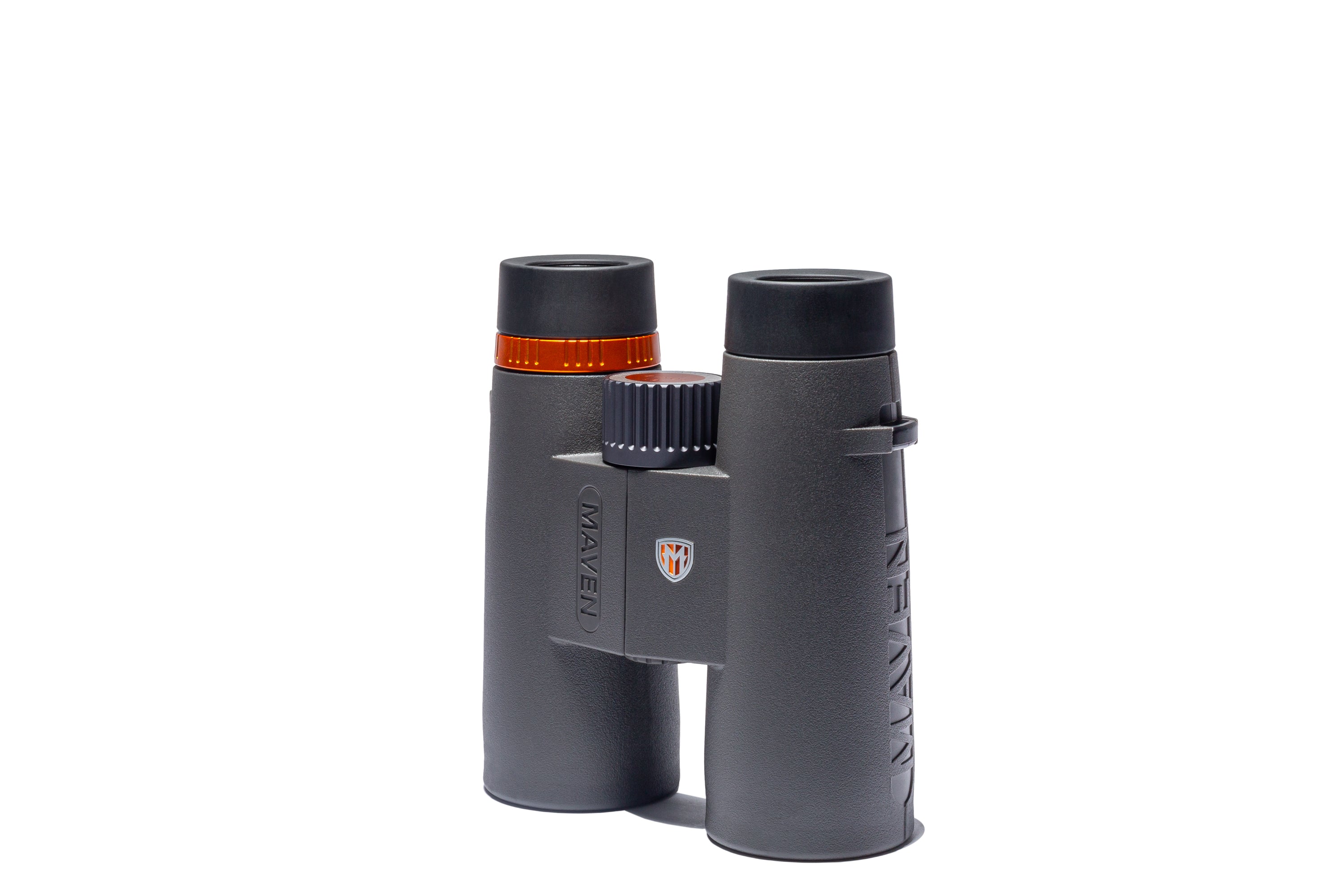
Explore this need in the finder →The Maven C.1 12x42 is the high-power choice in a full-size 42 mm roof-prism family. Its 60-degree apparent field can feel spacious at the eyepiece, but the real field is only five degrees—262 feet at 1,000 yards. The 3.5 mm exit pupil and 15 mm eye relief are also the smallest figures among the C.1 powers. Choose it for the added fixed magnification, not on the assumption that “wide apparent” means a broad outdoor scene.
More reach, but less room to find a moving subject
The 12x42 keeps the same 42 mm objective as the C.1 8x42 and 10x42, yet its narrower five-degree real field shows less of the outside scene. Maven lists 262 feet at 1,000 yards, compared with 341 feet for the 8x42 and 314 feet for the 10x42. Its apparent field is 60 degrees, matching the 10x42 and exceeding the 8x42’s 52 degrees. These measures answer different questions: the apparent number is the angular view at the eyepiece; the real figure tells you how much terrain or sky appears in view. If a broad real scene is the essential requirement, the 12x does not meet the six-degree threshold used by the ordinary finder question.
Higher magnification can reveal more detail on a distant animal or a stationary feature, but it also magnifies hand movement and makes it harder to keep a moving subject in view. That general optical tradeoff is why a 12x binocular is often more demanding to hand-hold than an 8x; it is not a hands-on stability rating for this Maven. Its 3.5 mm exit pupil is the smallest in the family, compared with 5.3 mm on the 8x42 and 4.2 mm on the 10x42. All three use the same 42 mm objective, so the 12x does not add aperture to balance its higher power.
Eye relief and physical fit deserve an early check
The C.1 12x42 is listed at 24.5 ounces and 5 by 5.7 by 2.1 inches. Close focus is 5.9 feet, and the stated interpupillary range is 58–72 mm. Its 15 mm eye relief is shorter than the 10x42’s 16 mm and the 8x42’s 19.5 mm. Eyeglass wearers should be especially cautious: a numeric eye-relief figure is useful for screening, but it cannot prove that a particular face, frames and eyecup position will reveal the whole field. The manual instructs viewers to adjust the interpupillary hinge and twist-up eyecups before judging the image fit.
Focus setup uses a central wheel followed by the right-eye diopter ring, according to Maven’s C Series manual. The product page and specification table identify ED objective glass, fully multi-coated lenses, phase correction and dielectric-coated Schmidt-Pechan prisms. These are the manufacturer’s construction details; no independent test is claimed for contrast, color fringing or sharpness across the image. The published 60-degree apparent field is not a substitute for trying the eyepiece if viewing comfort is a priority.
Tripod compatibility helps, but not without an accessory
Unlike the compact C.2, Maven lists the C.1 as tripod adaptable, and the C Series manual’s tripod instructions expressly exclude only C.2. The manual shows an adapter threading into the binocular’s socket and specifies that the adapter is sold separately. Maven’s listed package contains a neck strap, lens caps and microfiber storage bag, not the adapter. A viewer who needs a tripod-compatible binocular can keep this model in consideration; someone who needs the mounting adapter in the standard box should not treat compatibility as proof that it is included.
The maker describes the C.1 as waterproof and fog-proof, lists nitrogen filling and gives an IPX7 pressure-test result of one meter for 30 minutes. The practical reading is weather protection under the manufacturer’s stated conditions, not underwater operation. Maven also specifies a polymer frame. For lens care, the manual recommends removing dust and grit before wiping glass and using suitable lens cleaner and microfiber rather than a shirt or tissue. It cautions that pointing binoculars toward the Sun or another bright light can permanently damage eyes.
When to take the 12x—and when to step down
This version fits a viewer who values 12x detail, accepts a five-degree real field and is prepared to use careful handheld technique or buy the optional adapter for a steadier fixed view. It is a poor match for quick scanning, walking while observing, a hard requirement for at least six degrees of real field, or a minimum of 16 mm eye relief. The 10x42 preserves a 60-degree apparent field while widening the real view to six degrees; the 8x42 gives the widest real view, the largest exit pupil and the longest eye-relief specification. Those alternatives are not interchangeable: the right choice depends on whether reach, scene coverage or eye placement is the constraint that matters most.
Against Maven’s C.2 compact 10x28, the C.1 uses a much larger objective and is tripod adaptable, but it is also a full-size instrument at 24.5 ounces. If the goal is a light bag or pocket, a 42 mm C.1 is the wrong category of compromise even at its higher power. If the goal is long-range detail in outdoor wildlife viewing, its fixed 12x and support compatibility are relevant strengths, provided the narrower field, shorter relief and separate adapter are acceptable. Maven’s published specifications describe the configuration; they do not promise that the individual user will see the same comfort or apparent steadiness.
Maven C.1 product page · Maven C.1 specifications · Maven C Series manual. The exact product page offers the 12x42 as a separate power option; the shared manual describes adapter setup and cautions.
Key specifications
Key details at a glance
| Magnification | 12× |
|---|---|
| Objective diameter | 42 mm |
| Real field of view | 5° |
| Apparent field of view | 60° |
| Eye relief | 15 mm |
| Exit pupil | 3.5 mm |
More specifications and setup details
| Close focus distance | 5.9 ft |
|---|---|
| Manufacturer-published weight | 24.5 oz |
| ED glass confirmed for this exact model | Yes |
| Phase coatings confirmed | Yes |
| Lens and prism coatings | Maven lists ED objective glass, fully multi-coated lenses, phase correction, a dielectric reflective coating on the roof prisms and scratch/oil-resistant lens coating. These are manufacturer specifications, not independent optical measurements. |
| Water and fog protection | Maven’s C.1 specification table states IPX7 pressure-tested to 1 m for 30 minutes. That is not an underwater-viewing claim. |
| Tripod use | The exact table lists tripod adaptability. The family manual describes an optional adapter sold separately and excludes C.2, not C.1. The page lists a strap, caps and storage bag; it does not list the adapter. |
| Published weight note | Maven’s power-specific row lists 24.5 oz for the 12x42 instrument; this is not independent weighing or packed-system mass. The generic highlight says 24.5 oz while the exact power table lists 24.0 oz for the 8x42; the power-specific table is used. |
| Manufacturer-rated waterproof | Yes |
| Tripod adapter in package | No |
Use the exact model’s instructions for operating limits, supplied equipment and version differences.
Sources for this review
Sources for this assessment
- Maven U.S. C.1 binocular family product page
- Maven Shopify JSON for C.1 family
- Maven C.1 exact U.S. power-specific specification table
- Maven C Series binocular manual (8-page PDF directly linked from C.1 page)
- Maven U.S. binocular collection page (reused identical bytes)
- CPSC SaferProducts narrow exact-name query snapshot
Choose your optical trade-off first.
Choose viewing purpose first, then magnification, objective size, scene width and any fit, weather or mounting constraint. A direct-Sun requirement is separate: only exact manufacturer-confirmed solar binoculars can pass it.