
On this page
A lighter 10x50 contrast to the low-power 7x50
The Maven B.6 10x50 lists 30.688 oz and a 6.5° real field, a substantially lighter 50 mm alternative to Celestron’s 44.3 oz 7x50. Its higher fixed magnification narrows the scene, and ED/coating labels should not be read as independent image-quality tests.
Explore the needs this model fits
Your needs, this model
Does it fit your priorities?
Does the B.6 10x50’s 6.5° field preserve at least 6° of real scene for scanning?
Maven publishes 6.5° / 341 ft at 1,000 yd; this is a specification, not a tracking test.
Explore this need in the finder →Will the 10x50 meet an 18 mm eye-relief floor and a 31 oz instrument cap?
The B.6 10x50 table lists 18.1 mm and 30.688 oz. Eye relief still does not guarantee a glasses fit for every face.
Explore this need in the finder →Are confirmed ED glass, phase correction, water protection and tripod compatibility essential?
Maven lists ED objectives, phase correction, an IPX7 pressure test and tripod adaptability; the separate adapter is not listed in the standard package.
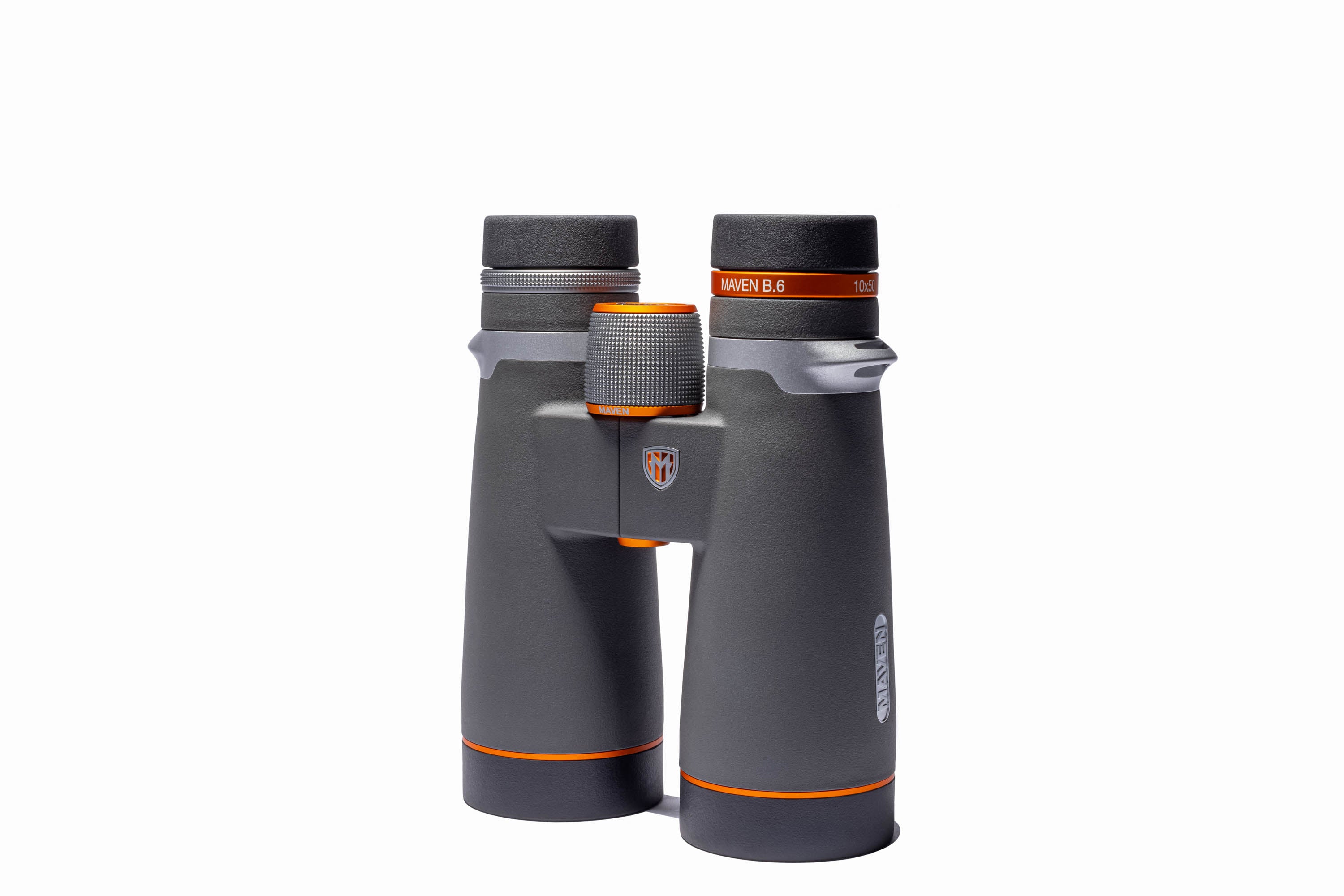
Explore this need in the finder →The Maven B.6 10x50 pairs a 50 mm objective with a 10x view, a 6.5° real field and a 5 mm exit pupil. It is the broader, easier-to-scan B.6 choice; the maker lists a 30.688-ounce instrument and a tripod-adaptable body. Its main compromise is not subtle: it is substantially heavier than a common 42 mm walking binocular.
Why 10x is the B.6 scanning option
Maven’s specification page gives the 10x50 a 6.5° field, or 341 feet at 1,000 yards, compared with 5.5° and 289 feet for the 12x50. For an animal appearing between trees or a bird moving along a ridge, the wider real field gives more scene around the subject while you locate it. The 65° apparent-view figure is also comfortably wide by the site’s published threshold, but it is the real field that changes how much terrain is visible at once.
The 5 mm exit pupil is larger than the 12x50’s 4.2 mm. That geometry can give a little more tolerance for eye placement and a larger beam when your pupil opens; it is not a promise that the 10x50 will look brighter to every observer. Maven publishes a 25 brightness figure and 94.75% light-transmission figure for this configuration. Those are maker specifications, not independent measurements of contrast, glare, resolution or a particular person’s night vision.
A 50 mm B Series body has a real carrying cost
The page lists 30.688 ounces for the 10x50 and describes the body as 6.6 inches in size. That puts it in a different carry class from a small compact, even though Maven presents the B.6 as a mid-sized binocular. For comparison, the company’s B1.2 10x42 specification is about 26.8 ounces and 6.6°; the B.6 buys a larger 50 mm objective and 5 mm exit pupil but weighs several ounces more while giving up a tenth of a degree of real field. If an all-day neck carry is the first requirement, compare the lighter 10x42 before accepting the larger aperture.
The optical table lists ED objective glass in a three-group, four-element construction, a Schmidt–Pechan roof prism, dielectric reflective coating, phase correction and multi-coated lenses. The page also describes a magnesium frame, nitrogen filling, multi-position eyecups and scratch- and oil-resistant lens coating. These details identify the build; they do not establish measured edge sharpness or color correction in a sample.
Check fit and the operating plan
Published eye relief is 18.1 mm, near focus 7.5 feet and interpupillary adjustment 58–74 mm. Maven lists a ±3 diopter correction and multi-position eyecups. A wearer of glasses should still try the eye placement with their own frames: an eye-relief figure cannot guarantee the full field for every face. The 7.5-foot minimum is useful for nearby subjects, but this is a full-size outdoor binocular, not a specialist close-focus instrument.
Ten power is the more forgiving B.6 configuration for hand-held scanning, although individual steadiness varies and the maker publishes no stabilization feature. For a long fixed view, the product is tripod adaptable. The linked B Series manual describes a separate adapter; the standard product listing names a neck strap, lens caps and a double-layer microfiber storage bag, not a tripod or adapter. Budget for the support hardware separately if it is essential to your plan.
Weather claims, contents and limits
The dedicated B.6 specification page lists an IPX7 pressure test at 1 m for 30 minutes, nitrogen purging and a functional temperature range from −13°F to 140°F. The product page calls it waterproof and fogproof. The pressure test is not an invitation to use the binocular underwater; keep caps and manual instructions in mind, and dry the outside before storage. The manual’s ordinary-care advice—remove grit before wiping and use a soft brush or blower—matters more than attempting to clean a dirty lens with a cloth.
This standard B.6 is a fixed-power viewing optic. No integrated laser rangefinder, reticle or image stabilization is confirmed for the reviewed 10x50 configuration. If any of those is essential, do not infer it from the B Series name or from a separate Maven riflescope or rangefinder. The listing’s finish choices are Grey / Orange, Black / Grey and Moss / Black; the review covers the same 10x50 optical configuration across those finishes, not a color preference.
Who should choose this version?
Choose the 10x50 when your route mixes open-country scanning with distant identification, and you prefer the broader 341-foot field and 5 mm exit pupil to the 12x50’s greater enlargement. The 12x50 makes more sense when extra detail is the priority and you can tolerate its narrower scene, slightly shorter eye relief and greater hand-motion sensitivity. A B1.2 10x42 is the more sensible comparison for frequent walking; a large 56 mm instrument such as the B.5 is a different, heavier plan for users who accept more mass for a larger exit pupil. The B.6 10x50 is the middle ground only if 30.7 ounces still fits the way you actually carry optics.
Maven B.6 product page · Maven B.6 power-specific specification table · Maven B Series manual. Specifications and package contents are manufacturer statements; this assessment does not claim personal ownership or independent optical testing.
Key specifications
Key details at a glance
| Magnification | 10× |
|---|---|
| Objective diameter | 50 mm |
| Real field of view | 6.5° |
| Apparent field of view | 65° |
| Eye relief | 18.1 mm |
| Exit pupil | 5 mm |
More specifications and setup details
| Close focus distance | 7.5 ft |
|---|---|
| Manufacturer-published weight | 30.69 oz |
| ED glass confirmed for this exact model | Yes |
| Phase coatings confirmed | Yes |
| Lens and prism coatings | Maven lists ED objective elements, Schmidt-Pechan roof prisms, dielectric reflective coating, phase correction and multi-coated lenses. These are published design claims, not an independent optical test. |
| Published weight note | Maven’s B.6 specification table lists 30.688 oz for both powers; this is a maker figure, not an independent weighing or packed-system weight. |
| Manufacturer-rated waterproof | Yes |
| Tripod adapter in package | No |
Use the exact model’s instructions for operating limits, supplied equipment and version differences.
Sources for this review
Sources for this assessment
- Maven B.6 U.S. product page, package description and selector
- Maven Shopify product JSON for all six current B.6 power/finish SKUs
- Maven B.6 specifications page with separate 10x50 and 12x50 columns
- Maven B Series manual V8 linked by the B.6 product page; identical archived copy reused
- Maven current U.S. binocular collection page, B.6 collection card from existing archive
- CPSC exact-name recall search snapshot (narrow query only)
- Maven B.6 10x50 image from the exact product page gallery

Choose your optical trade-off first.
Choose viewing purpose first, then magnification, objective size, scene width and any fit, weather or mounting constraint. A direct-Sun requirement is separate: only exact manufacturer-confirmed solar binoculars can pass it.
Your needs, this model
50 mm binoculars: low-power sky view or 10x reach
Choose it when: Maven's listed 10x50 is more than 13 oz lighter than the 7x50 example while offering higher fixed magnification.
50 mm binoculars: low-power sky view or 10x reach →