
On this page
Your needs, this model
Does it fit your priorities?
Do you want the most enlargement in the standard B.5 family at fixed 18x?
This exact standard version is fixed 18x56; Maven lists 194 ft at 1,000 yd, the narrowest B.5 field. It is not the reticle-only MOA or MIL SKU.
Explore this need in the finder →Will the standard 18x56 meet an 18 mm eye-relief floor and 45 oz instrument cap?
Maven lists 18 mm and 45 oz for the standard 18x row. Test eyecup fit and account for adapter/tripod separately.
Explore this need in the finder →Is manufacturer-confirmed tripod support and waterproofing essential for the 18x?
The product page confirms tripod adaptability and IPX7/1 m/30 min. The adapter is separate; no underwater use is claimed.
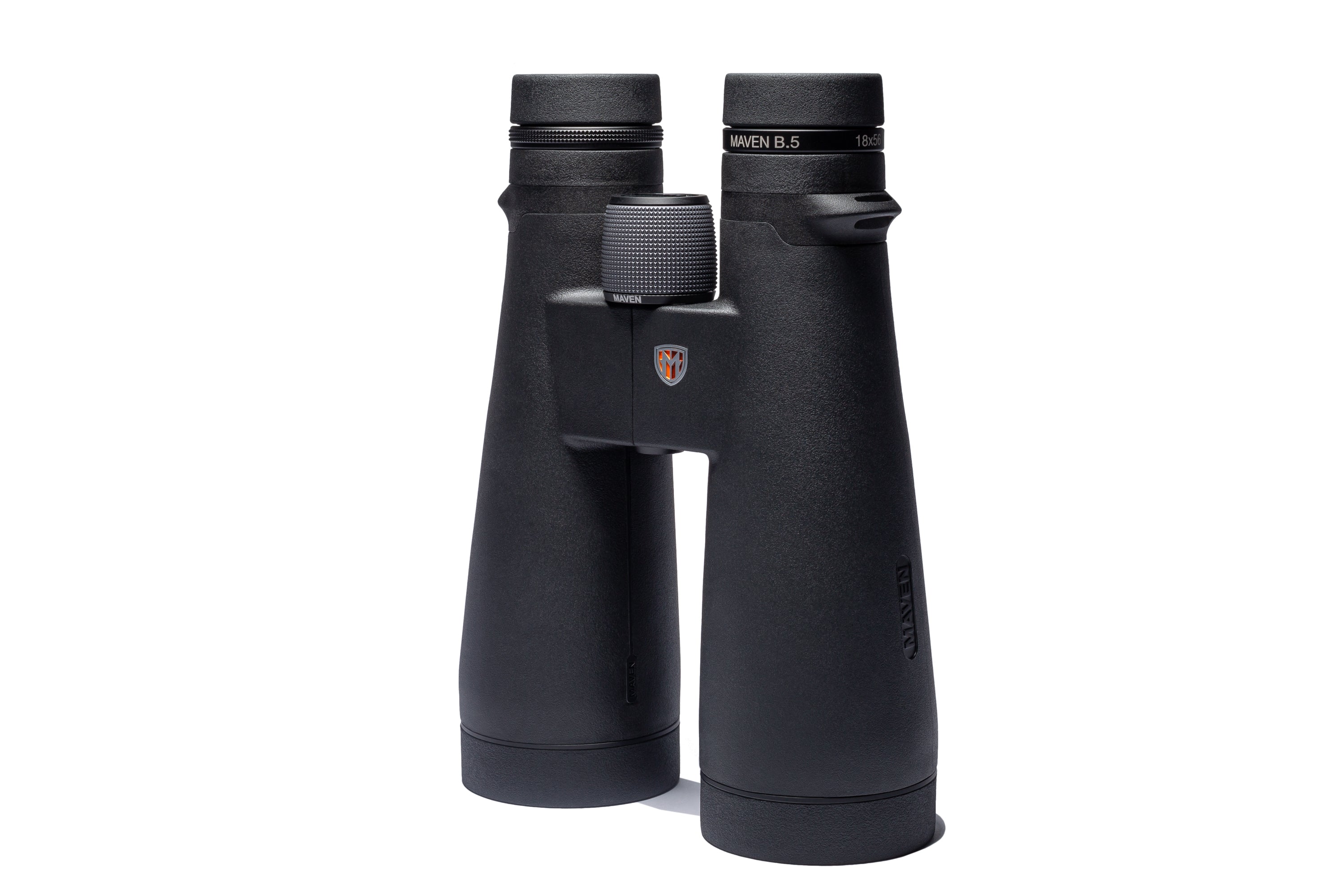
Explore this need in the finder →The ordinary Maven B.5 18x56 is the most powerful fixed binocular in the standard B.5 family. Its manufacturer lists a 3.7° real field (194 feet at 1,000 yards), 3.1 mm exit pupil, 18 mm eye relief and a 45-ounce body. That combination is aimed at inspecting distant detail from a chosen position. It is not the best B.5 for quickly finding a moving subject, and its high power makes stable support more than a nice extra for long sessions.
Pick a target before raising the binocular
At 18x, the published field is the narrowest of the line: 194 feet at 1,000 yards, compared with 236 at 15x, 289 at 12x and 341 at 10x. The narrower window gives less room for panning and reacquiring an animal. Locate the area at lower power or with unaided vision, then use the 18x for selected detail. If your outings consist mostly of scanning across trees, following sports or looking at nearby objects, the 10x or 12x will be easier to use.
The 3.1 mm exit pupil is the smallest of the four standard powers. It provides less tolerance for eye placement than the 10x56’s 5.6 mm or 12x56’s 4.7 mm figures. The B.5 is still a 56 mm binocular, but a large front lens does not make the 18x image immune to hand movement or guarantee low-light superiority. Maven lists 92.7% transmission and a relative-brightness value of 9.6 for this configuration; these are maker specifications, not independent night-sky or dawn testing.
Use a support plan
Maven confirms the 18x56 is tripod adaptable. Its B Series manual explains that the adapter is sold separately: remove the socket cover, thread the adapter on, then attach it to the tripod. The tripod and adapter are not among the product page’s listed standard contents. For extended glassing, plan to bring stable support rather than treating a high-magnification binocular as a hand-held substitute for a mounted optic. The instrument itself is 45 ounces before a strap or support is added.
The listing specifies 18 mm eye relief, 9.8-foot near focus, 56–75 mm interpupillary adjustment, 6.1 × 8.2 × 2.6-inch dimensions, multi-position eyecups, an Abbe-Koenig prism, phase correction, fluorite glass and a magnesium body. Maven also lists nitrogen filling and an IPX7 test at 1 m for 30 minutes. That is the maker’s stated protection test; it is not a safe-use promise for submersion. Glasses fit remains personal even with 18 mm listed relief.
Do not confuse it with the reticle model
This standard 18x56 has no confirmed optical ranging reticle or laser rangefinder. Maven sells a distinct B.5 18x56 MOA/MIL model with an etched reticle, focusing and leveling rings, and angular-unit choices. If you need that feature for a spotter-to-shooter call, choose the specific reticle version and the unit you already use. If you do not need an angular scale, the standard model avoids that specialized interface. Neither configuration is an electronic rangefinder or automatic ballistic display.
For some distant-viewing tasks a spotting scope may be more practical than a 45-ounce pair of 18x binoculars. For a wider scene or less demanding handheld observation, the 15x56 gives a 236-foot field and a larger 3.7 mm exit pupil; stepping down to 10x increases the field to 341 feet. These are configuration differences, not a claim that the alternatives have been field-tested side by side.
Care, fit and sensible expectations
The package list includes a neoprene neck strap, lens caps and a double-layer microfiber bag. Maven’s instructions describe separate left/right diopter adjustment, setting IPD, and twisting the eyecups to fit the viewer. For cleaning, remove dust and grit with a blower or soft brush before wiping; the manual warns against canned air, tissue and rough cotton. The instructions warn not to view the Sun with these ordinary binoculars. Maven describes a lifetime warranty with stated exceptions for loss, deliberate damage and cosmetic damage that does not affect performance.
Choose the 18x56 when your target is distant and mostly stationary, a narrow field is acceptable, and you have a support plan. Choose 15x if reacquisition and a slightly wider scan matter more; choose 12x or 10x for faster tracking and a broader field. At 45 ounces, this is a specialized high-power tool rather than a casual compact. No personal ownership or optical test is claimed; the advice follows the maker’s documented measurements and instructions.
Maven B.5 standard binocular page · Maven B Series manual · Maven binocular specification chart. Manufacturer statements are not independent optical measurements.
Verify both support and the exact 18x version
Maven's B.5 Binocular Bundle menu includes an 18x56 choice as well as 10x, 12x and 15x powers, and offers a tripod and binocular adapter as bundle selections. The 18x56's 3.7° real field and 45 oz instrument weight make stable support central to the decision, not an optional convenience. The bundle page does not give the completed system weight. It also does not identify an MOA or MIL reticle in the magnification choice, so do not assume which reticle or exact 18x variant is supplied if that detail matters; confirm it directly with Maven. The reticle-specific reviews remain the safer comparison route until the exact bundle configuration is confirmed.
Key specifications
Key details at a glance
| Magnification | 18× |
|---|---|
| Objective diameter | 56 mm |
| Real field of view | 3.7° |
| Apparent field of view | 66.6° |
| Eye relief | 18 mm |
| Exit pupil | 3.1 mm |
More specifications and setup details
| Close focus distance | 9.8 ft |
|---|---|
| Manufacturer-published weight | 45 oz |
| ED glass confirmed for this exact model | Yes |
| Phase coatings confirmed | Yes |
| Lens and prism coatings | Maven lists fluorite glass, Abbe-Koenig prisms, phase correction, fully multi-coated lenses, scratch/oil-resistant lens coating, multi-position eyecups and a magnesium body. These are manufacturer specifications, not independent optical measurements. |
| Water and fog protection | Maven’s B.5 specification table lists an IPX7 pressure test at 1 m for 30 minutes and nitrogen filling; the product page calls the binocular waterproof/fogproof. This does not establish underwater-use capability. |
| Tripod use | The exact product page marks the B.5 tripod adaptable. The linked B Series manual says the adapter is sold separately; no tripod or adapter is among the page’s standard listed contents. |
| Published weight note | Maven’s exact B.5 power table lists 45 oz for this instrument. This is a manufacturer figure, not an independent weighing or packed system weight. |
| Manufacturer-rated waterproof | Yes |
| Built-in image stabilization confirmed | No |
| Integrated laser rangefinder | No |
| Tripod adapter in package | No |
Use the exact model’s instructions for operating limits, supplied equipment and version differences.
Sources for this review
Sources for this assessment
- Maven B.5 U.S. product page and four-power specification table
- Maven Shopify JSON, B.5 standard product and ten exact finish/power variants
- Maven B Series manual, version 8, linked by B.5 standard product page
- Maven binocular specifications PDF, already archived with the C.2 family (reused, not downloaded again)
- Maven U.S. binocular collection page, already archived with B.7 family (reused, not downloaded again)
- CPSC SaferProducts exact-name B.5 query, one dated check
- Exact Maven product-page-linked image used for this B.5 profile

Choose your optical trade-off first.
Choose viewing purpose first, then magnification, objective size, scene width and any fit, weather or mounting constraint. A direct-Sun requirement is separate: only exact manufacturer-confirmed solar binoculars can pass it.