
On this page
Your needs, this model
Does it fit your priorities?
Do you need 15x reach but a broader field than the 18x56 B.5?
The 15x row lists 236 ft per 1,000 yd, 42 ft wider than the 18x row; its 4.5° field remains narrower than 10x or 12x.
Explore this need in the finder →Does the 15x56 meet a 17.5 mm relief floor and 45 oz limit?
Maven’s exact row lists 17.8 mm eye relief and 45 oz. The finder accepts half-millimeter thresholds, so a 17.5 mm minimum is the nearest supported lower threshold; the source value remains 17.8 mm. Neither figure guarantees personal fit or describes packed-system weight.
Explore this need in the finder →Can a waterproof 15x56 be set up on an optional tripod adapter?
The exact page lists IPX7/1 m/30 min; B Series manual confirms tripod adaptation through an adapter sold separately.
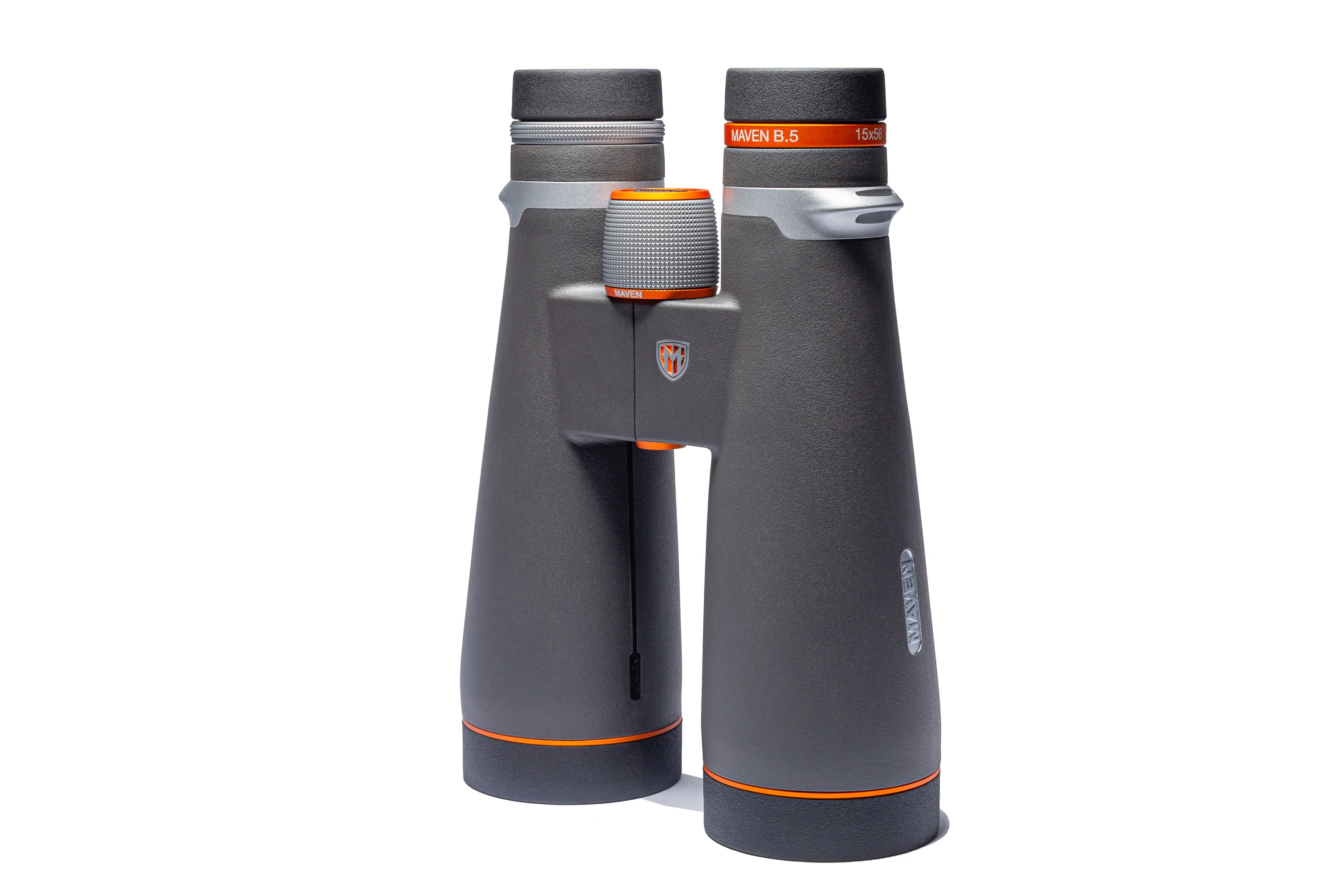
Explore this need in the finder →Maven’s B.5 15x56 trades the broad sweep of 10x and 12x binoculars for much more enlargement. The manufacturer lists a 4.5° real field (236 feet at 1,000 yards), a 3.7 mm exit pupil, 17.8 mm eye relief and a 45-ounce instrument weight. It is for selecting and studying distant terrain, not for quickly tracking a bird through nearby branches. A stable tripod setup is a practical part of the plan for sustained viewing.
Fifteen power changes how you look
The 15x56 sits between the B.5’s 12x and 18x options. It supplies more apparent enlargement than 12x, yet its listed 236-foot field is 42 feet wider than the 18x56’s 194 feet at 1,000 yards. The 4.5° real field is also narrower than the 12x56’s 5.5° and the 10x56’s 6.5°. In open country that can be a useful compromise: once you have located the subject, fifteen power gives more reach without choosing the line’s tightest view. In wooded cover or for a fast-moving subject, that narrower field is a real drawback.
The 3.7 mm exit pupil is smaller than at ten or twelve power, so eye alignment has less margin than on those models. Maven lists 17.8 mm eye relief. People who wear glasses should test the eyecups and their own frames in person; the listed dimension is not a guarantee that every viewer will see the whole field. The maker’s 9.8-foot close-focus value is respectable on paper for an optic this size but does not turn it into a close-focus or macro pair.
High power is useful only when the image is controlled
At fifteen power, ordinary hand motion is more conspicuous than it is at ten. Maven confirms tripod adaptability, but the B Series manual identifies its tripod adapter as a separate purchase. The binocular itself weighs 45 ounces, not including the strap, protective storage or support hardware. Plan around a tripod or another stable rest for long sessions; do not assume a lightweight-sounding magnesium frame makes the complete setup light.
This configuration has a 56 mm objective and the B.5’s listed Abbe-Koenig prism, phase correction and fluorite glass. Maven reports 92.5% light transmission and a relative-brightness value of 13.9. These are published figures, not measured field performance. A large objective does not erase the smaller exit pupil created by fifteen power, and neither a “fluorite” label nor a transmission percentage guarantees what you will see in your particular light or with your eyes.
What you get and what remains optional
The exact product page lists a neoprene neck strap, lens caps and a double-layer microfiber storage bag. The maker describes the binocular as waterproof and fogproof, and its table specifies an IPX7 test at 1 m for 30 minutes. That rating is not a statement that the optic can be used underwater. The manual covers diopter setting, IPD adjustment, twist-up eyecups and the tripod adapter. It also says to keep dust and grit from the lenses and not to use canned air or rough cloths. These are ordinary binoculars: the non-reticle 15x56 does not have a built-in laser rangefinder, and it must never be pointed at the Sun.
Who should choose it over the other powers?
Choose the 15x56 when the main task is inspecting distant, mostly stationary wildlife, terrain or a target from a deliberate viewing position. Choose 10x56 for faster subject acquisition, a 341-foot field and a 5.6 mm exit pupil. Choose 12x56 for a moderate increase in reach with a 289-foot field and 4.7 mm exit pupil. Choose 18x56 only when the smallest field is acceptable and the most enlargement in this family matters. All four fixed-power versions share the listed 45-ounce instrument weight; changing power is not a way to save carry weight.
The 15x56 is therefore a niche fit for open country and stable observation—not the default one-pair choice for ordinary birding, travel or quick handheld use. If you need a measuring reticle, compare the separate B.5 18x56 MOA or MIL versions. Their reticles are fixed at 18x and distinguishable by angular unit; the standard B.5 15x56 is not that product. No ownership, comparative test or optical lab measurement is claimed here; the decision is tied to Maven’s published specs and manual.
Maven B.5 product page and 15x56 row · Maven B Series manual · Maven binocular specification chart. Product characteristics are manufacturer-published; no personal test is represented.
High power is the reason to choose the support kit
Maven's B.5 Binocular Bundle page offers 10x56, 12x56, 15x56 and 18x56, along with selectable tripod and binocular-adapter components. The 15x56 is an open-country, stationary-viewing choice: its 4.5° real field is distinctly narrower than the 10x and 12x versions, and the instrument is listed at 45 oz before support gear. Higher magnification makes hand tremor conspicuous; choosing the kit is sensible only if the support items suit your use and you can carry them. The manufacturer does not state a single loaded package weight or make every option a fixed included item. Verify 15x56 and the actual tripod/adapter selections.
Key specifications
Key details at a glance
| Magnification | 15× |
|---|---|
| Objective diameter | 56 mm |
| Real field of view | 4.5° |
| Apparent field of view | 67.5° |
| Eye relief | 17.8 mm |
| Exit pupil | 3.7 mm |
More specifications and setup details
| Close focus distance | 9.8 ft |
|---|---|
| Manufacturer-published weight | 45 oz |
| ED glass confirmed for this exact model | Yes |
| Phase coatings confirmed | Yes |
| Lens and prism coatings | Maven lists fluorite glass, Abbe-Koenig prisms, phase correction, fully multi-coated lenses, scratch/oil-resistant lens coating, multi-position eyecups and a magnesium body. These are manufacturer specifications, not independent optical measurements. |
| Water and fog protection | Maven’s B.5 specification table lists an IPX7 pressure test at 1 m for 30 minutes and nitrogen filling; the product page calls the binocular waterproof/fogproof. This does not establish underwater-use capability. |
| Tripod use | The exact product page marks the B.5 tripod adaptable. The linked B Series manual says the adapter is sold separately; no tripod or adapter is among the page’s standard listed contents. |
| Published weight note | Maven’s exact B.5 power table lists 45 oz for this instrument. This is a manufacturer figure, not an independent weighing or packed system weight. |
| Manufacturer-rated waterproof | Yes |
| Built-in image stabilization confirmed | No |
| Integrated laser rangefinder | No |
| Tripod adapter in package | No |
Use the exact model’s instructions for operating limits, supplied equipment and version differences.
Sources for this review
Sources for this assessment
- Maven B.5 U.S. product page and four-power specification table
- Maven Shopify JSON, B.5 standard product and ten exact finish/power variants
- Maven B Series manual, version 8, linked by B.5 standard product page
- Maven binocular specifications PDF, already archived with the C.2 family (reused, not downloaded again)
- Maven U.S. binocular collection page, already archived with B.7 family (reused, not downloaded again)
- CPSC SaferProducts exact-name B.5 query, one dated check
- Exact Maven product-page-linked image used for this B.5 profile

Choose your optical trade-off first.
Choose viewing purpose first, then magnification, objective size, scene width and any fit, weather or mounting constraint. A direct-Sun requirement is separate: only exact manufacturer-confirmed solar binoculars can pass it.