
On this page
Your needs, this model
Does it fit your priorities?
Does 12x56 meet a wider-apparent-view request while staying at 56 mm?
Maven lists a 66° apparent field and 289 ft real field per 1,000 yd for the 12x56; apparent and real field are different measurements.
Explore this need in the finder →Is the 12x56 within a 17 mm relief floor and 45 oz cap?
The exact row lists 17.4 mm relief and 45 oz instrument weight. A glasses wearer should still check their own frame fit.
Explore this need in the finder →Will the 12x56 meet waterproof and confirmed tripod-adaptability needs?
Maven lists IPX7/1 m/30 min and the product/manual confirm adapter support; the adapter is sold separately.
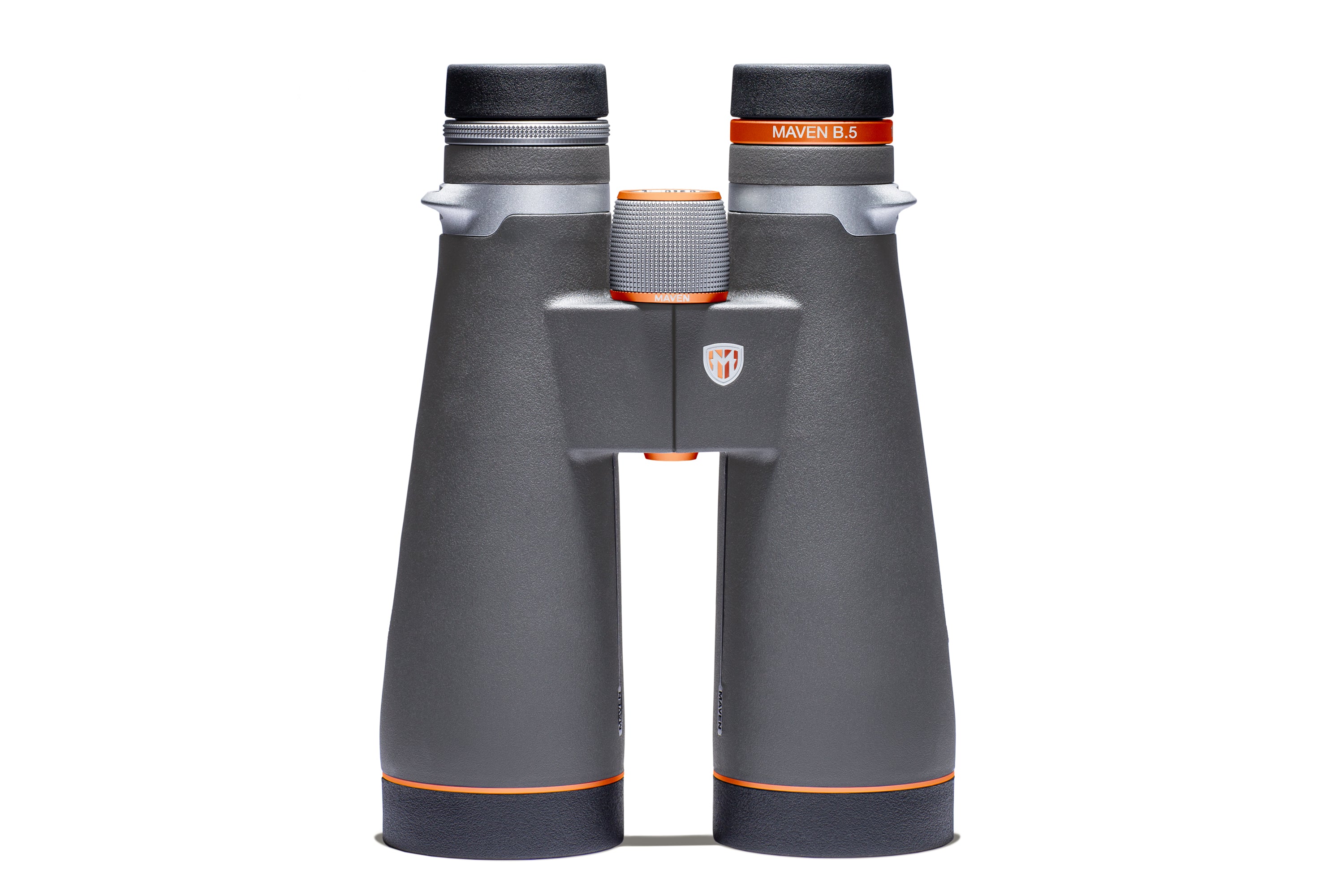
Explore this need in the finder →The Maven B.5 12x56 raises power over the 10x56 while retaining a 56 mm objective and the same listed 45-ounce mass. Maven publishes a 5.5° real field (289 feet at 1,000 yards), a 4.7 mm exit pupil and 17.4 mm eye relief. It is a long-range observation instrument for someone willing to carry a large binocular and manage more shake than at ten power—not a compact that becomes light merely because its magnesium frame is described as small.
The middle power narrows the search window
At 12x, a distant subject appears larger than at 10x, but the published real field falls from 341 to 289 feet at 1,000 yards. That is a real trade, not just a different number on a label: scanning takes more deliberate movement, and a moving subject can leave the narrower window sooner. The 4.7 mm exit pupil remains larger than the 3.7 mm at 15x and 3.1 mm at 18x, so 12x preserves more eye-placement margin than the high-power variants.
Its manufacturer-listed apparent field is 66°. That is a different measure from the 5.5° real field: apparent field describes how broad the view seems through the eyepiece; real field describes how much of the scene is covered. Do not compare the 66° figure with 289 feet as if they were competing ways to report the same thing.
Large objectives and serious carry weight
Maven lists 92.6% light transmission, a relative-brightness value of 21.8, and twilight factor 25.9. These manufacturer values make the 12x56 worth comparing for daylight-edge observations, but none is an independent evaluation of resolution, contrast or viewing comfort. The 56 mm front lenses make for a large optical package. At 45 ounces before adding the supplied strap or a separate adapter, this is not a light walking pair. If you often hike with binoculars on your chest, first compare a 42 mm configuration and decide whether the added reach is worth a heavier load.
The B.5 specification table lists 17.4 mm eye relief. That may work for some glasses wearers, but the maker does not provide a guarantee for every face, frame shape or viewing posture. Try the eye cups with your normal glasses rather than treating the number as a fit promise. The published close-focus distance is 9.8 feet; this is not a specialist close-focus instrument for very nearby subjects.
Construction and practical operating plan
The shared B.5 specification table identifies fluorite glass, an Abbe-Koenig prism, phase correction, multi-position eyecups, a magnesium body and nitrogen filling. The manufacturer lists IPX7 testing at 1 m for 30 minutes and calls the configuration waterproof/fogproof. That rating does not make it safe for underwater use. It is tripod adaptable through a separately sold B Series adapter; the B Series manual describes attachment to the socket beneath its cover. A tripod is not listed in the standard package.
A useful plan is to carry it in a protective bag to a fixed overlook, use the 12x field for distant terrain, then mount it for longer observation if hand movement becomes distracting. Included items are a neoprene neck strap, lens caps and a double-layer microfiber bag. The manual advises clearing dust and grit before wiping the glass, warns against canned air and abrasive cloth, and includes a solar-viewing warning: never point these ordinary binoculars at the Sun.
Which B.5 power should replace it?
Pick 10x56 when the broadest B.5 scene, largest exit pupil and longest listed eye relief matter most. Move to 15x56 when distant detail outranks ease of scanning; accept a 4.5° field, 236 feet at 1,000 yards and 17.8 mm relief. The 18x56 is the narrowest choice, best reserved for a selected distant subject and a stable mount. If the 12x reach still feels insufficient, a spotting scope may make more sense than expecting handheld binoculars to behave like a locked camera.
The B.5 12x56 suits open-country wildlife viewing, extended glassing from a vehicle or stationary point, and users who value more enlargement than 10x but do not want the narrowest B.5 view. It is a poor fit for ultralight travel, rapid scanning in clutter or anyone who requires a tripod adapter in the box. No independent test is claimed; the recommendation follows the maker’s field, weight, eye-relief, objective and manual figures.
Maven B.5 product page and specification table · Maven B Series manual · Maven binocular specification chart. Claims are attributed to manufacturer material; no personal ownership or lab testing is implied.
Match the tripod package to 12x use
The B.5 Binocular Bundle is a different route from the standalone 12x56: its selector includes 10x56, 12x56, 15x56 and 18x56, with choices for a tripod and binocular adapter. The 12x setting is the middle ground in that menu, but its listed 5.5° real field is narrower than the 10x56's 6.5°; steadiness matters more as power rises. The page gives a way to select support gear, not a published weight for the completed package. Treat the 45 oz figure here as the binocular alone and confirm which tripod and adapter are actually in the order. If a tripod system is not needed, compare a lighter 10x42 instead.
Key specifications
Key details at a glance
| Magnification | 12× |
|---|---|
| Objective diameter | 56 mm |
| Real field of view | 5.5° |
| Apparent field of view | 66° |
| Eye relief | 17.4 mm |
| Exit pupil | 4.7 mm |
More specifications and setup details
| Close focus distance | 9.8 ft |
|---|---|
| Manufacturer-published weight | 45 oz |
| ED glass confirmed for this exact model | Yes |
| Phase coatings confirmed | Yes |
| Lens and prism coatings | Maven lists fluorite glass, Abbe-Koenig prisms, phase correction, fully multi-coated lenses, scratch/oil-resistant lens coating, multi-position eyecups and a magnesium body. These are manufacturer specifications, not independent optical measurements. |
| Water and fog protection | Maven’s B.5 specification table lists an IPX7 pressure test at 1 m for 30 minutes and nitrogen filling; the product page calls the binocular waterproof/fogproof. This does not establish underwater-use capability. |
| Tripod use | The exact product page marks the B.5 tripod adaptable. The linked B Series manual says the adapter is sold separately; no tripod or adapter is among the page’s standard listed contents. |
| Published weight note | Maven’s exact B.5 power table lists 45 oz for this instrument. This is a manufacturer figure, not an independent weighing or packed system weight. |
| Manufacturer-rated waterproof | Yes |
| Built-in image stabilization confirmed | No |
| Integrated laser rangefinder | No |
| Tripod adapter in package | No |
Use the exact model’s instructions for operating limits, supplied equipment and version differences.
Sources for this review
Sources for this assessment
- Maven B.5 U.S. product page and four-power specification table
- Maven Shopify JSON, B.5 standard product and ten exact finish/power variants
- Maven B Series manual, version 8, linked by B.5 standard product page
- Maven binocular specifications PDF, already archived with the C.2 family (reused, not downloaded again)
- Maven U.S. binocular collection page, already archived with B.7 family (reused, not downloaded again)
- CPSC SaferProducts exact-name B.5 query, one dated check
- Exact Maven product-page-linked image used for this B.5 profile

Choose your optical trade-off first.
Choose viewing purpose first, then magnification, objective size, scene width and any fit, weather or mounting constraint. A direct-Sun requirement is separate: only exact manufacturer-confirmed solar binoculars can pass it.