
On this page
Your needs, this model
Does it fit your priorities?
Are you comparing an earlier fixed 10x42 roof binocular for ordinary observation?
Part 176288 is a discontinued 10x42 with a listed 326 ft at 1,000 yd field and 16 mm eye relief; include earlier profiles to see it.
Explore this need in the finder →Do the published 16 mm eye relief and 24 oz instrument weight meet your first-pass limits?
Those figures are published for part 176288, not independently measured. They do not promise full-field glasses fit or complete-system weight.
Explore this need in the finder →Is an optical ranging reticle essential?
The 176288 page mentions MIL-L inconsistently and has no reticle specification row. Its state stays unknown and cannot pass a required-reticle filter; part 176289 is the documented sibling, but is also discontinued.
Explore this need in the finder →The Leupold BX-T HD 10x42 (part 176288) is a discontinued, tactical-leaning 10x42 roof-prism binocular whose published field, eye relief and handling details are more useful than the page’s broad claims about optical performance. It is best treated as an earlier-model reference for someone comparing this specific open-bridge design—not as a current purchase recommendation. One point needs special care: the exact page does not clearly establish whether this part has the MIL-L reticle fitted.
A defined 10x42, not a measured-performance claim
Leupold’s exact U.S. page identifies part 176288 as fixed 10x42. Its table lists a 6.2-degree angular field and a linear field of 326 feet at 1,000 yards. It also lists 16 mm eye relief, a 4.2 mm exit pupil, 7.5-foot close focus, 24 ounces, 5.6 inches long and an interpupillary adjustment range of 58–74 mm. These are maker specifications, not measurements from my own viewing or weighing. A 10x view gives more apparent reach than an 8x pair but is less forgiving of hand movement; the stated field helps compare scene width, but cannot predict how comfortably a particular face sees the whole circle.
The 42 mm objective and 4.2 mm exit pupil describe the geometry, not a measured low-light advantage. Leupold calls this its Elite Optical System and lists fully multi-coated lenses, DiamondCoat 2 exterior surfaces and phase-coated roof prisms. Those are documented construction features, not a substitute for a controlled comparison. The page gives no independent contrast or transmission measurement.
Field handling and weather boundaries
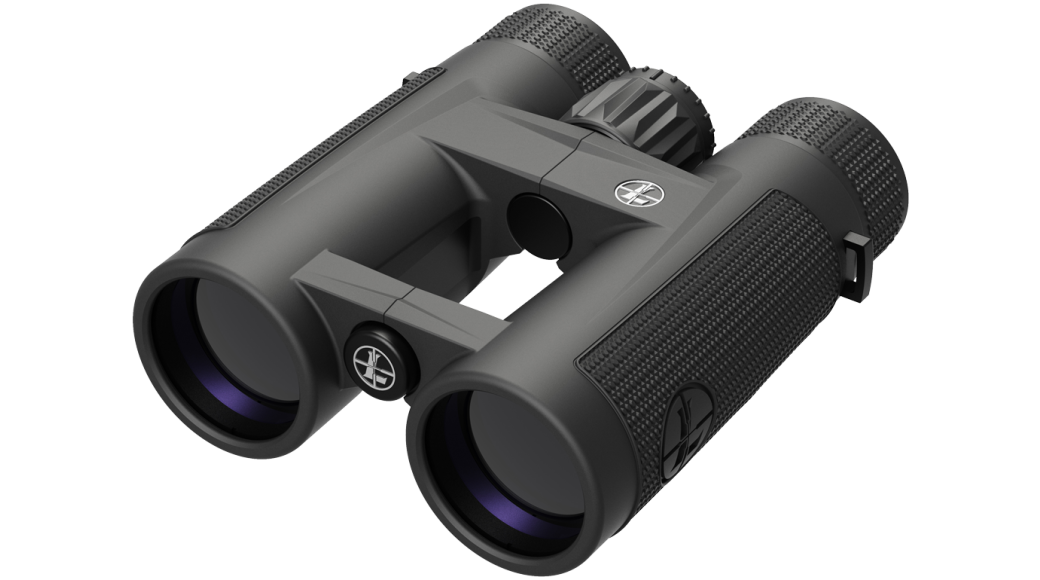
The exact page describes an open-bridge roof-prism body, rubber armor, a central focus dial, twist-up eyecups and field-replaceable eyecups. It confirms a built-in rotatable 1/4-20 tripod port, so the binocular can be mounted with separately chosen support hardware; the page does not list a tripod adapter as an included item. Leupold calls the body waterproof and fogproof but supplies no immersion depth, duration or IP rating here. Treat that as protection for outdoor use, not permission to submerge it.
At 24 ounces before any carry gear, this is not an ultralight compact. The 16 mm stated eye relief is a shortlist number, not a guarantee that glasses will show the full field. Try the eyecup positions with the wearer’s own frames before making fit essential. The 7.5-foot close-focus figure is useful for nearby subjects compared with many distant-viewing designs, but it does not turn the binocular into a macro instrument.
The reticle ambiguity is a real model-selection limit
The manufacturer’s page for part 176288 contains conflicting wording: its overview refers to a MIL-L reticle, while the longer description calls that reticle “available,” and the part’s specification table has no reticle row. Leupold lists a separate BX-T HD 10x42 MIL-L part, 176289, with an explicit MIL-L specification and a page-linked reticle sheet. I therefore leave the reticle state for 176288 unknown. Do not treat this part as a confirmed reticle-equipped model when that feature is essential; the 176289 page is the documented option, but it too is discontinued and government-issue-only.
This caution matters because a manual reticle and an electronic laser rangefinder solve different tasks. A manual scale can help estimate distance only when the target’s size is known and the image is steady; it does not produce a laser reading, a ballistic hold or a measured distance by itself. If your need is a confirmed optical ranging scale, choose a product with an explicit exact-model reticle specification instead of relying on the 176288 page’s generic wording.
What comes with it—and what to compare instead
The page lists a Berry-compliant MOLLE case and strap, lens covers and a lens cloth. Those are the manufacturer’s listed package pieces, not a promise about a used or surplus unit’s condition. The exact page says the model has been discontinued and is no longer available for purchase, so this review does not link to a retailer or infer that any old listing is authentic, complete or serviceable.
If you want a current passive 10x42 to compare for ordinary wildlife, landscape or event viewing, start with the Leupold BX-4 Pro Guide HD Gen 2 10x42 review. That is a different model, not a drop-in tactical equivalent, and it should not be assumed to have a reticle. For a reticle-specific requirement, compare only exact models whose manufacturer pages document the reticle and how it is used.
Setup and care
Leupold’s binocular owner manual describes matching the hinge to your interpupillary distance, focusing the left image with the center wheel and setting the right-eye diopter separately. Use the manual’s sequence before judging sharpness or comfort. Brush dust away before wiping glass, and use a clean lens cloth rather than grinding grit into the coating. This is an ordinary viewing instrument, not a direct-Sun binocular; never point it at the Sun.
Read the exact Leupold BX-T HD 10x42 part 176288 page for current manufacturer information. Its discontinued status, precise optical table and unresolved reticle wording make it most useful as a careful reference when comparing older tactical binoculars.
Key specifications
Key details at a glance
| Magnification | 10× |
|---|---|
| Objective diameter | 42 mm |
| Real field of view | 6.2° |
| Eye relief | 16 mm |
| Exit pupil | 4.2 mm |
| Close focus distance | 7.5 ft |
More specifications and setup details
| Manufacturer-published weight | 24 oz |
|---|---|
| Phase coatings confirmed | Yes |
| Lens and prism coatings | The exact product page lists a fully multi-coated lens system and DiamondCoat 2 exterior surfaces, and says the roof prisms are phase-coated. It does not identify ED glass or a complete coating stack. |
| Tripod use | Exact page confirms a built-in rotatable 1/4-20 port. It does not list an adapter or tripod in the package; choose compatible mounting hardware separately. |
| Published weight note | Manufacturer-listed instrument weight; excludes carry gear and is not an independent weighing. |
| Manufacturer-rated waterproof | Yes |
| Built-in image stabilization confirmed | No |
| Integrated laser rangefinder | No |
| Direct 1/4-20 tripod thread confirmed | Yes |
Use the exact model’s instructions for operating limits, supplied equipment and version differences.
Sources for this review
Sources for this assessment
- Leupold exact U.S. BX-T HD product page, part 176288
- Leupold official U.S. discontinued-binoculars directory page; observed listing leupold-discontinued-binoculars-cycle77-p3-r5
- Official exact product-page main image displayed by the exact part page
- Leupold Binocular Owner’s Manual Rev N, generic setup/care guidance; linked from exact BX-T HD MIL-L sibling page, not model-specific optical evidence.

Choose your optical trade-off first.
Choose viewing purpose first, then magnification, objective size, scene width and any fit, weather or mounting constraint. A direct-Sun requirement is separate: only exact manufacturer-confirmed solar binoculars can pass it.