
On this page
Your needs, this model
Does it fit your priorities?
Is this exact fixed 15x56 configuration the magnification and objective you want for ordinary outdoor viewing?
The exact Leupold U.S. page identifies part 172457 as fixed 15x56 and lists 231 feet per 1,000 yards (4.4°). This establishes the format, not an independent tracking or resolution test.
Explore this need in the finder →Does the exact page’s 18 mm eye-relief figure clear the questionnaire’s 18 mm minimum step, with the listed 45.0-ounce weight and 58–74 mm hinge range also in view?
The exact page lists 45.0 ounces, 18.0 mm eye relief and 58–74 mm interpupillary distance. These are manufacturer screening figures, not a promise of comfort or glasses fit.
Explore this need in the finder →Do you need this high-power configuration with the page-confirmed tripod tray in the standard package?
The exact 15x56 page names a Binocular Tray Tripod Adapter with the listed included accessories and also confirms a built-in rotatable 1/4-20 port. The tray model/part number is not stated.
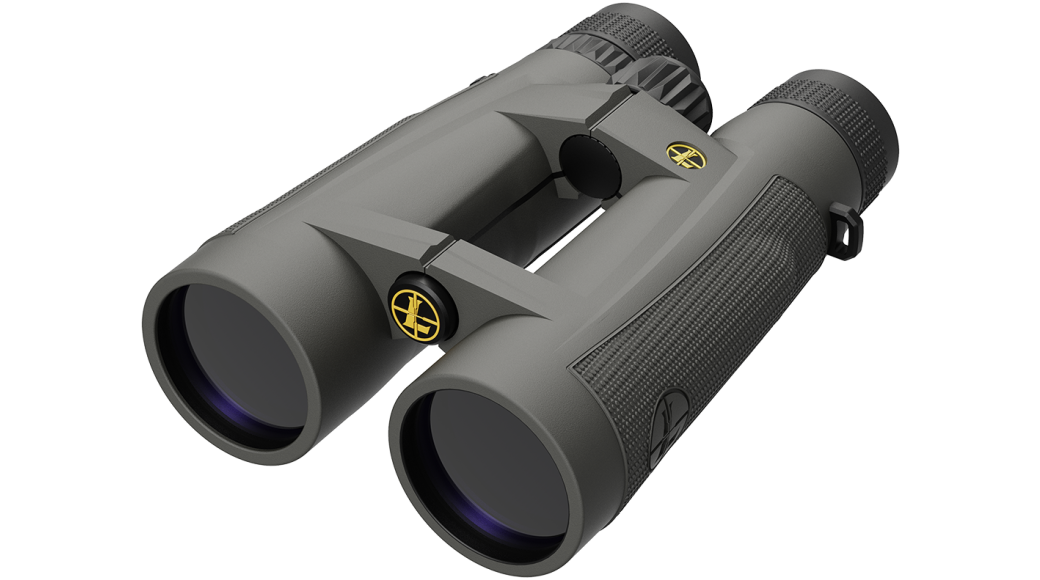
Explore this need in the finder →The BX-5 Santiam HD 15x56 is the most specialized member of Leupold’s five-size Santiam group. It is a high-power, large-objective binocular with a 45-ounce body, an 8.2-inch length and a 231-foot field at 1,000 yards. Its exact U.S. page also says the standard package includes a binocular tray tripod adapter, unlike the other four Santiam pages, which name a strap, case, lens covers and cloth but do not confirm an adapter.
A binocular for distant detail, not quick scanning
Fifteen power can make a distant subject appear substantially larger than it does through an 8x or 10x binocular. That can be useful when glassing across a broad basin or trying to inspect a faraway ridge without immediately carrying a spotting scope. The trade is a narrower view: Leupold lists 4.4 degrees and 231 feet per 1,000 yards, compared with 272 feet for the 12x50 and 377 feet for the 8x42. It will take more deliberate panning to find a small moving subject.
At 45 ounces and 8.2 inches, this is not the lightest choice to keep in hand through a long walk. Fifteen power also makes body movement more visible. A stable rest or the supplied tray-and-tripod arrangement is a sensible part of the plan when fine detail matters. This is still a fixed-power binocular, not a zooming scope, and the exact page does not identify a reticle, laser ranging or electronic stabilization.
Fit and the supplied mount
The published eye relief is 18 mm, the objective diameter is 56 mm and the listed interpupillary range is 58–74 mm. The exit pupil is listed as 3.7 mm. These are product-page specifications; they do not prove a bright image, eyeglass compatibility or comfortable facial fit. Try the eyecups with the normal glasses and check whether the view remains full as you move your eyes. A stated 18 mm is only a starting screen.
Leupold confirms a built-in rotatable 1/4-20 tripod port and the exact page names a “Binocular Tray Tripod Adapter” among the supplied accessories, along with a shoulder strap, case, lens covers and cleaning cloth. The item’s separate model number is not given there. This distinction matters: the tray is the one package fact that sets the 15x56 apart from its siblings. If you already own a tripod, confirm that its head, plate and chosen mounting arrangement work with the supplied tray before relying on the setup.
The manufacturer lists a 9.8-foot close-focus distance. That is longer than the 5-foot values listed for the two 42 mm Santiam models, so the 15x56 is clearly oriented toward distance rather than nearby objects. Its 56 mm objective is the largest in the family, yet the 3.7 mm listed exit pupil is smaller than the others because power rises more quickly than objective diameter. Exit-pupil geometry is not an independent brightness test.
Optics and outdoor protection
The exact page describes an open-bridge roof-prism design, phase-coated prisms, fully multi-coated lenses, DiamondCoat 2 and Guard-Ion treatment. It also lists twist-up, field-replaceable eyecups, a central focus wheel and waterproof/fogproof construction. Leupold’s performance wording is its own claim; no independent image-quality testing is represented here. ED glass is not identified on the exact page. Nor does it publish a numerical immersion depth, duration or IP rating, so the waterproof statement should not be expanded into an underwater-use claim.
The general Leupold owner manual linked from this product explains hinge setting, center focusing, diopter adjustment and lens care. It is not a 15x56 optical specification sheet. For a large binocular that may spend long periods on a support, protect the exposed lenses when not in use and remove dust before wiping, following the manual’s general cleaning order.
How to place it beside the other four
The 12x50 is 12.9 ounces lighter, 1.4 inches shorter and lists a 41-foot wider field than this 15x56. It gives up three powers and does not list a bundled tripod tray. The Santiam 10x50 weighs 31.5 ounces and has a 304-foot field; it is easier to carry and scan with but gives less magnification. The 8x42 is the lightest and broadest-view choice for mobile observation. Pick the 15x56 only if its long-distance magnification is a real need rather than a specification to collect.
A spotting scope remains a better fit if you need much higher variable magnification or a different digiscoping setup. Conversely, the binocular can be faster to bring to the eyes and allows two-eyed viewing. The manufacturer’s cited field and power help compare the options but cannot predict what detail you will resolve in a given atmosphere or at a given distance.
The best match is a stationary observer or long-range glasser willing to carry a heavier instrument and use its supplied tray. If most viewing is handheld while walking, start with the BX-5 8x42 or 10x42 instead. Confirm the fit, support and tray arrangement before purchase, and do not assume the same accessory package applies to the four smaller Santiam configurations.
Manufacturer sources: BX-5 Santiam HD 15x56 part 172457 exact U.S. product page and its linked general binocular owner manual.
Key specifications
Key details at a glance
| Magnification | 15× |
|---|---|
| Objective diameter | 56 mm |
| Real field of view | 4.4° |
| Eye relief | 18 mm |
| Exit pupil | 3.7 mm |
| Close focus distance | 9.8 ft |
More specifications and setup details
| Manufacturer-published weight | 45 oz |
|---|---|
| Phase coatings confirmed | Yes |
| Lens and prism coatings | The exact page describes phase-coated roof prisms, fully multi-coated lenses, DiamondCoat 2 exterior lens treatment and Guard-Ion hydrophobic coating. It does not identify ED glass or every coating-stack detail. No independent transmission measurement is claimed. |
| Water and fog protection | Manufacturer waterproof/fogproof wording; no exact-page numeric immersion/IP specification located. |
| Tripod use | The exact page confirms a built-in rotatable 1/4-20 port and specifically includes a Binocular Tray Tripod Adapter; the separate accessory model/part number is not listed. |
| Published weight note | Exact manufacturer product-page instrument weight; carry accessories add weight. No independent weighing was performed. |
| Manufacturer-rated waterproof | Yes |
| Built-in image stabilization confirmed | No |
| Integrated laser rangefinder | No |
| Onboard ballistic solution display | No |
| Tripod adapter in package | Yes |
| Direct 1/4-20 tripod thread confirmed | Yes |
Use the exact model’s instructions for operating limits, supplied equipment and version differences.
Sources for this review
Sources for this assessment
- Leupold exact U.S. product page, part 172457
- Leupold Binocular Owner’s Manual (Rev N; generic setup/care, not configuration-specific optical evidence)
- Exact page-linked manufacturer product image URL for part 172457
- Archived Leupold U.S. binocular directory observation leupold-us-binoculars-cycle70-p2-r3
- Dated exact model/part-name public CPSC recall search; empty response only

Choose your optical trade-off first.
Choose viewing purpose first, then magnification, objective size, scene width and any fit, weather or mounting constraint. A direct-Sun requirement is separate: only exact manufacturer-confirmed solar binoculars can pass it.